
HELP MENU & SYSTEM CONFIGURATION
Version 5.03
Thank you for choosing Stockbox Photo® Gallery Software.
The preferred choice for professional photographers, artists and artisans
to display and sell their work online.
Using the Help Menu
- To launch the main help documentation, click on the
 icon that is located at the right top corner of the Stockbox Photo®
Admin Control Panel.
icon that is located at the right top corner of the Stockbox Photo®
Admin Control Panel. - To launch help documentation for each section of the Admin Control
Panel, click on the
 icon that is located on each page next to the main navigation menu.
 - Throughout this documentation we will refer to Stockbox Photo® Gallery Software as Stockbox or the System.
Navigating the Help Menu
- Select the topic from the main menu by clicking on it. This will display information for the selected topic.
- To search this document on a PC, click on the ctrl + F keys and enter the keywords you wish to search for. On a Mac, click on the Apple Key + F and enter the keywords you wish to search for.
Stockbox Photo® Versions
There are currently three versions of Stockbox Photo® Gallery Software. In this document certain features may be identified as only being available for a particular version or versions. This information is provided as a guide only and in the case of errors or omissions the current release versions, will determine the actual feature list offered for the respective software versions.
- Standard Version
The Standard Version offers the core functions that will allow you to display and sell your digital or tangible products online, but it does not include any of the advanced features.
- Professional Version
The Professional Version contains all of the core features offered in the Standard Version and includes some of the more advanced features.
- Enterprise Version
The Enterprise Version contains all of the core features offered in the Standard & Pro. Versions and includes all of the available advanced features.
To upgrade your version, please login to our Help Desk and browse to the Upgrade page, or contact our sales department for more information.
GETTING STARTED
There are two stages to getting your gallery "up and running".
Stage 1 - The physical installation of the software and customization of the templates.
Stage 2 - Populating the gallery with your media
MEDIA MANAGER
The Media Manager section contains some of the core functionality of the gallery administration. It displays all categories and media that currently reside in the database. To browse from one category to another, click on the category name and all of its sub-categories and media will be displayed. All available data can be sorted by the displayed hyperlinked column titles. You can reverse the displayed sort order by clicking on the same link again.
Using the Media Manager you can perform the following administrative functions:
- Add New Categories
- Edit an Existing Category
- Remove or Delete Existing Categories
- Set Category Sort Order
- Visible to Photographers (Ent. version)
- Add New Media (Via FTP or Web Browser)
b. i. Individual Upload Media via a Web Browser
b. ii. Batch Upload Media via a Web Browser (Pro. & Ent. versions) - Import Hi-res Files
- Edit Existing Media
- Remove or Delete Existing Media
- Add Zoomify™ Files for Existing Media
- Featured Media (Pro. & Ent. versions)
- Enable Download Links (Instant Download Setup)
- Pricing Selected Media
- Approve Photographer's Media (Ent. version)
- Un-Approve Selected Media (Ent. version)
- Create new order (Ent. version)
- Apply IPTC metadata to the Gallery (Pro. & Ent. versions)
- Searchable IPTC Data (Pro. & Ent. versions)
- Protect & Un-protect a Category (Pro. & Ent. versions)
- Add Access-users for Private Galleries (Pro. & Ent. versions)
- Set FTP Download Server for a Category (Ent. version)
- Category Auto Price Configuration (Pro. & Ent. versions)
- Global Update of Media Details
- Category and Media Status
- Quick Search Media (Pro. & Ent. versions)
- Global FTP Download Server Configuration (Ent. version)
- Multiple Media File Selection (Pro. & Ent. versions)
- Auto Detect Newly Uploaded Media or Categories
- Generate Thumbnails
- Watermark Images
- Rebuild Database
- Resize Images
- IPTC Configuration (Pro. & Ent. versions)
- IPTC Mapping Configuration (Pro. & Ent. versions)
- Media Type Manager
- Media File Types
- Media Utilities (Ent. version)
- POP3 Media (Ent. version)
- Send to Friend Logs
- FTP Syndication (Ent. version)
- Media Export (Ent. version)
- Media Statistics (Ent. version)
- Media Configuration
- Add New Category

Stockbox recognizes a system directory (folder) on your server as a category in the gallery. You can create as many categories (directories/folders) and sub-categories as you need.There are two ways to add a new category
- Using the Media Manager
- Using an FTP client
a. Using the Stockbox Media Manager (Manually)
Using the manual method you can only create one category at a time. Since Stockbox recognizes a system directory as a category, you need to ensure that the gallery directory that you are about to add a new category to is writeable (777) also Safe Mode on your server must be turned off. If your host is unable to turn off the Safe Mode, then you will have to create the new categories with your FTP client (see below).- Click on the Media Manager
 Media Manager link in the main menu.
 - Browse to the particular category by clicking on the category name.
- Click on the
icon to add a new category.

- Your current working directory
This line shows the current working category that you are browsing. The new category will be created under (within) this category.
- System Name
The System Name is used as the physical server directory name. It must not contain any of the following invalid characters ~ ` ! @ # $ % ^ & * ( ) + = \ | } ] { [ " ' : ; / ? > . < , and spaces.
If the system detects any of the invalid characters listed above, it will return an error when the data is submitted.
- Display Name
Use this field to add a more meaningful name to the category. You can use spaces and other characters that are not permitted in the system name. By default the category system name is displayed in the gallery. If you enter a display name it will be displayed instead of the system name.
- Description
Use this field to describe the category. You can use HTML code in this field if required.
- Template Name: (Pro. & Ent. versions)
With the Pro. and Ent. versions you can assign different gallery templates to different categories (ideal for advertising or branding). You can use this feature to create a different look and feel for each category (the functionality will be the same). If you do not select a template from the drop down menu when creating a new category, the system will use the default gallery template. All templates that are in the ./template/english/ folder will display in the drop down menu, but you should only select the category_template_sample.tpl or another template created using the same dynamic call tags and page header (head section of html code) as the category_template_sample.tpl template. You can create and upload via FTP as many templates as required to the "./template/english/" folder.
- Icon (Category Icon)
When the system displays the categories in the gallery, it can display an icon that is assigned to the particular category. You can either upload a category icon to the “icon” directory via FTP, or you can upload the icon to the category’s directory itself. If you upload the icon to the target category’s directory, then you must name it as “icon.jpg”. The system will automatically load the “icon.jpg” for the that particular category for selection when it detects one. You can also use thumbnail images in the particular category for icons, by selecting the “Use Random Image” option in the Icon drop down list. When you are using the “Use Random Image” option, the system will randomly use media thumbnail images from the target category and its sub categories for the category icon. The system will only display the category's display name if the “Do Not Use Icon” option is selected.
- Use this setting for existing sub-categories
Tick this checkbox if you want to use the same Icon Configuration for the target category's sub-categories.
- Visible to Photographers (Ent. version)
If you do not want the category to be visible in the Photographer's (Contributor's) Media Manager, then you should un-check this box.
- Click the Submit button to add the new category.
Before adding a new category name on the server, the system will check that the safe mode is turned off on the server. Please check with your hosting service provider that it is set correctly. If this configuration is not possible, you will have to create a new category using an FTP client by creating a new folder (category) on the server and changing its permissions to 777(read/write/execute) before uploading any new media to it.
b. Using an FTP Program to add a new category
When you have finished adding or uploading new categories on the server, you will need to use the “Auto Detection” feature to add these new categories and their media to the database. Stockbox will only display the new categories and their media in the gallery after they have been added to the database. In order to use this method you need to have an FTP client program installed on your local computer. After adding a new category via FTP you will need to change its permissions to 777(read/write/execute) before uploading any new media to it.- Connect to your web server.
- Browse to the directory where the Stockbox software is installed.
- Browse to target directory inside of the "gallery" directory. All categories and images should be in folders (directories) under the "gallery" directory.
- Upload the new directory and its contents to the target directory.
- Once the uploading is complete, login to the Stockbox Admin
Control Panel and click on the Media Manager
Auto Detection link
in the Media Manager drop down menu.
- Click on the category that holds the new category and images that you have just finished uploading.
- Click on the
 icon to add the new category and its contents to the database.
 - Click on the
 icon to add all of the new categories to the database (Pro. & Ent.
versions).
icon to add all of the new categories to the database (Pro. & Ent.
versions).
This method allows you to batch upload new categories and images to the Stockbox system. This is a very efficient method of uploading a large quantity of images to your gallery.There are three category statuses:
- Public Status
Categories with "Public Status" can be viewed by all users. - Private Status
Categories with "Private Status" can only be viewed by users that have been granted access (username and password) to a Private Gallery. You can add Private users (access-users) to a Private category (protected category) using the "Add Access Users" feature. - Hidden Status
Categories with "Hidden Status" are hidden to all users. Stockbox will not display the category (including its sub-categories and its media) in the gallery. The administrator will still be able to view the hidden folders and files in the Admin Control Panel.
- Edit an Existing
Category

Use this feature to change a category’s properties. It is not possible to edit the category’s system name once it has been created. When you are editing an existing category you are able to edit the following.
- Category Display Name.
- Category Description.
- Category Template.
- Category Icon.
- Click on the Media Manager
Media Manager link in the main menu.
- Browse to the target category.
- Click on the
icon to edit the category properties.
- Edit all information in the available text fields as required.
- Click the Submit button to save the changes.
- Remove or Delete
an Existing Category


Stockbox recommends that you should set the category status to hidden instead of removing or deleting it from the database when your gallery is live and users have already purchased media from this selected category. This will prevent missing data on the Sales Reports and other sections.
- Remove
The remove feature will remove the category and its contents from the database, but not the physical files from the web server. - Delete
The delete feature will delete the category and its contents from the database AND the physical files on the web server. The system may return a "Can't delete directory from the server" message upon confirming the delete action. If this happens, it means that there are still some files in the target directory that are rejecting the delete action. In this situation, you will need to use your FTP client to remove the directory from the physical server. After deleting the directory with your FTP client, you will need to use the Rebuild Database function to remove the old entries from the database.
- Click on the Media Manager
Media Manager link in the main menu .
- Browse to the target category.
- Click on the
icon to remove the category and its contents from the database.
- Click on the
icon to delete the category and its contents from the database AND
from the web server.
- When performing either of these actions a confirmation dialog
box will open. In order to complete the action, you will need to
confirm the action by clicking on the
 icon in the dialog box.
Note: If you have assigned an image to more than one category and you only want to delete one instance of the image, then you will need to use the Remove function. DO NOT use the Delete function as it will delete the physical file from the server and remove all instances of the image.
- Remove
- Set Category
Sort Order
In order for the this feature to be active you will need to select the "Sort Order Value" option for the "Category Default Sort Field Name" in the Media Configuration.
Stockbox displays categories in the gallery based on the “Sort Order” index value in ascending order. The lowest value will display in the first position and the highest value will display in the last position in the gallery. You do not have to use consecutive numbers (1,2,3,4...) if you want to leave room for additional categories. Therefore, you could add values such as (1,5,10,15...) if you perhaps want to later add a category between 1 and 5 in the display order.
If you don't want the Virtual CD "categories" (Ent. version) to display in the category section of the gallery (only in the Virtual CD section), then you should input a sort order value of 0 (zero).
To update the "Sort Order" index value, input a value into the target category's "Sort Order" field and click on the
icon at the bottom of the screen.
- Visible
to Photogs (Ent. version)
If you do not want the category to be visible in the Photographer's (Contributor's) Media Manager, then you should click on the "Yes" link. To make a category visible, you should click on the "No" link.
- Add New Media

Before selling your media online, you will need to upload the displayed images to the gallery folder and bring the related information into the database. The Stockbox system only stores the media path and all of its properties such as its category, description and other info to the database. It doesn’t convert the media to binary data and store this data in the database. In other words, all media files reside in the same physical location where you upload them or add them through the Stockbox system. With the Pro. and Ent. versions you can assign the same media file to more than one category without duplicating the physical instances of the media on your web server.Stockbox provides two methods for you to add new media to the system.
- Using an FTP (client) Program.
- Using the Stockbox Admin Control Panel.
The most efficient way to upload a quantity of media is via FTP and then use the media Auto Detection function in the Media Manager section to add them to the database.
6a. Using an FTP (client) Program
This feature is similar to adding a new category using your FTP program. With this feature you can add an unlimited number of media to the Stockbox database at one time. Assuming that you have the FTP program installed on your local computer, you can follow the instructions below to upload new media to your gallery.- Use any FTP (client) program to connect to your server.
- Browse to the directory where you installed the Stockbox software.
- Browse to the "gallery" directory.
- Browse to the directory (category) where you want to upload the images to, or create a new directory if required.
- Browse to the local directory where you store your digital media.
- Click Upload, to upload all selected media to the target directory (category).
- Once the uploading is complete, login to the Stockbox Admin
Control Panel and click on the Media Manager
Auto Detection link
in the main menu.
- Click on the category that holds the images that you have just finished uploading.
- Click on the
icon to add the new images to the database.
- Click on the
icon to add all of the new images to the database (Pro. & Ent. versions).
Note: If you upload an entire category of images (or you add images to a newly created directory) you can bring all images in that category into the database with one click. If you add images to a category that has already been added to the database and you're using the standard version, you will have to add the images with individual clicks.
Uploading Images via FTP to the 'Upload' folder for use with the Import Hi-res
 function (Ent. version)
This feature will automatically generate the download files, the display files and the thumbnail files from the high-resolution images that are uploaded to the "upload" folder. You must only upload hi-res images to this folder. Under the "upload" directory on your server, there may be some folders that are named as "admin" or the photographer's username. When a new photographer is added to the system, it will automatically create a new folder under the "upload" folder with the photographer's username. You can take advantage of this feature, by creating an FTP account for each photographer and grant the permission on their folder only. If you are not sure how to create FTP accounts, you will need to contact your hosting provider for assistance. In doing so, each photographer would be able to use their FTP account to upload their hi-res images to your server. Using an FTP client to upload hi-res images to the server is more efficient than doing so via your web browser. The admin user or photographer is able to import the hi-res images to the gallery as desired once their hi-res images have been upload to the server.
Video and other formats of display media
The workflow for uploading video content is basically the same as for images, except that the system is not able to generate a thumbnail image from the video clip file. Therefore If the media is video, audio or another format, you will need to create a thumbnail image offline for the media and upload it to the same directory where the media display file is located. The thumbnail file needs to be prefixed with the thumbnail prefix that is assigned to the system in the Media Configuration section.Example:
Media system name: video1.mpg (this is a video type)
The thumbnail prefix name: gallery_ (this can be set in the Media Configuration section)
Then the thumbnail for this media should be gallery_video1.jpg
Upload this thumbnail to the directory where the video1.mpg file is located.
6b. Using the Stockbox Admin Control Panel to upload new media
There are two methods of uploading images via the Admin Control Panel- Single Image Upload
- Batch Upload Media (Pro. & Ent. versions)
6b. i. Single Image Upload: The "Add New Media"
icon will not be visible in the main gallery directory. You must browse
to a category to use it. The new media will be created under the current
working category. The current working category is shown at the top left
of the page.- Login to the Stockbox admin control panel.
- Click on the Media Manager
Media Manager link in the main menu.
- Create a new category if needed.
- Browse to the category where you want to add the new media.
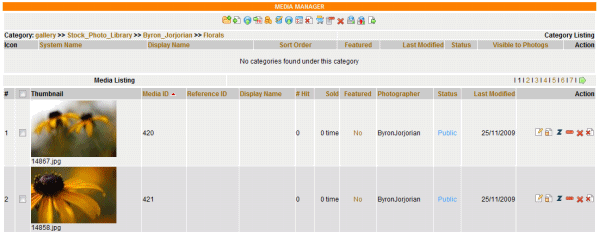
- Click on the
icon to add the new media.
- Click the Browse button to browse to the image on your local machine.
- Enter all information into the provided text fields or leave them blank if you're not ready at present (you can return later to edit).
- Click Submit button to add the new media to the database. The new image is now uploaded and the information you entered is now stored in the database.
- Continue to upload other images as required.
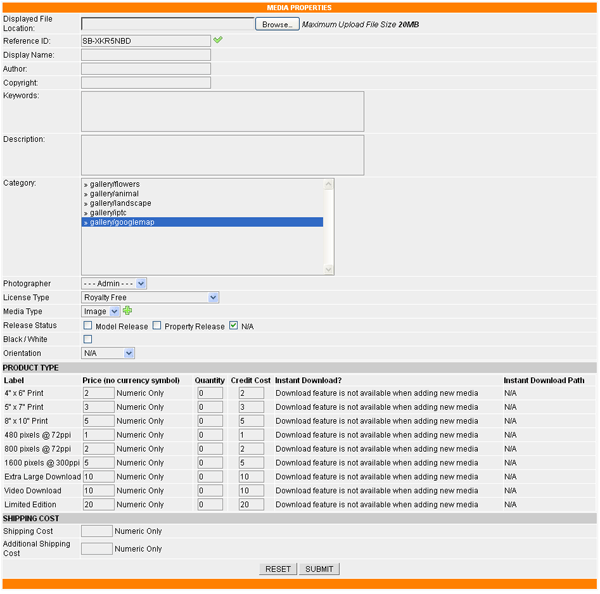
- File Location (System Name)
When uploading new media to the server you need to specify the location of the media file on your local machine. Click on the Browse button to locate your local media. Stockbox will upload your media to the current location that you are browsing. This location is the highlighted item in the category drop down list.
Maximum Upload File Size x MB: Depending on your PHP configuration you may see a different notice for this. The x MB value is the maximum file size that you can upload to your server. This value can be increased by editing the "upload_max_filesize" value in your server's php.ini file. If you are on a shared server, you will need to ask your host to edit this value for you.
- Reference ID (Pro. & Ent. versions)
The Stockbox system will auto fill this field with a random number plus the prefixed value that is configured in the Media Configuration under the "Reference ID Prefix" option. You can update this field to any value as desired, but the system requires this value to be unique in the database.
- Display Name
Stockbox will display this name in place of the system name on the thumbnail and media detail pages.
- Author
Use this field to input the media's author. The system displays this info on the Media Detail page.
- Copyright
Use this field to input the media's copyright details. The system displays this info on the Media Detail page.
- Keywords
Use this field to add keywords for the target media. You will need to separate each keyword or keyword phrase by a “ ; ” semi-colon and avoid using punctuation. The system displays this info on the Media Detail page.
- Description
Use this field to add a description for the target media. The system displays this info on the Media Detail page.
- Category
Choose the category that you want add your media to. You can assign the same media file to multiple categories (Pro. & Ent. versions) by holding down the Ctrl key while clicking on the category name in the list. Note: If you have assigned an image to more than one category and you only want to delete one instance of the image, then you will need to browse to the image in the category that you want to remove it from and use the Remove function. DO NOT use the Delete function as it will delete the physical file from the server and remove all instances of the image.
- Photographer (Ent. version)
With the Ent. version you are able to select the photographer that is associated with the media. The photographer's username is taken from the photographer (contributors) registration section. When a photographer is assigned to the media, all sales will be applied to the specified photographer. The commission rate is calculated based on the commission rate that you set in the photographer's profile. The system will prefix the file name with the photographer's user name.
- License Type (Ent. version)
The media can be either “Royalty Free”, “Rights Managed”, “Rights Managed with no Calculator” or "Royalty Free & Rights Managed"
When new media is uploaded it will be designated as "Royalty Free". For "Royalty Free" media, the available products (Product Types) will be displayed on the media detail page if a price has been assigned to the product type. For “Rights Managed’ media the system will use the Rights Managed Price Calculator created in the License Manager section of the Admin Control Panel. Therefore, you will need to configure the License Tree in order for the system to work correctly. - Media Type (Ent. version)
This is an optional field that allows you to set the Media Type. By default there are two options available, Video and Image. You can also add additional Media Types by clicking on the
icon. This feature is beneficial for users that want to search for
a particular Media Type. If this option is enabled in the Advanced
Search, then users are able to select which type of media they want
to be returned in the search results. The system displays this info
on the Media Detail page.
- Release Status (Ent. version)
With the Ent. version you are able to set the media release status. The three statuses available are, Model Release, Property Release and N/A. The system will display the status information in the gallery on the Media Detail page and the Media Preview window. The Release Status is also utilized on the advanced search page.
- Black / White (Ent. version)
This is an optional field that allows you to specify if an image is Black & White. If your image is Black & White, then you need to tick the box, otherwise leave it unchecked. This feature is beneficial for users that want to search for Black and White images only. If this option is enabled in the Advanced Search, then users are able to have only Black & White images returned in the search results. The system displays this info on the Media Detail page.
- Orientation (Ent. version)
The orientation option is used to describe (Horizontal, Vertical, Square or Panorama) the target media. This feature is beneficial for users that want to search for media that have a particular orientation. If this option is enabled in the Advanced Search, then users are able to select which type of media orientation they want to be returned in the search results. The system displays this info on the Media Detail page.
- Google Map URL (Ent. version)
Enter the Google Map URL address in this field, so that users are able to click on the link to view the location where the image was taken. The following link has information on how to create the Google Map URL,
http://mapki.com/wiki/Google_Map_Parameters
- Original File Path (Ent. version)
This is the path to your original hi-res media file that is residing on the server. You can replace it with a new one by clicking on the Upload Original File icon. For printed product types, this image
will be sent to the printing provider for print fulfillment.
icon. For printed product types, this image
will be sent to the printing provider for print fulfillment.
- Product Type
Use this section to set prices (and credit costs Ent. version) for the available product types. If the product type is not available for this media then leave it blank and it will not display in the gallery. If you have configured the product types in the Product Manager section, then all available products will display here. The enable download links feature is not available when adding media.
Note: The product type will only be available for the end-user to select on the Media Detail page if it has been assigned a price. The Add to Cart button will not display unless at least one product type has been assigned a price.
With the Ent. version you are able to set the credit cost for each media or to all media at once using the Product Manager section. The credit cost is only applied to the Subscription Product Type and Packages Product Type.
When adding new media, the system will pre-fill the product type price and credit cost fields with a base price and credit cost respectively. You will need to click on the Submit button in order to set the product prices and credit costs for the target media.
- Shipping Cost & Additional Shipping Cost
This section is only used when you want to charge a shipping cost based on each individual media. The “Shipping Cost” is applied to the first quantity of the target media and the “Additional Shipping Cost” is applied to the second and subsequent quantities.
Note: The shipping cost will NOT be applied to an “instant download” product type.
Please see the “Single Item Shipping Method” to learn more on how to set the shipping cost and additional shipping for each media.
6b. ii. Batch Upload Media: (Pro. & Ent. versions)
Using this feature you can upload multiple display files, thumbnails. sample (comp) download files or high-res download files to your server in one operation. In order for this feature to function, your web browser must support flash files. All modern browsers should support flash files. If you don't see the flash file load when you click on the Upload Icon, you will need to install the flash add-on for your web browser.Once the "Flash Upload" file is loaded in your browser, you will see two "windows". One labeled "Local" and another with labeled "Server".
Local
This window will display the files on your local computer when you select them in the "Browse" window.
Server
This window will display the folders and files on your server where the Stockbox software is installed. You should only upload high-res files to the "Download Folder - Hi-res files" and "Hi-res Auto Resize" folder and your Display Images to the "Gallery Folder- Low-res Files" folder. Please note that the "Hi-res Auto Resize" option in the server pane will not display if the ImageMagick© path set in the Media Configuration is not correct.- Login to the Stockbox Admin Control Panel.
- Click on the Media Manager
Media Manager link in the main menu.
- Click on the
Upload Icon.
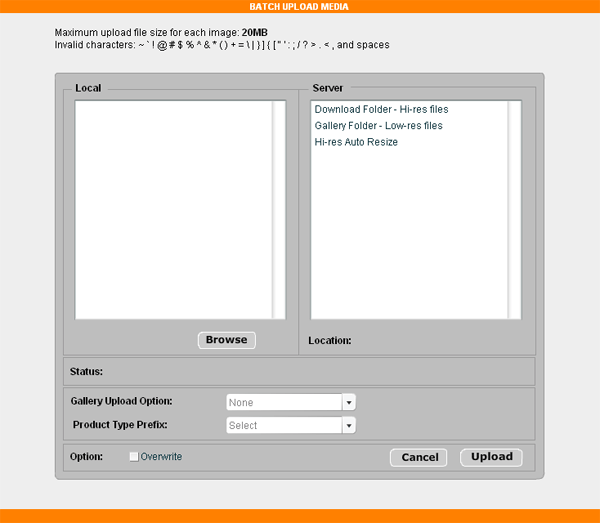
- Browse to the particular directory on your server by clicking on one of the "Download Folder - Hi-res Files", "Gallery Folder - Low-res files" or "Hi-res Auto Resize" (Ent. version) options.
- When selecting the "Hi-res Auto Resize" folder
(Ent. version) you must upload hi-res images to this folder only.
This feature will automatically generate
the download files, the display files and the thumbnail files
from the uploaded hi-res images. This option is only available when you have ImageMagick© Installed
on your server and you have input the correct path in the Media
Configuration. Also, the system only supports JPG or JPEG file
formats when using this feature. Once you have completed the upload of the hi-res files to this folder, you must use the
Import Hi-res
function to import these files
into the gallery.
- To browse back up one level, click on the ".." link displayed above the folder/file listings.
- To browse back to the root level, click on the "."
link displayed above the folder/file listings.
- Click the "Browse" button under the Local window.

- To select more than one file, hold the Ctrl Key while selecting the additional files.
- Click on the Open button to select the highlighted files.
- Click on the Upload button to upload the selected files
to the selected folder.
- Gallery Upload Options:
We recommend that run a batch process on your hi-res images to re-size them for display prior to uploading them to the gallery folder. You need to upload your display sized images to the gallery folder and the system will use these to generate the thumbnails. If you want to offer instant downloads, then you will need to upload the high resolution files to the download folder.
- Display Files
This option is only available when you upload files to the "Gallery" folder. If this option is selected, the system will automatically import (Auto Detect) the uploaded display images into the gallery database once the action is completed. Depending on the setting in the Media Configuration the system will also generate the thumbnail images for the media. The file names will be prefixed with the prefix assigned (gallery_ by default) in the Configuration Media
section. - Sample Files
This option is only available when you upload files to the "Gallery" folder. You should select this option when you're uploading sample files for the "Sample Download" feature. The system will prefix the uploaded files with the "sample_" prefix. - Thumbnail Files
This option is only available when you upload files to the "Gallery" folder. You should select this option when you're uploading thumbnails for your display images. The file names will be prefixed with the prefix assigned (gallery_ by default) in the Configuration Media
section.
- Display Files
- Product Type Prefix:
Once the download files have been uploaded you will need to assign the download files to display files using the Global Enable Download Links function. There is more information on this in the Media Manager
Instant Download Links section of the main help menu.
- Rights Managed
This option is only available when you upload files to the "Download" folder. If you are uploading Rights Managed download files then you will need to select this option in the dropdown menu. The system will prefix the uploaded files with the "LICENSED_" prefix. - Other Product Types
If you are uploading images for Royalty Free downloads then you should select the applicable Product Type in the dropdown menu and the system will prefix the uploaded files with the "Product Name" (not the Label) as specified in the Product Manager section of the Admin Control Panel.
- Rights Managed
- Option:
- Overwrite
When this option is selected, the system will overwrite existing files in the selected category (directory) if they have the same filename as those being uploaded.
- Overwrite
- Cancel
You are able to cancel the upload process at anytime after it has started by clicking on the Cancel button. The browser will continue to finish the current file upload before it stops.Note: This is not a FTP Client Application so it still relies on your server's PHP configuration. The maximum size for each file uploaded is restricted by the upload_max_filesize, post_max_size, max_execution_time and memory_limit configuration settings in your php.ini file. The PHP default for the upload_max_filesize variable is 2 MB. If you have a dedicated server you can increase this limit by editing the php.ini file on your server. If you don't have a dedicated server, you will need to ask your hosting provider to do it for you. The server may timeout during the uploading of media to the server if your internet connection speed is too slow.
- Import Hi-res Files
(Ent. version)
This feature will automatically generate the download files, the display files and the thumbnail files from the high-resolution images that are uploaded to the "upload" folder. This option is only available when you have ImageMagick© Installed on your server and you have input the correct path in the Media Configuration. Also, the system only supports JPG or JPEG file formats when using this feature. The system will only generate the download files when the uploaded hi-res image satisfies the minimum dimension that are configured in the Product Type section. When there is no instant download configured for a particular product type, the system would recognize it as a print or delivery product and it would not generate the download files for these product types. Also, if you don't have any product types added when importing the hi-res images to the gallery, the system won't be able to generate the download files and you will need to manually generate the download files for the display images later if you want to offer them.
Under the "upload" directory on your server, there may be some folders that are named as "admin" or the photographer's username. When a new photographer is added to the system, it will automatically create a new folder under the "upload" folder with the photographer's username. You can take advantage of this feature, by creating an FTP account for each photographer and grant the permission on their folder only. If you are not sure how to create FTP accounts, you will need to contact your hosting provider for assistance. In doing so, each photographer would be able to use their FTP account to upload their hi-res images to your server. Using an FTP client to upload hi-res images to the server is more efficient than doing so via your web browser. The admin user or photographer is able to import the hi-res images to the gallery as desired once their hi-res images have been upload to the server.
- Click on the
icon to import
the hi-res Images to the gallery that were uploaded by the admin. To import
the hi-res images for a particular photographer, you will need to click on the Import Icon
for the particular photographer under the Photographers
Active Photographers section.
- The Dimensions below are the actual dimension of
the uploaded images.
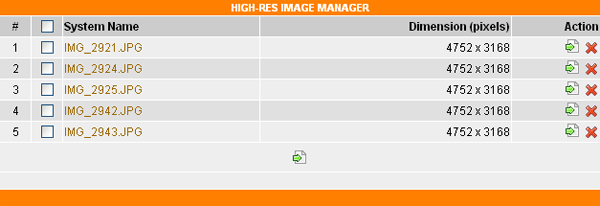
- Click on the Import Icon
 for a particular file to import it to the database
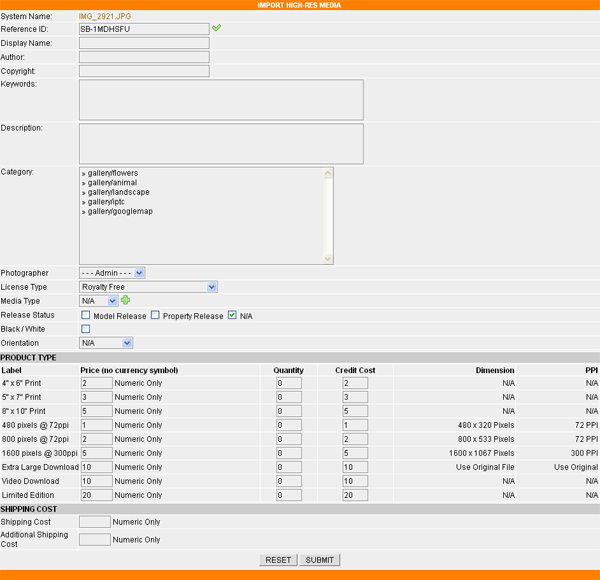
- Fill-in all appropriate info to the provided fields.
- Enter 0 to any product type field that is not available for this image. The Dimension that shows in the Product Type section is the dimension that you have configured in the Product Type Instant Download Configuration. The system will auto calculate the other dimension based on the uploaded image's dimension and its orientation. The N/A in the PPI column indicates a print or delivery product and the system will not generate download files for these product types.
- Click
on the Submit button to import this image into the
gallery.
NOTE: You must have ImageMagick© installed in order to use this function. Depending on your server configuration, this operation may take some time to process the download, display and thumbnail files.
- To import multiple high-res files at once, tick
the respective checkboxes and click on the "Import All" ion.

- Fill-in all appropriate info to the provided fields.
- When
importing multiple hi-res images, you will need to select one of
the three Product Type options.
- All Product Types.
- Only Instant Download Product Types
- Only Non Instant Download Product Types.
- Click
on the Submit button to import the selected hi-res images
into the gallery.
NOTE: You must have ImageMagick© installed in order to use this function. Depending on your server configuration, this operation may take some time to process the download, display and thumbnail files.
- Click on the
- Edit Existing Media
The Edit Existing Media feature is similar to adding new media to the system feature.
- Browse to the target category in the Media Manager.
- Click on the
icon for the target media and edit the media properties as needed.
- IPTC Tab (Pro. & Ent. versions)
The IPTC feature allows you to add or edit the media's IPTC metadata header. Click on the IPTC Tab to view and edit the media's IPTC metadata info as required. The IPTC feature supports keyword phrase search strings. Please separate each keyword or keyword phrase by entering a " ; " semi-colon at the end of each keyword or phrase.
Please note: Before using this feature, you must ensure that all image folders AND files have permissions of 777 (r/w/e) otherwise the IPTC changes will not be saved. To add the IPTC metadata for edited images to the searchable database, you will need to click on the Searchable IPTC icon for the target category in the Media Manager. Only the fields
that are checked in the IPTC Configuration
will be searchable.
icon for the target category in the Media Manager. Only the fields
that are checked in the IPTC Configuration
will be searchable.
- File Location (System Name)
It is not possible to edit the media system name once it has been added to the system.
- Display Name
Stockbox will display this name in place of the system name on the thumbnail and media detail pages.
- Author
Use this field to input the media's author. The system displays this info on the media details page.
- Copyright
Use this field to input the media's copyright details. The system displays this info on the media details page.
- Keywords
Use this field to add keywords for the target media. You will need to separate each keyword or keyword phrase by a “ ; ” semi-colon and avoid using punctuation. The system displays this info on the media details page.
- Description
Use this field to add a description for the target media. The system displays this info on the media details page.
- Category
Choose the category that you want add your media to. You can assign the same media file to multiple categories (Pro. & Ent. versions) by holding down the Ctrl key while clicking on the category name in the list. Note: If you have assigned an image to more than one category and you only want to delete one instance of the image, then you will need to use the Remove function. DO NOT use the Delete function as it will delete the physical file from the server and remove all instances of the image.
- Photographer (Ent. version)
With the Ent. version you are able to select the photographer that is associated with the media. The photographer's username is taken from the photographer (contributors) registration section. When a photographer is assigned to the media, all sales will be applied to the specified photographer. The commission rate is calculated based on the commission rate that you set in the photographer's profile. The system will prefix the file name with the photographer's user name.
- License Type (Ent. version)
The media can be either “Royalty Free”, “Rights Managed”, “Rights Managed with no Calculator” or "Royalty Free & Rights Managed"
When new media is uploaded it will be designated as "Royalty Free". For "Royalty Free" media, the available products (Product Types) will be displayed on the media detail page if a price has been assigned to the product type. For “Rights Managed’ media the system will use the Rights Managed Price Calculator created in the License Manager section of the Admin Control Panel. Therefore, you will need to configure the License Tree in order for the system to work correctly. - Media Type (Ent. version)
This is an optional field that allows you to set the Media Type. By default there are two options available, Video and Image. You can also add additional Media Types by clicking on the
icon. This feature is beneficial for users that want to search for
a particular Media Type. If this option is enabled in the Advanced
Search, then users are able to select which type of media they want
to be returned in the search results. The system displays this info
on the Media Detail page.
- Release Status (Ent. version)
With the Ent. version you are able to set the media release status. The three statuses available are, Model Release, Property Release and N/A. The system will display the status information in the gallery on the Media Detail page and the Media Preview window. The Release Status is also utilized on the advanced search page.
- Black / White (Ent. version)
This is an optional field that allows you to specify if an image is Black & White. If your image is Black & White, then you need to tick the box, otherwise leave it unchecked. This feature is beneficial for users that want to search for Black and White images only. If this option is enabled in the Advanced Search, then users are able to have only Black & White images returned in the search results. The system displays this info on the Media Detail page.
- Orientation (Ent. version)
The orientation option is used to describe (Horizontal, Vertical, Square or Panorama) the target media. The system will automatically determine the orientation based on the dimensions of the display media when the display images are "Auto Detected", but this value can be changed using the dropdown menu options if desired. This feature is beneficial for users that want to search for media that have a particular orientation. If this option is enabled in the Advanced Search, then users are able to select which type of media orientation they want to be returned in the search results. The system displays this info on the Media Detail page.
- Google Map URL (Ent. version)
Enter the Google Map URL address in this field, so that users are able to click on the link to view the location where the image was taken. The following link has information on how to create the Google Map URL,
http://mapki.com/wiki/Google_Map_Parameters
- Original File Path (Ent. version)
This is the path to your original hi-res media file that is residing on the server. You can replace it with a new one by clicking on the Upload Original File icon. For printed product types, this image
will be sent to the printing provider for print fulfillment.
- Product Type
Use this section to set prices and credit costs (Ent. version) for the available product types. If you have correctly configured the product types in the Product Manager section, then all available products will display here. With the Ent. version you are able to set the credit cost for each media or to all media at once using the Product Manager section.Price: Enter the price for each product type that is available for this media. If the product type is not available for this media then leave the price field blank (or enter a value of 0.00) and it will not display in the gallery.
Quantity: Enter the available quantity and the system will only allow the sale of products up to and including the quantity that you input here.
Credit Cost: (Ent. version) The credit cost is only applied to the Subscription Product Type and Packages Product Type.

To add a download link for a product type, click on the Enable Download Link checkbox for the target product type and a popup box will appear that will allow you to browse to the download file that you previously uploaded to the server.- Click on the "Browse" button.
- Click on the target category to highlight it, followed by the "Browse" link (repeat to browse subcategories).
- Click on the target media file to highlight it, followed by the "Select" link to select the download file.
- Click on the "SAVE" button to assign the download link.
To remove a download link for a product type, click on the Remove Download Link for the target product type.
Note: The product type will only be available for the end-user to select if it has been assigned a price. The Add to Cart button will not display unless at least one product type has been assigned a price.
- Shipping Cost & Additional Shipping Cost
This section is only used when you want to charge a shipping cost based on each individual media. The “Shipping Cost” is applied to the first quantity of the target media and the “Additional Shipping Cost” is applied to the second and subsequent quantities.
Note: The shipping cost will NOT be applied to an “instant download” product type.
Please see the “Single Item Shipping Method” to learn more on how to set the shipping cost and additional shipping for each media. - Click on the Submit button to save changes.
- Browse to the target category in the Media Manager.
- Remove or Delete
Existing Media
Stockbox recommends that you should set the media status to hidden instead of removing or deleting it from the database when your gallery is live and users have already purchased this media. This will prevent missing data on the Sales Reports and other sections.
- Remove
The remove feature will remove the target media from the database, but not the physical files from the web server. - Delete
The delete feature will delete the target media from the database and the physical files from the web server. Sometimes the system returns "Can't delete file from the server" message upon confirming the action. If this happens you will need to make sure that the file permissions for this media are set to 777 and try again.
- Click on the Media Manager
Media Manager link in the main menu.
- Browse to the target category.
- Click on the
icon to remove the target media from the database.
- Click on the
icon to delete the target media from the database and the physical
files from the web server.
- When performing either of these actions a confirmation dialog
box will open. In order to complete the action, you will need to
confirm the action by clicking on the
icon in the dialog box.
- Remove
- Add Zoomify™ Files for Existing Media
(Pro. & Ent. versions)

Zoomify™ (www.zoomify.com) makes high-quality images zoom-and-pan for fast, interactive viewing on the web with just HTML, JPEGs, and Flash. Photoshop CS3 and later has a Zoomify™ export feature.
- Click on the Media Manager
Media Manager link in the main menu.
- Click on the
Zoomify™icon
for the particular media.
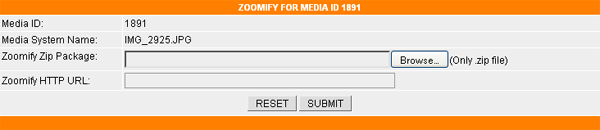
There are two ways to add the Zoomify™ files for a particular media.
- Zoomify™ Zip Package
When using this option, you must zip all files under your Zoomify™ folder. This zip package must include the "html" file and the folder containing all Zoomify™ images.

- Click on the Browse button to browse to the Zoomify™ zip file.
- Click on the SUBMIT button to submit the Zoomify™ package. The Stockbox system will rename the html file to "index.html" and place this package in the "images/current-time-stamp-folder" on the server. If the package is correct you should see the URL in the Current Zoomify™ URL. - Zoomify™ HTTP URL
When using this option, you can enter the URL that links to your public Zoomify™ if you have one. The system will use this URL instead of the Zoomify™ Package.
- Zoomify™ Zip Package
- Click on the Media Manager
- Featured
Media (Pro. & Ent. versions)
The featured media are displayed in the Featured Media section in both the public and private galleries.
To assign media to be featured, you will need to do the following.
- Click on the Media Manager
Media Manager link in the main menu.
- Browse to the target category
- Click on the NO link in the Featured Media column (the status will change to YES). The target media will now be Featured.
- To remove media from the featured section, click on the YES link in the Featured Media column (the status will change to NO). The target media will no longer be featured.
Stockbox replaces the [FEATUREDMEDIA] call tag with the featured media. The featured media tag can be added to the gallery.tpl template as desired.
There are two ways to display featured media in the gallery. These can be defined in the Media Configuration section. Here you can change the style from horizontal to vertical and you can also specify how many images you whish to display. If there are more featured media than available spaces, the system will "rotate" (change) the media that are displayed each time the page refreshes.
Horizontal Style Vertical Style 

- Click on the Media Manager
-
Enable Download Links (Instant Download Links setup)

Using Stockbox, you can offer instant downloads of your digital products and sell tangible products (such as prints) at the same time. Once the purchase has been confirmed by the payment processor the download link will be activated in the customer's "My Account area". There are two methods to assign download links
- Using the Global Enable Download Links function to assign links for an entire category of images.
- Assigning download links individually on the Media Properties page in the Media Manager section.
When users assign a download link to target media, the system stores this download link path in the database and this info will not be changed unless the admin deletes a download link from this media. When you rename the target media using the Media Utilities (Ent. version) feature, the system will auto update the database with the new details and the download links will remain valid.
a. The Global Enable Download Links function is used to assign the download links to the entire target category (directory) or multiple media (Pro. & Ent. versions). Before using this feature, you will need to ensure that the following items are configured correctly.- You will need to have created at least one Product Type in the Product Manager section.
- The high resolution "download files" must be uploaded to the "download" directory via FTP or using the Batch Upload Media function, under the same directory structure (mirror) as the display images in the gallery directory AND you have prefixed the file name with the respective product type if you are uploading the images via FTP. If you use the Batch Upload Media function, then the system will apply the filename prefix for you. This download directory is protected by the Apache .htaccess. This directory is only accessible by the system and can not be accessed through a web browser.
- Please note that when assigning download links for Rights Managed media (Ent. Version), you have to give the high resolution files a LICENSED_ prefix.
Enable Download Links for a Category
- Click on the
- Category
Select the category from the drop down list. All of this category's media will be assigned a download link with the selected product by clicking on the Enable Download button.- Enable Type
Use the drop down list to select either Price, Credit or Rights-Managed (see below) for this download link.- Product Type
Select a product type from the drop down list. You will need to have created at least one Product Type in the Product Manager section to use this function.- Price
Enter the price of the product type.- Credit
Enter the credit cost for the product type.- Disable File Extension
Tick this checkbox and the system will ignore the difference between the display and download the file extensions. e.g. If you have .jpg display images and you have .tiff download files, then you will need to check this box.- Use FTP Server (Ent. version)
Tick this checkbox if you are storing the download files on another server (Ent. version). You need to make sure that the FTP info of the target category (directory) is correctly configured. The system will not check for the FTP info during the setting of the Download Links to the target category.- Including Subcategories
Tick this checkbox and the system will apply the settings and download links to all media that are in subcategories of the target category.- Click the Enable Download button to assign download links to the target category.
Enable Download Links for Selected Media (Pro. & Ent. versions)
To use this function you need to select media in the Media Manager section by ticking the checkbox in the second column of the Media Listing section.
- Enable Type
Use the drop down list to select either Price, Credit or Rights Managed for the download link
- Product Type
Select a product type from the drop down list. You will need to have created at least one Product Type in the Product Manager section to use this function.
- Price
Enter the price of the product type.- Credit
Enter the credit cost for the product type.
- Disable File Extension
Tick this checkbox and the system will ignore the difference between the display and download the file extensions. e.g. If you have .jpg display images and you have .tiff download files, then you will need to check this box.- Use FTP Server (Ent. version)
Tick this checkbox if you are storing the download files on another server (Ent. version). You need to make sure that the FTP info of the target category (directory) is correctly configured. The system will not check for the FTP info during the setting of the Download Links to the target category.- Including Subcategories
Tick this checkbox and the system will apply the settings and download links to all media that are in subcategories of the target category.
- Click the Enable Download button to assign download links to the selected media.
b. Assigning download links individually on the Media Properties page in the Media Manager.Before using this feature, please make sure that all high resolution download files are residing in the download directory under the same directory structure (mirror) as the gallery folder and that you have prefixed the download files correctly.
Example of Royalty Free product type file name prefixes
e.g. Assuming you have the following:
pic1.jpg, pic2.jpg, pic3.jpg under the category1 with the path gallery/category1. So the paths of the pic1, pic2, pic3 are as follows:
gallery/category1/pic1.jpg
gallery/category1/pic2.jpg
gallery/category1/pic3.jpg
If you want to set the price for the product type named highdownload. Then the paths of the downloadable files should be as follows:
download/category1/highdownload_pic1.jpg
download/category1/highdownload_pic2.jpg
download/category1/highdownload_pic3.jpg
If you want to set the price for a second product type named lowdownload. Then the paths of the downloadable files should be as follows:
download/category1/lowdownload_pic1.jpg
download/category1/lowdownload_pic2.jpg
download/category1/lowdownload_pic3.jpg
Example of Rights-Managed file name prefixes
e.g. Assuming you have the following:
pic1.jpg, pic2.jpg, pic3.jpg under the category1 with the path gallery/category1. So the paths of the pic1, pic2, pic3 are as follows:
gallery/category1/pic1.jpg
gallery/category1/pic2.jpg
gallery/category1/pic3.jpgFor Rights Managed images the paths of the downloadable files should be as follows:
download/category1/LICENSED_pic1.jpg
download/category1/LICENSED_pic2.jpg
download/category1/LICENSED_pic3.jpgAlso please note that you can only assign one download file to media that have been designated as RM.
- Browse to the target media in the Media Manager section.
- Click on the Edit
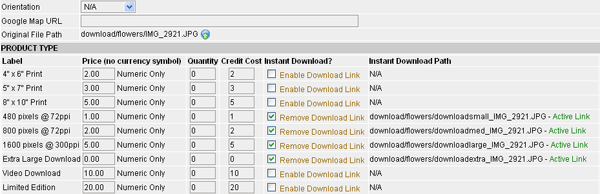
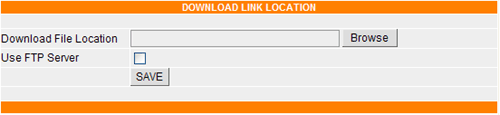
- Check the "Enable Download Link" checkbox for the target product type and a popup box will appear that will allow you to browse to the download file that you previously uploaded to the server.
- Click on the "Browse" button to browse to the download file on the same server or click on the Use FTP Server if the download file is stored on a different server (Ent. version).
- Click on the target category to highlight it, followed by the "Browse" link (repeat to browse subcategories).
- Click on the target media file to highlight it, followed by the "Select" link to select the download file.
- Click on the "SAVE" button to assign the download link.

- Pricing Selected
Media

By default any media that you upload to the system will be displayed for viewing by customers. However, the customers will not be able to add items to their shopping cart unless you apply a price to a product type for that media. There is more information on the various ways to price your media in the Pricing Media section of this help menu.
- Click on the Media Manager
- Click on the
- To apply Global Pricing for multiple media, you will first need to select the particular media in the Media Manager by ticking the checkbox in the second column in the Media Listing section.
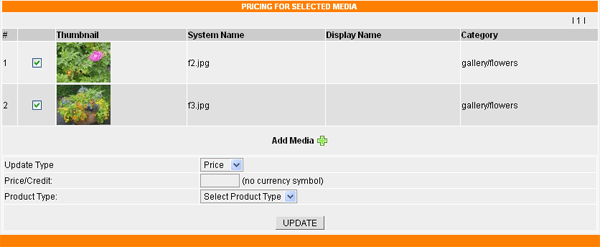
- Update Type
Select the update type you want to apply from the dropdown list. The "Credit" Type is only available in the Ent. version.- Price / Credit (Ent. version)
Enter a price or credit cost that will be set to all media in the selected media for the specified product type.- Product Type
Select the product type that you wish to assign a price for.- Click on the Update button to update the pricing/credit values.
Remove Products/Pricing
If you would like to remove a product type from display, you can enter a price of 0.00. This can be applied to a category or for the entire gallery by using the Global Pricing feature in the Product Manager section.
- Approve Photographer's
Media
 (Ent.
version)
(Ent.
version)
When a photographer’s media is uploaded to your server its status depends on the photographer’s profile. If their “Enable File Upload Without Admin Approval” option is enabled then the uploaded media status will be “approved”, otherwise it will have a "pending" status. If the media is in a pending status, you will need to approve it before the system will display it in the gallery. The same procedure applies to new photographer's categories as well. The “Enable File Upload Without Admin Approval” option is changeable in the photographer’s profile. When the media is in a pending status the photographer is still able to edit the media properties such as pricing, set shipping cost or assign a download link to it.
- Click on the icon
under the Media Manager features.
- The list of the un-approved media will display.
- Click on the
 icon to approve the selected media.
 - Click on the
icon to view and edit the selected media details.
- Click the "Approve All" link to approve all un-approved
media.

Note: The photographer that has been assigned to the media (username prefixed to file name) can be changed on the media properties page, by editing the media.
- Click on the icon
- Un-Approve
Selected Photographer's Media
 (Ent. version)
To un-approve a photographer's media that was previously approved, you will need to do the following.
- Select the media files that you want to Un-Approve.
- Click on the Un-Approve Selected Media icon
in the Media Manager feature menu.
- The list of the previously Approved media you want to Un-Approve will display.
- Click on the
icon to Un-Approve the selected media.

- Create New Order
(Ent. version)
With the Ent. version you are able to create a new order for your customers without going through the gallery. First you need to select the particular media in the Media Manager using the Multiple Media File Selection feature.
- Click on the Create Order
 icon after selecting a group of media.

- Tick the checkbox of desired Product Type or Add to Cart checkbox for rights managed media.
- Click Submit to continue.
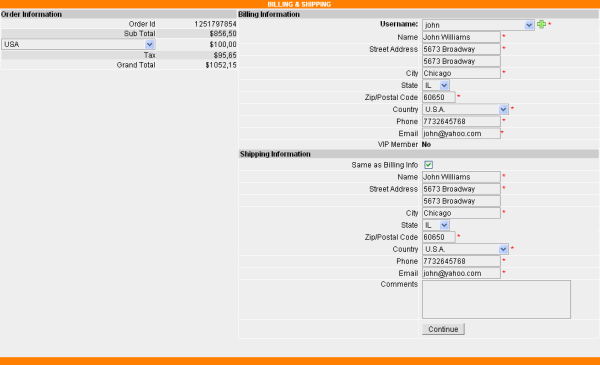
- Select the Shipping Zone if it's available.
- Select the Customer Username in the Username drop down
list. The customer's info will be pre-populated in the billing fields
based on the selected username. You could click on the Add New Customer
icon to add a new customer to the system.
- Fill in the Shipping Information. The system only displays this when it's a delivery order.
- Click Submit button to continue.
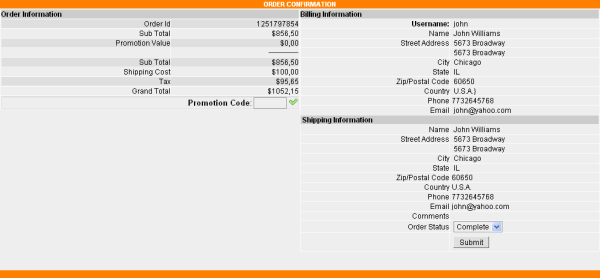
- Enter a Promotion Code if applicable and click on the
icon to apply the code. The system will deduct the Promotion Value
(if it's a valid Promotion Code) from the Grand Total.
- Select the Order Status.
Complete: the system will set this new order to completed status once it's submitted. If the order is an instant download type, then the user will be able to download the order once it has been created.
Pending: the system will set this new order to pending status once it's submitted. - Click Submit
The new order will be created in the system and the details can be viewed in the Order Manager section.
- Click on the Create Order
- Apply IPTC metadata
to the Gallery
(Pro. & Ent.
versions)
The IPTC feature allows you to add media properties to it's metadata header. Stockbox can read, write, and display the IPTC metadata in the gallery. The media must be in the .jpg or .jpeg file format.
There are two ways of writing the IPTC metadata to images.1. Using the Edit Media Properties feature (Apply to individual images)
- Browse to the target category in the Media Manager.
- Click on the Edit
icon for the target media to edit the media properties.
- Click on the IPTC Info
 icon to edit the embedded IPTC info.
Note: Before using this feature, you must ensure that all image folders AND files have permissions of 777 (r/w/e). To add the IPTC metadata for edited images to the searchable database, you will need to click on the Searchable IPTC
icon for the target category in the Media Manager. Only the fields
that are checked in the IPTC Configuration
will be searchable.
- Click on the Apply IPTC
icon
for the target category.
- Select the target Category in the drop down list.
- Fill in all relevant information to the provided input fields. The IPTC feature supports keyword phrase search strings. Please separate each keyword or keyword phrase by entering a " ; " semi-colon at the end of each keyword or keyword phrase.
- Click the Submit button to apply the new IPTC
metadata to the media in the target category.
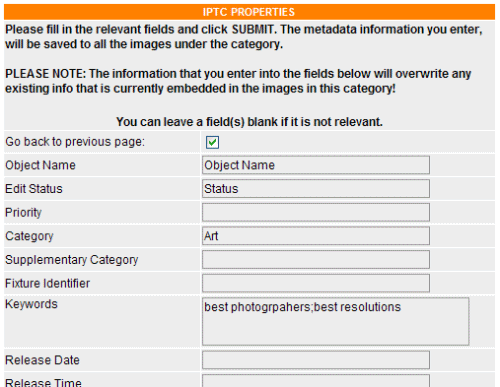
Note: Before using this feature, you must ensure that all image folders AND files have permissions of 777 (r/w/e). Using this feature will overwrite any existing IPTC metadata for the selected category of images and the original info can NOT be recovered. All IPTC metadata added using the Global Apply IPTC feature will be available for searching. However, it is recommended that you should click on the
icon for the target category after each use of the Global Apply
IPTC feature. Only the fields that are checked in the
IPTC Configuration will be searchable.
- Browse to the target category in the Media Manager.
- Searchable
IPTC Data
(Pro. & Ent. versions)
All IPTC metadata is automatically imported into the database upon uploading new media to the server or using the Global Apply IPTC feature. However, to ensure that all the IPTC metadata is searchable by users, Stockbox recommends that you should use this feature after you make changes to the IPTC metadata.
- Browse to the target category.
- Click on the Rebuild Searchable IPTC
icon for the target category.
- All IPTC metadata will be searchable by all users.
Note: Only the fields that are checked in the IPTC Configuration will be searchable. If you make any changes to the IPTC configuration after you import your images to the database, you need to use the Rebuild Searchable IPTC function again for it to update the new searchable contents.
- Protect
& Un-protect Category (Private Galleries)
 -
-
 (Pro.
& Ent. versions)
(Pro.
& Ent. versions)
By default all new categories will have "Public" status. The Protect feature allows you to Protect or Un-Protect a selected category. If the category is Protected, the system will only allow users that have input the assigned user/password combination for the protected category to be able to view it. If the category is protected, the status will display as Private in the Media Manager. If the category is un-protected (default), then the status will display as Public.
- Protecting a category
Browse to the target category.
Click on the Protect
icon to protect the target category.
The system will prompt you for confirmation before protecting it. You will need to confirm the action by clicking on the
icon on the confirmation page.
- Un-protecting a category
The Un-protect feature is only visible when a category status is "Private" (protected). When you un-protect a protected category, all of its media will be un-protected as well and will become viewable to all users. By default this will not include it's sub-categories and media that are in the sub-categories. If you need to unprotect all contents of the target category including any sub-categories; you will need to check the “Including Sub-categories” checkbox on the confirmation page.
- Protecting a category
- Access Users
 (Pro. & Ent. versions)
The Access User icon is only visible when a category’s status is "Private" (protected). Click on this icon to add a new "Access User" to the target category. Once new access users are added to the system, they are able to login to the private gallery to view protected categories that are associated with username/password combination input into the Private Gallery Access User Manager.
The system provides two options to add access user(s) to the protected category.
- Registered User Access
The system allows you to add existing registered customers to the protected category. Once it's added to the system, users need to login with the username/password that they created when they registered to your site. The advantage of this option is that the system doesn't require a second login for purchasing media.
- Non-Registered User Access
This option requires that you create a username/password combination for the user. After logging into the protected category, access user(s) are able to browse the contents of the protected category, but in order to make a purchase they will need to register to system. The advantage of using this option is that you can create a username/password combination to give out to your clients at an event, or have multiple users login to view media using the same user/pass.
Click the Submit button to add the new access user to the database.
To remove an access user, click on the
icon for the user that you wish to remove.To access a protected category (Private Gallery) click on the
Private Gallery link in the right top corner of the admin control panel,
or from the Private Gallery Login link in the public gallery. Note: You can assign the same username/password combination to more than one protected category, so that a user can view more than one protected category. Also, you can add as many access users to a target category as required.
- Registered User Access
- FTP Server Configuration
for a Category
 (Ent. version)
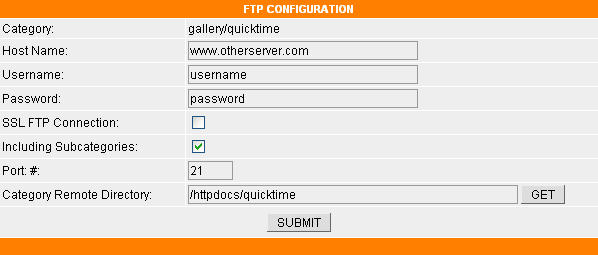
If you are storing the high resolution download files on another server (separate from the Stockbox installation), you can use this function to setup the FTP information of the other server. Each category has its own FTP server information, so you can have different categories of images residing on different servers. The system does not check for valid download files on the remote server. It assumes that you have correctly configured the download files on the remote server.
- Click on the FTP Server Configuration
icon to
setup the FTP information.
- Enter all information into the provided input fields.
- Click on the Get button to set the path to the downloadable directory on the other server. This directory should contain all the downloaded files of the selected category. If the information is entered correctly you will see a popup window that will allow you to select the remote path.
- Including Subcategories: Ticking this checkbox will allow the system to update the Remote FTP Server Configuration to all of the target category's subcategories.
- Click the Submit button to submit the info
to the server.
- Click on the FTP Server Configuration
-
Category Auto Price and Credit Configuration
 (Pro. & Ent. versions)
Use this configuration to disable the automatic pricing function set in the Product Manager Product
Types section or enable the automatic pricing function for particular
Product Type to selected categories.
- Click on the
icon to configure the auto price feature for the target category.
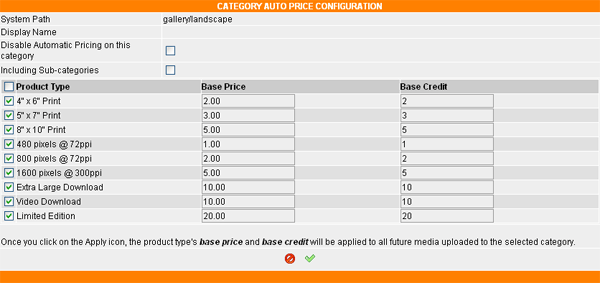
- System Path
This is the path of the target category. - Display Name
The display name is a display of the selected category. - Disable Automatic Pricing on this Category
To disable the "Auto Price" on the target category tick this box. - Including Sub-categories
To apply the same setting to the subcategories of the target category, tick this box. The settings will be applied once the action is completed by clicking on the Apply icon. - Product Type
Tick the Product Types that you want to "Auto Price" in the target category. The system will auto price the configured base price and base credit for all future media that are uploaded to the target category. - Click on the
icon to apply the action, or click on the
 icon to cancel the action.
- Click on the
- Global Update
of Media Details

The Global Update
icon will not be visible in the main gallery directory. You must browse
to a category to use it. The global update feature allows you to update
the media properties for media in an entire category (including sub-categories
if selected) or selected media. With this feature, you will be able
to update the following media data fields:
- Display Name
- Description
- Author
- Photographer Username
- Copyright
- Keywords
- # Hits
- Rights Managed
- Rights Managed with no Calculator
- Royalty Free
- Rights Managed & Royalty Free
- Media Release
- Media Orientation
- Black & White
- Media Type
- Click on the Media Manager
Media Manager link in the main menu.
- Browse to the target Category or select particular media in the Media Manager.
- Click on the
icon under the media manager title.

- Select "Global Update Type" in the drop down list. This dropdown will only display if you are updating selected media. To update a category of media, choose the "Update Selected Category" option, or to update a group of selected media, choose the "Updated Selected Media" option.
- Select the desired field in the Field Name dropdown list.
- Check the Including Subcategories checkbox, if you want to update all subcategories of the target Category. This option is only applied when you choose "Update Selected Category" in the "Global Update Type" dropdown list.
- Check the Over Write Old Data box, to overwrite any existing data, otherwise leave this box un-checked and the new data will be appended to the existing data.
- Enter the Global Value that you want to set
such as Keywords, Description etc.
- For Rights Managed and Royalty Free values are pre-defined, so you can't change this value
- For Media Release values, you can input one of the following as required. 1 = Property Release, 2 = Model Release or 3 = All Release
- For Media Orientation values, you can input one of the following. H = Horizontal, V = Vertical, S = Square, P = Panorama or N = N/A
- For Black & White, you can input one of the following. 1 = Black & White or 0 = No Black & White
- For Media Type, you can enter one of the following. 1 = Image or 2 = Video - Click the Submit button to update the data.
- Category
& Media Status
Stockbox recommends that you should set the category or media's status to hidden instead of removing or deleting it from the database. This will prevent missing data on sections such as the Sales Reports.
- To change the media status click on the
 icon for the target media.
 - To change the category status click on the
icon for the target category.
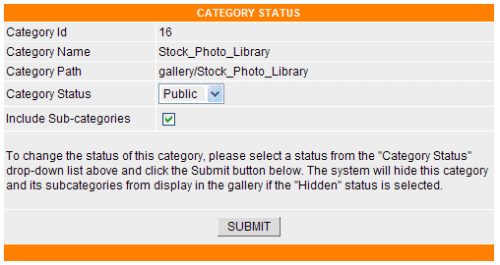
- Select the Category Status in the drop down list and
click the Submit button to change its status.
- To change the media status click on the
- Quick Search
Media
(Pro. & Ent. versions)
To quickly view target media details, input the search phrase in the Media Search field and select the database field in the next dropdown list and then click the Submit button. The system will list all the media that match the search phrase. - Global
FTP Download Server Configuration
 (Ent. version)
You should use this feature only when you have all download links on the same remote server. You should not use this function when the download files are residing on the same server where the Stockbox system is installed.
- Click on the Media Manager
Media Manager in the Navigation Menu.
- Click on the Global FTP Server Configuration
icon in the Media Manager.
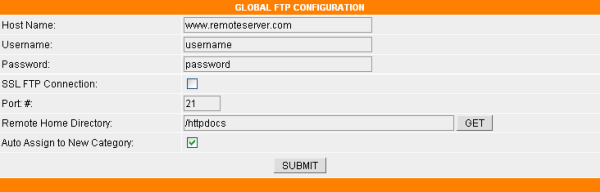
- Host Name:
Enter the host name of the remote FTP server. It can be the IP Address or domain name. - Username:
Enter the username of the remote FTP server. - Password:
Enter the password of the remote FTP server. - Tick the SSL FTP Connection checkbox when your server requires an SSL connection.
- Port #:
Enter the port of remote FTP server. Most servers are using port 21 or 991 for an SSL connection. - Remote Home Directory:
Click on the GET button to connect to the remote server and browse to the directory where the download files reside, then click SELECT. - Auto Assign to New Category:
If this checkbox is checked, the system will auto update the Remote FTP server info to a new category when it's added to the system.
Note: The system will not check whether the high-res files exist on the remote ftp server. The download files must be named using the same naming convention as the download files would be if you were using the Global Enable Download Links feature. - Click on the Media Manager
-
Multiple Media File Selection (Pro. & Ent. versions)
The Multiple Media File Selection feature allows you to select a group of media for Global Update, Delete, Enable Download Links, Create New Order (Ent. version).
- Click on the Media Manager
Media Manager in the Navigation Menu.
- Click on a particular category.
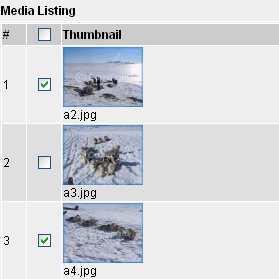
- Tick the checkbox for the target media.
- When you have a group of media that you want, you can click
on any global Icon
 in the Media Manager Functions menu.
- Click on the Media Manager
- Auto Detection
The Auto Detection function is used to detect new categories and media that are residing in the gallery directory on your server, but have not yet been added to the database. Using this function you can add an entire category of media and its contents to the database at one time.
To Add a new category of media to the database
- Click on the Media Manager
Auto Detection link in the main menu.
- Browse to the category that holds the newly uploaded category or media.
- Click on the Add to Database
icon to add the new category or media to the database. If you auto
detect a category, Stockbox will add all of the media contents in
this category to the database.
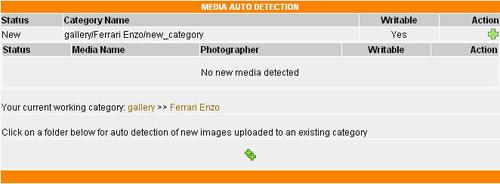
To Add new media to the database
- Browse to the category that holds the newly uploaded media.
- Click on the
icon to add the new media to the database.
- If you are adding media to an existing category (already auto detected) then you will need to add the files individually.
- If you have many individual files to add, you can click on the
icon (Pro. & Ent. versions), to add all new media to the
database at once.
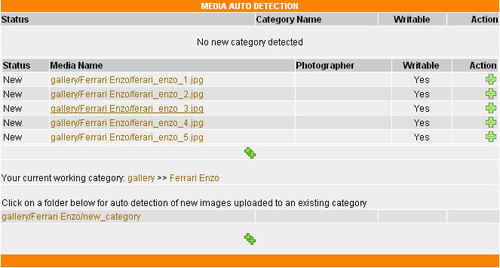
- Click on the Media Manager
- Generate Thumbnails
The thumbnail images can be generated automatically by checking the Auto Generate Thumbnail on New Media feature in the Media Configuration. By using this feature, the thumbnail images will automatically be generated from the uploaded display files (according to the reduction value specified) when new media are brought into the system using the Auto Detection feature. Otherwise they can be generated (or re-generated) using the method outlined below. Before using this feature, you must ensure that all image folders and files have permissions of 777 (r/w/e).If you want to use the system's "Generate Thumbnails" feature, you should convert all display images to jpg format (or .gif or .png if your server's GD version supports them) before uploading them to the server. Alternatively, you can upload other file types with a pre-made thumbnail. Remember to upload the thumbnail to the same directory and give the thumbnail the admin defined thumbnail prefix, which is gallery_ by default.
- Click on the Media Manager
Generate Thumbnails link in the main menu.
- Click on the
icon for the target category to generate thumbnails. The thumbnails
for the entire category of images will be created from the display
images based on the reduction value set in the
Media Configuration section.
- Click on the
icon to confirm and compete the action, or click on the
icon to cancel the action.
- After this action completes, the status for the target category will change from Not Generated to Generated.
Note: If there are a large number of images in the directory, the execution may timeout before the operation completes, this is not a fault in the system. Just click on your browser's refresh button and the system will continue to generate thumbnails from where it left off. Keep doing this until you see the "Action Performed Successfully" message. If you do not see the success message, check to see if the thumbnail overwrite box in the Media Configuration section is checked. If it is, un-check the box and click on the generate thumbnails link again.
Video and other formats of display media
If the media is video, audio or another format of display image, you will need to do the following:
Create a thumbnail image for the media and upload it to the same directory where the media is located.
Example:
Media system name: video1.mpg (this is a video type).
The thumbnail prefix name: gallery_ (this can be set in the Media Configuration section).
Then the thumbnail for this media should be gallery_video1.jpg
Upload this thumbnail to the directory where the video1.mpg is located.
- Click on the Media Manager
- Watermark Images
The system can either apply a Text or Image watermark to the display images. The type of watermark that will be applied will be determined by the setting in the Media Configuration section. Before using this feature, you must ensure that all image folders AND files have permissions of 777 (r/w/e).
- Click on the Media Manager
Watermark Images link in the main menu.
- Click on the
icon for the target category to add watermarks.
- Click on the Apply
icon to add watermarks to images in the category that have not had
a watermark previously applied.
- Click on the Overwrite
icon to use the watermark overwrite option that will apply a watermark
to ALL images. If an image was previously watermarked it will be
re-watermarked. This re-application will darken (make it less transparent)
the appearance of the watermark.
- Click on the Cancel
icon to cancel the action.
- After this action completes the status for the target category will change from Not Generated to Generated.
Note: This feature applies a physical watermark on the display images. Images can't be recovered to their original un-watermarked state after they have been watermarked. So please make sure that you backup all display images locally before doing so. To view a demo of how the image will look after it has been watermarked, click on the
 icon in the Media Configuration section.
- Click on the Media Manager
- Rebuild
Database
This feature allows you to remove any invalid (old) entries from the database. Invalid entries will occur when moving files from one directory to another or deleting files from the system via your FTP client. To avoid invalid entries you should run this feature on a regular basis.To confirm the action click on the Rebuild
icon.
To cancel the action click on the Cancel
icon.
- Resize Images
The most efficient method to resize your display images is to run a batch process on your high resolution original images prior to upload. This saves server resources and considerably saves file transfer times and bandwidth.The system will resize the longest dimension of the images to the size entered in the Media Configuration. The system will maintain the aspect ratio of the images during the resize process. Only images which have a larger size compared to the resize value will be resized. Before using this feature, you must ensure that all image folders AND files have permissions of 777 (r/w/e).
This feature is not recommended for a large category of images or for very large files, as it can cause the server to timeout before the operation completes. If a blank page is displayed, please continue by refreshing the screen until the message "Action Performed Successfully" is shown. This indicates that the resize image process is complete.
- Click on the Media Manager
Resize Images link in the main menu.
- Click on the Resize
icon for the target category to resize that category of images.
- Click on the
icon to confirm and complete the action, or click on the Cancel
icon to cancel the action.
- The system will resize the images in the category based on the setting in the Media Configuration section.
Note: Images can't be recovered to their original size after resizing. So please make sure that you backup all images locally before doing so.
- Click on the Media Manager
-
IPTC Configuration (Pro. & Ent. versions)
This feature allows you to control how the IPTC metadata information is displayed and utilized by the system. If your display images have IPTC metadata embedded, the Stockbox system will import and utilize this data for display and search purposes. The system can also be used to add IPTC metadata to your display images.
- Click on the Media Manager
IPTC Configuration in the main menu.
- Displayed Status: Check the boxes for the desired metadata field(s) to make them display in the gallery.
- Linkable: Check the boxes for the desired metadata field(s) to make them linkable in the gallery. This will create hyperlinks, that when clicked will return results for similar words or phrases.
- Phrase: Check the boxes for the desired metadata field(s) to have the system search by phrase. When searching by phrase is enabled, you will need to ensure that your keywords and keyword phrases are separated with semi-colons.
- Searchable: Check the boxes for the desired metadata field(s) to make them searchable.
- Toggle All: To toggle all checkboxes for the
selected column check this box.

- Click on the Media Manager
- IPTC Mapping Configuration (Pro. & Ent. versions)
This feature allows you to have the Stockbox system automatically import the IPTC metadata to the specified Media Properties fields when new media is imported into the system.
To launch the IPTC Mapping, click on the IPTC Mapping link in the IPTC Configuration section.
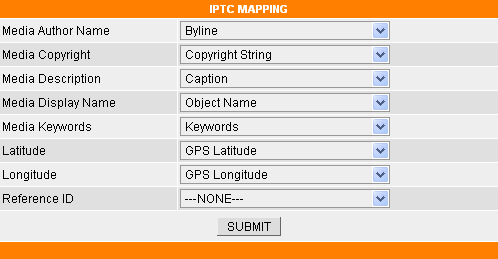
- Select the IPTC field in the drop down menu for the corresponding Media Properties field name.
- Click on the SUBMIT button to save the changes.
Note: The system only maps the data once when the image is imported into the gallery. It won't update new data for existing image properties if you select a new setting in the dropdown menu. To update existing images with the new setting, you must either remove them from the database and then re-import them, or you can click on the Searchable IPTC icons for the respective categories in the Media Manager. - Media Type Manager
You can create as many media types in the system as you wish. By default there are two media types available when you install the system, Video and Image. The system allows you to add the file type extension that will be associated with the target Media Type. When the system imports new media into the system, it will automatically set the Media Type for the media based on the file extension of the uploaded media.
To launch the Media Type Manager, click on the Media Manager Media Type Manager
link in the main menu.
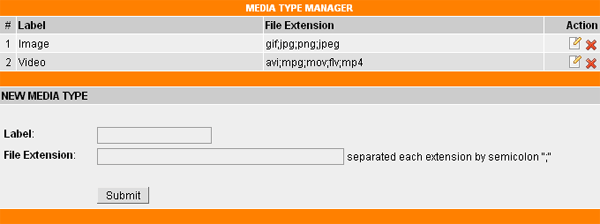
- To Add a new Media Type, enter the Type Label and associated File Extension(s) and click on the SUBMIT button.
- To Edit a particular media type, click on the Edit
icon
- To Delete a particular media type, click on the Delete
icon
- Media File Types
The system can display any files that are viewable in a web browser. If the file format is not viewable from within a web browser, the system provides a link for customers to download the file. The file can then be viewed locally in the associated application. In the same way, other file formats that will open in a web browser can be added to the system by inputting the opening code into the media file types section of the admin area. Current default file types are: gif, jpg, au, avi, aif, htm, html, mid, mp3, mp4, mpg, mov, png, ra, ram, rar, swf, wav, zip, wma, wmv, flv and pdf.The media file types feature allows you to add new media file types, edit or delete existing media file types. The media file type code will be used to open the media when it's displayed on the media detail page. If you need to add a new media file type that is not in the list, you can add it to the database using the add feature by clicking on the
icon.- To Add a new file type
Click on the
icon to add a new media file type.
Extension: this is the file's extension. It should not contain a dot.
e.g. for media .mp3 the entered characters should be mp3
Player Type: Only use this field when you have more than a player for the same file type.
e.g. for the video file type, you could add a QuickTime Player and a Windows Player for users to switch from one to the other. You will need to add the opening code for each type.
Label: Only use this field when you have more than a player for the same file type. The system will only show this on the Media Detail page for users to switch to another media player when it detects that there is more than one player for the selected media.
Opening Code: Enter the code that will be used to open the media. The code should not contain any actual file paths (see the following example).
<EMBED src="[FILENAME]" type="audio/mp3" hidden=true autostart=true loop=true height=1 width=1> </EMBED><table border=0 cellspacing=0 cellpadding=3><tr><td> </td><td align=center><font face="Verdana,Arial,Helvetica" size=1>Having trouble hearing this file?</font><br><font face="Verdana,Arial,Helvetica" size=2><a href="[FILENAME]"><b>Click here to download it!</b></a></font></td></tr></table>
The system will replace the [FILENAME] tag with a real system file name. So when adding a new opening code, simply replace the actual file path with the [FILENAME] tag. If you are not sure about this code, please see other sample codes that are already available in the system.
You can add the image's media properties or the IPTC metadata to the image's alt tag by enabling the "Media Alt Tag" option in the Media Configuration section. You will also need to make sure that you have the alt="[ALT]" tag entered into the Opening Code for the jpg and gif file types.
- To Edit a file type
Click on the Edit
icon for the target media file type.
Edit the opening code as required.
Click the Submit button to save the changes.
- To Delete a file type
Click on the Delete
icon for the target media file type.
You will need to confirm the delete action by clicking on the
icon on the confirmation page. Stockbox recommends that you do not
delete any media file types, as they may be needed sometime in the
future.
- To Add a new file type
- Media Utilities
(Ent. version)
The Media Utilities feature gives you the ability to edit your media from within the gallery admin area. This feature is available for the Ent. Version only and you need to ensure that ImageMagick® is installed on your server. Please visit the ImageMagick® website to download a copy of their software to install on your server. If you do not have root access to your server, you will need to ask your host install this for you.
- Click on the Media Manager
Media Utilities link in the main menu.
- Click on the
 Detach
icon to use the Media Utilities feature in a separate window.
Detach
icon to use the Media Utilities feature in a separate window.
EDITING YOUR CATEGORY
The folder icon symbolizes the media category.
- Click on the Resize
icon
for the target category to Resize all media inside
this category.
- At the RESIZE CONFIRMATION section: Enter your pixels dimension in the Resize To field. The system will resize the longest dimension to the specified value. The system will maintain the aspect ratio of the images during the resize process. Only images which have a larger size compared to the resize value will be resized.
- Click on the
icon to Cancel.
- Click on the
icon to complete the action.
- Click on the Rename
icon
for the target category to Rename this category.
- Click on the Delete
icon for
the target category to Delete this category.
- Click on the Move
 icon for
the target category to Move this category to a
different location. If you have assigned download links to media
that you move, the links will remain valid unless you remove the
download files from the original download folder location. If you
prefer, you can move the download files in the download folder via
FTP to match the new location of the display files and re-assign
the download links using the Global Enable Download Links function.
icon for
the target category to Move this category to a
different location. If you have assigned download links to media
that you move, the links will remain valid unless you remove the
download files from the original download folder location. If you
prefer, you can move the download files in the download folder via
FTP to match the new location of the display files and re-assign
the download links using the Global Enable Download Links function.
Note: To Resize, Delete or Move multiple categories, please check all of the target category checkboxes in the
column,
then click on the
,
or
icons at the
top of the MEDIA UTILITIES section to Resize, Delete or Move multiple
categories.EDITING YOUR MEDIA
- Click on the Resize
icon for the
target media to Resize this media.
- Click on the Rename
icon for the target
media to Rename this media.
- Click on the Delete
icon for the target
media to Delete this media.
- Click on the Move
icon for the target
media to Move this media to a different location.
f you have assigned download links to media that you move, the links
will remain valid unless you remove the download files from the
original download folder location. If you prefer, you can move the
download files in the download folder via FTP to match the new location
of the display files and re-assign the download links using the
Global Enable Download Links function.
Note: To Resize, Delete or Move multiple media, please check all of the target media checkboxes in the
column,
then click on the
,
or
icons
at the top of the MEDIA UTILITIES section to Resize, Delete or Move
multiple media.USING ADVANCED MEDIA UTILITIES
If your media extension is an image type, you can use our Advanced Utilities feature with powerful tools to edit your images.
By clicking on the icon,
you can choose the effect that you want to apply to the image.
icon,
you can choose the effect that you want to apply to the image.- At the message Do you want to convert all media under
this category? Click the
Yes/No
Action button. If you click Yes, then you will have
the following options.
- Check the Do you want to convert all media under this category's subcategories? Check this box, if you want to apply your customized effect to all of the media in the current category and it's subcategories.
- Check the Do you want to continue converting your remaining media in this category? Check this box, if you want to continue applying this effect to the remaining media that did not have the effect applied previously, due to an issue while applying the effect during the last action.
- Click on the
icon to Cancel or click on the
icon to Convert
After customizing the image with your desired effect(s) you can do one of the following:
- Click on the
 icon
to "Save" your converted media.
icon
to "Save" your converted media.
- Click on the
 icon
to "Save As" your converted media.
icon
to "Save As" your converted media.
- Enter the new file name in the File Name field
- Choose the image type to save as in the Save as type dropdown list.
- Click on the Save button to save your new image. Click on the Cancel button to cancel.
Note: If you use the "Save As" feature, then you will need to use the auto detection feature to bring the newly saved image into the database.
- Click on the Media Manager
- POP3 Media
(Ent. version)
Stockbox has a convenient way to add media to your database, it is called the POP 3 Media Manager feature. You or your photographers can just send an email with the media attached to an email account that is setup in the POP3 Media Manager section. Then you can use this feature to check the mailbox, download the attached media and add them to the gallery categories.This feature also allows you or your contributors to upload images to the gallery directly from their mobile phone (if they have a camera feature on their phone). After capturing their photo they can simply send the camera phone image to the email address that you have setup in the POP3 Media Manager.
In the Account Information section:
- Hostname: Enter your POP3 Mail Server URL
- Username: Enter your POP3 Email Username
- Password: Enter your POP3 Email Password
- Mailbox Name: Enter your mailbox name, Stockbox will download all messages from this mailbox.
- Port #: Enter your POP3 server port number.
icon
to save the new settings.
Click on the Download Mail
icon to connect and download email messages from your POP3 Mail Server.
POP3 MAIL MANAGER
If you connect to your POP3 Mail Server successfully, all unread messages will be downloaded automatically. Messages that contain attached media will be listed.
Click on the desired Media Name to preview your Media.
Click on the desired Photographer to edit the photographer's profile. The photographer needs to prefix their file name with their user name (e.g. photog_image1.jpg) for the system to recognize that the image belongs to a particular photographer (contributor).
Choose the category that you want to add new media to in the Category column, then click on the
icon to add your media to the database.
If you want to add more information to the new media before adding it to the database, click on the
icon.
If you want to delete the new media instead of adding it to the database, click on the
icon.
- Send to
Friend Logs
The Send to Friend Logs feature allows you to manage the user's send to friend email information.
- You can view where the email was being sent to and other related
information by clicking on the
 icon.
icon. - You can delete specific send to friend logs by clicking on the
icon for that log.
- Click on the
 icon to delete all SEND TO FRIEND LOGS.
- You can view where the email was being sent to and other related
information by clicking on the
- FTP Syndication
 (Ent. version)
With the Ent. version you are able to upload selected media download files to a remote FTP server. This feature is an easy and efficient way for to supply your customers with images.
First you need to select the particular media in the Media Manager using the Multiple Media File Selection feature. The system only allows you to upload selected media to the remote FTP server when the selected media has download links assigned to it. So you must assign the download links to the particular media before using this function.
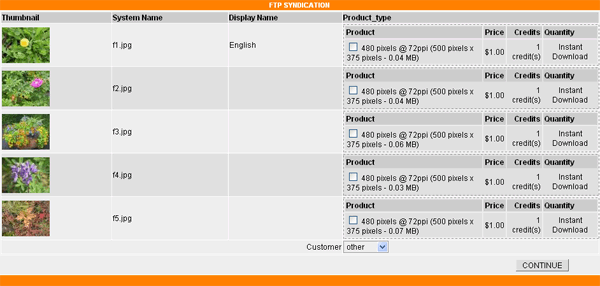
- Tick the Product Type for the particular media to upload.
- Select the customer's username in the "Customer" drop down menu. When "Other" is selected, you will have to fill-in the Remote FTP details in the following screen prior to the upload.
- Click on the CONTINUE button to continue
the upload process.
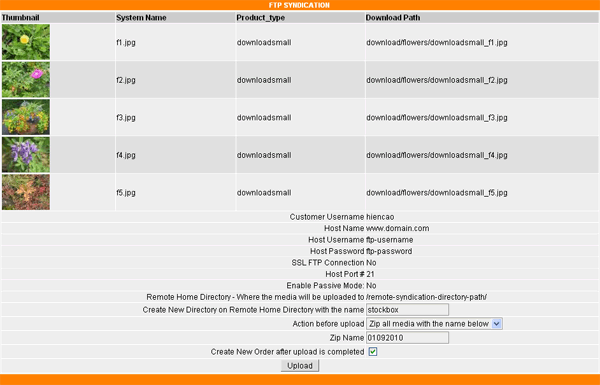
- FTP Info (Host Name, Password, etc.)
The system will ask you for the FTP info if it doesn't see any FTP details configured for selected user. -
Create New Directory on Remote Home Directory with the name
You can instruct the system to create a new directory on the Remote FTP Server's home directory by entering the name in this field. The system will create the new directory with the entered name before uploading the download files to it. - Actions before uploading
- Zip all media with the name below
Select this option when you want the Stockbox system to zip all download files into a Zip file named according to the name entered into the Zip Name field. This option is good when you want all files to be in a single package. However, this option will take a little more time for the system to zip all of the files before uploading the zip file to the server. - Upload All Media as is
Select this option when you want the Stockbox system to just upload all media as they are currently named. The system will upload all download files to the Remote FTP Server under the selected home directory.
- Zip all media with the name below
- Create New Order after upload is completed
Tick this checkbox when you want system to create new order based on the selected media with the selected product type. The new order will be created once all files have been uploaded to the Remote FTP Server. -
Click on the Upload button to start
the upload process.
- Media Export
(Ent. version)
Image Sitemap Export
The Sitemap Export feature (in addition to the Stockbox SEO feature) is designed to improve the ability for the search engines to index your site content. You can find more information on sitemaps via the following sites.
http://www.google.com/support/webmasters/bin/answer.py?hl=en&answer=178636
http://www.sitemaps.org
- Click on the Media Export
icon in the Media Manager menu icons to launch the Media Export page
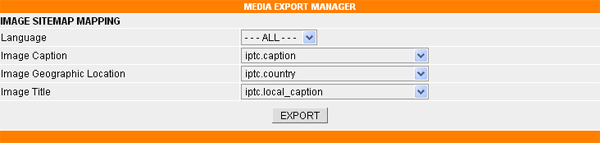
- Language
The system will list all current active languages that are in the system in the language drop down list. You can either select one language or have the system export the data for all languages. The language selection only applies to the media properties fields and not the IPTC metadata. - Image Caption
Select the desired field for the Image Caption. - Image Geographic Location
Select the desired field for the Image Geographic Location. -
Image Title
Select the desired field for Image Title. - Click on the EXPORT button to export all media based on the mapping field selections.
- Click on the Media Export
- <loc>http://example.com/sample.html</loc>
Stockbox system uses the category's URL for this tag - <lastmod>yyyy-mm-dd</lastmod>
Stockbox uses the category's last modified date for this tag - <changefreq>monthly</changefreq>
Stockbox uses the monthly setting for this tag. You could use other value for this tag, always, hourly, daily, weekly, yearly, never. Use this value for archived URLs.
This value can be changed in the tpl/english/export/admin_sitemap_xml.tpl template. - <priority>0.8</priority>
Stockbox uses the 0.8 setting as the default value for this tag.
This value can be changed in the tpl/english/export/admin_sitemap_xml.tpl template. - <image:image>
Stockbox lists all media for the category above.
- <image:loc>
Stockbox uses the URL path to the media thumbnail. -
<image:caption>
Stockbox uses the mapping field above. - <image:geo_location>
Stockbox uses the mapping field above. - <image:title>
Stockbox uses the mapping field above. - <image:license>
Stockbox will not include this tag in the Sitemap file. If you would like to enable this tag, please open the file
tpl/english/export/admin_sitemap_image.tpl and add your own value to it. When you're finished editing, upload it back to where it was downloaded from.
- <image:loc>
- Media Statistics (Ent. version)
The Media Statistics feature provides you with traffic statistics for your gallery. In order for the system to log user's activities, you must enable the "Enable Media Stats Logs" option in the Media Configuration.
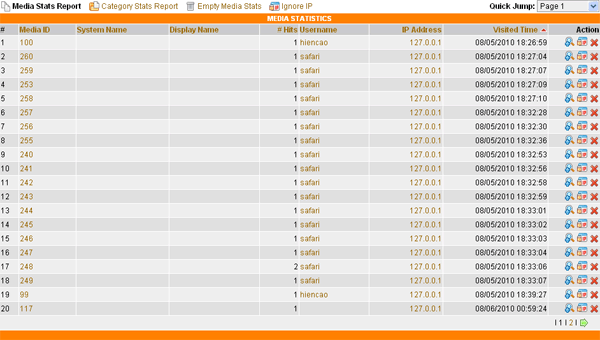
- To View more traffic details for a particular media ID, click on the
 icon.
icon.
- To have the system ignore a particular IP Address, click on the
 icon. Once the IP Address is added to the Ignore List,
the system will not log data when the user from this IP is browsing
your gallery. You may want to enter the IPs for the search
engines so that their activity is not logged by the system.
icon. Once the IP Address is added to the Ignore List,
the system will not log data when the user from this IP is browsing
your gallery. You may want to enter the IPs for the search
engines so that their activity is not logged by the system.
- To Delete a particular log, click on the
icon.
- To Empty ALL media statistics, click on the
icon.
Category Stats Report
Similar to the Media Statistics, the Category Stats Report shows the logs for all user's category history. In order for the system to log user's activities, you must enable the "Enable Media Stats Logs" option in the Media Configuration.
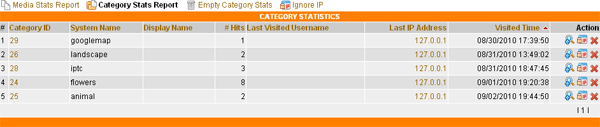
- To View more traffic details for a particular category ID, click on the
icon.
- To have the system ignore a particular IP Address, click on the
icon. Once the IP Address is added to the Ignore List, the system will not log data when
the user from this IP is browsing your gallery. You may want to
enter the IPs for the search engines so that their activity is
not logged by the system.
- To Delete a particular log, click on the
icon.
- To Empty ALL category statistics, click on the
icon.
Ignore IP
Use this function to instruct the system to ignore (by-pass) any user that is using a particular IP Address to access your site. The system will not log any activities when it sees the IP Address is in this list.
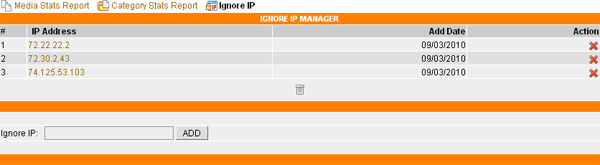
Important: If you have a high traffic site, the database may use up all of the available server space. To avoid this potential issue, you can set the Maximum Number of Logs per User in the General Configuration. The system will delete old entries for the user when it reaches the maximum number allowed, before inserting the new entries.
- To View more traffic details for a particular media ID, click on the
- Media
Configuration
This section allows you to configure the gallery thumbnails, watermarks, etc., etc...
Stockbox exports all media from the database in the .xml format. The following describes how the Sitemap is generated.
Depending on your database size, it may take a little while for the system to export all media in the database. Your web browser will ask you to save the export file to your local computer and by default the file name is called sitemap.xml (you shouldn't alter this name). Once you have it saved to your local computer, you can either submit the sitemap to the search engine(s), or upload the sitemap.xml file to www root directory on your server. The search engines will automatically detect this file when they crawl your site.
ORDER MANAGER
Using the Customer Orders section you can do the following
- Manage Customer's Orders.
- Completed Orders
- Pending Orders
- View, Print & Send Customer's Invoices.
- View, Print & Export Sales Reports.
- Download, FTP Syndication Instant Download orders
- Complete Printing Fulfillment for Printed Orders
- Completed orders, are orders that have been paid for via one of the integrated payment gateways.
- Pending orders, are orders that have not yet been paid for, or have been canceled by the admin. It is possible that the order was paid for by the customer, but the system did not receive confirmation of the payment from the payment gateway due to a technical issue. In this situation, the order will remain in Pending status until it is manually completed by the gallery admin.
- The displayed sort order of the Customer Orders or related information can be changed by clicking on the column header title links.
-
a. Completed Orders
The Completed Orders section displays a summary of all Completed orders that currently reside in the database.
- Click on the Order Manager
Completed Orders link in the main menu.
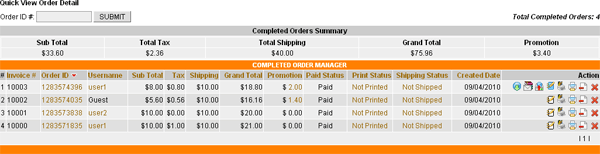
- To View the Order Details,
click on the Order Id link for the particular order.
- To Download instant download orders click on the Download
icon. This icon
will only be displayed when the order is an instant download order.
- To Send the ordered instant download files to the customer's email address, click on the
Send Order
 icon
(Ent. version). You
can enter a message for your customer on the next page that will
be displayed. The system will zip all instant download files before it sends
them to the customer's email address. Due to the limitation of
sending large files via email, this function is only intend for use
with small download file sizes.
icon
(Ent. version). You
can enter a message for your customer on the next page that will
be displayed. The system will zip all instant download files before it sends
them to the customer's email address. Due to the limitation of
sending large files via email, this function is only intend for use
with small download file sizes. - To Upload the ordered instant download files to the customer's server
via FTP, click on the FTP Syndication
icon
(Ent. version).
The system will confirm FTP details for the remote server on the next
page that will be displayed.
- To Process a print order for Print Fulfillment, click on the
Print Fulfillment
 icon
(Ent. version). You need to choose
the Print Fulfillment provider
on the next page that will be displayed.
icon
(Ent. version). You need to choose
the Print Fulfillment provider
on the next page that will be displayed. - To make Notes pertaining to a particular order, click on the
Notes
 icon for the particular order. The notes will be stored in the database
until the selected order is deleted from the database. The system
will display the notes under the Previous Notes section.
The username of the person who added it and the date will also be
logged. When a customer downloads an instant download type order
from their My Account area, the details of the download will also
be stored in the Previous Notes section.
icon for the particular order. The notes will be stored in the database
until the selected order is deleted from the database. The system
will display the notes under the Previous Notes section.
The username of the person who added it and the date will also be
logged. When a customer downloads an instant download type order
from their My Account area, the details of the download will also
be stored in the Previous Notes section.
- To Print Order Details, click on the Print
Order Details
 icon (Pro. & Ent versions).
The order details for the selected Order Id will popup with a print function enabled.
- To Cancel an order, click on the Cancel
 icon.
icon.
Once the order has been cancelled, the order changes from Completed to Pending and the order will be moved to the Pending Orders section. When an order is pending, the download link will not be available to customers in their My Account area.
- To Delete an order click on the Delete
icon.
You will need to confirm the delete action before the system removes the selected order from the database.
- To change an order's Shipping Status, click on the link
in the Shipping Status Column.
With the Pro. or Ent. version you are able to input the shipping information for the selected order id. When clicking on the shipping link of the selected order id, another window will display which allows you to input shipping information such as shipping provider, provider URL etc. Customers will be able view all of the information that you input into the shipping information page (except the shipping cost), by clicking on the Shipping Info icon in their "My Account" area.
- To view the Promotion Code details click on the promotion
value hyperlink.
The hyperlink is only visible if customers have input a promotion code during the checkout process. After clicking on the hyperlink, you will see all promotion codes that were used for the selected order id.
- To view the customer's Registration information, click
on the customer's username.
The customer's profile page will display with the customer's profile information.
- To Quick View Order Detail, enter the order
id number into the Order Id # field and then click
Submit.
The order details of the input order id # will display if it exists in the database.
b. Pending Orders
The Pending Orders section displays a summary of all Pending, Cancelled and Processing orders that currently reside in the database. A Cancelled order is a previously Completed order that was cancelled by the admin. A Processing order is an order submitted using the "Offline Form" and has not yet been processed by the admin.- Click on the Order Manager
Pending Orders link in the main menu.

- To View the Order Details,
click on the Order Id for the particular order.
- To change the status of an order from Pending
to Completed click on the
icon.
When an order is completed, the download link will be available to customers in their My Account area if there is an instant download media in the order. Once the status is changed to Completed the order will be moved to the Completed Orders section.
- To Delete an order click on the
icon.
You will need to confirm the delete action before the system removes the selected order from the database.
- To view the Promotion Code details click on the promotion
value hyperlink.
The hyperlink is only visible if customers have input a promotion code during the checkout process. After clicking on the hyperlink, you will see all promotion codes that were used for the selected order id.
- To view customer's Registration information, click on
the customer's username.
The customer's profile page will display with the customer's profile information.
- To Quick View Order Detail, enter the order
id number into the Order Id # field and then click
Submit.
The order details of the input order id # will display if it exists in the database.
- Click on the Order Manager
- Invoice
Manager - View Print & Send Customer's Invoices (Pro. & Ent.
versions)
You can preview, print or send an invoice to a customer's email address using this feature. The invoice data is taken from the customer's information collected through the Registration Form. You can add all information or just add selected fields using the invoice Configuration feature.
There are three sets of customer information that are used by the invoice feature.
- Customer Registration Information
This information is collected when the customer registers to your site.
- Billing Information
The billing information is collected during the customer checkout process.
- Shipping Information
If the order is a delivery order (not all instant download products), then the system will ask the customer to input their shipping address during the checkout process. This information is stored in the database and it's used for the invoice and order details sections.
Below is a sample invoice.
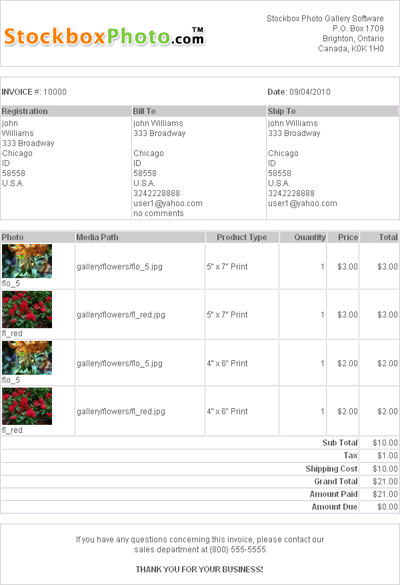
Invoice Configuration
This feature allows you to control the customer's registration form fields that will be displayed on the invoice page or in the invoice email that is sent to customers. The system WILL NOT add these fields after you first install the software on your server. You will need to do this manually as described below. The billing and shipping details are predefined by the system.- Click on the Order Manager
Invoice Manager link in the man menu.
- Click on the
Configuration link on the Customer
Invoice Manager page.
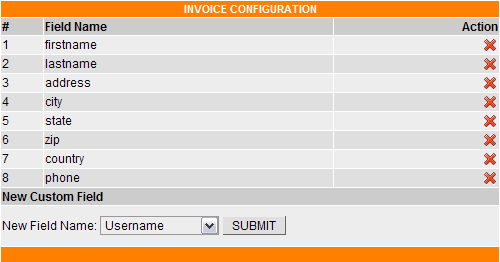
- New Field Name
The fields displayed in the dropdown menu are taken from the Customer Registration Form Fields that you have configured. If you have not configured this form yet, click here to learn how.
- Click the Submit button to add the new field to the database.
- Click on the Delete
icon for the target field name to delete it from the database.
- Click on the Order Manager
Invoice Manager in the main menu.

- Click on the
Configuration link
Use this feature to add or remove registration form fields from the invoice as required.
- To send an invoice to the customer's registered
email address, click on the Send Invoice
 icon for the target invoice id #.
- To view a customer's invoice detail, click
on the Preview
 icon for the target invoice id #.
- To print a customer's invoice detail, click
on the Print
icon for the target invoice id #.
- To quick print invoice detail, enter the invoice id # into the
Quick Print Invoice # text field and click submit.
The order invoice details for the entered id # will display if it exists in the database.
- Customer Registration Information
-
Print Fulfillment Manager (Ent. version)
The Frontline System requires all original images to be uploaded to their server via the provided FTP information. The provider require an XML file to be attached together with the uploaded images and order info. You will need to update your account info in the XML data. Each provider may require different file formats for printing, so please contact the provider for more information on the printing file format.The system allows you to process the print order in two ways:
- Automatically
To have the system automatically process the print fulfillment for all new orders automatically, you must enable the "Enable Automatic Print Fulfillment for New Completed Orders" option in the General Configuration. - Manually
To manually process the print fulfillment for a particular order, go to the Order Manager
Completed Orders and click on the
icon.
In order for the system to upload the original images to the print provider's server, you must upload the original images to your server, so that they will be available for the system to upload to the print provider. The original images should reside in the "download" folder and the files should be named the same as the corresponding display file. Also, the folder structure of the download folder must be the same (mirror) as the gallery folder where the display files are stored. The system will first look into the original file path database field to see if there is a link attached to it. If no link is found, the system will look into the "download/category-path/file-name.jpg". When you upload images using the Hi-res auto Resize feature and using the Import function to import images to the gallery, the system will automatically move the hi-res images to the correct directory in the download folder as well as assigning the original link to the respective display image.
When processing the print fulfillment, it is possible that you may encounter errors due to one or more of the following situations.
- The Original Images are not available.
- Print provider Product Code or Billing Code are not available.
If either one of the above situations apply to all items in a particular order, then the system won’t process the print fulfillment for that order. However, if either situation above occurs to only one or more items in the order (not all items in order), then you can continue to process the order as long as you have the "Continue Processing Print Fulfillment for Orders with Errors" option in the General Configuration enabled. Only items with a valid Printing Code & the Original Images available will be processed.
Frontline System - www.frontlinesystem.com
- Click on the Order Manager
Printing Manager link in the main menu.
- Click on the Edit
icon to update the Frontline XML data.
- Automatically
- Relocation
When this option is selected, you must provide the location where the order info and its images will be moved to. This location must reside on the same server where the Stockbox system is installed. - FTP
When this option is selected, you must provide the remote FTP info that you have from the Frontline Provider.
- XML Data
There are few tags in the XML data that must not be removed or moved within the XML data. You can add more XML tags between these tags when needed.
- [BATCH] & [/BATCH]
- [IMAGE] & [/IMAGE]
<frontline removeAfterProcess="false" assignDefaultProfile="true">[BATCH]
<batch code="[PRODUCT_CODE]">
The system will replace this tag value with the Frontline Product Code. You must configure the Frontline Product Code in the Product Type Manager under the Action Column Section.
<device>Stockbox</device> Replace this tag value with your own value. This description will appear in the Frontline order queue. Default = "Hotfolder"
<customerID>99999</customerID>
Replace this tag value with your Customer ID that you have from Frontline System Provider.
<variables>
<var name="info"><![CDATA[Frontlinesystem]]></var>
No need to change the value of this tag.
<var name="orderID">[order_info.order_id]</var>
The system will replace this tag value with the purchased Order ID.
<var name="userID">[customer_info.username]</var>
The system will replace this tag value with the customer's Username.
<var name="userEmail">[customer_info.email]</var>
The system will replace this tag value with the Customer Email Address.
<var name="ot_part">1</var>
No need to change the value of this tag.
</variables>
<order sort="Stockbox_#[order_info.order_id]">[IMAGE]
The system will replace the order_info.order_id with the purchased order ID.
<image quantity="[order_details.quantity]" rotationAngle="0">
No need to change the value of this tag.
<path><![CDATA[[order_details.original_file_name]]]></path>
The system will replace this tag value with the purchased Media System Name.
<backPrint row="1"><![CDATA[(C) - Frontlinesystem]]></backPrint>
Enter the backprint value as you wish. Frontline will use it for the backprint option.
<backPrint row="2"><![CDATA[2006-03-03 <[order_details.original_file_name]>]]></backPrint>
Enter the backprint row 2 as wish, otherwise Frontline will use the media system name.
<variables>
<var name="originalFileName"><![CDATA[[order_details.original_file_name]]]></var>
The system will replace this tag value with the purchased media system name. </variables>
</image>[/IMAGE]
</order>
</batch>[/BATCH]
</frontline> - [BATCH] & [/BATCH]
- Select Process Method
- Relocation
- In the "Relocation Directory" text field, enter the path where you want the system to move the order contents to. - FTP
- Enter the Host Name to the "Host Name" field
- Enter the Host Username to the "Host Username" field
- Enter the Host Password to the "Host Password" field
- Enter the Port # to the "Port #" field
- Tick the checkbox of "Enable Passive Mode" if Passive Mode is enabled on remote server
- Tick the checkbox of "SSL Connection" if it's enabled on the remote Server
- Enter the Remote Directory or select it using the GET button. The system will upload the order contents to this directory when it's processing a particular order.
- Relocation
- Enter the HotFolder Name.
You should have the HotFolder Name that is assigned to you when you sign up with Frontline. If not you will need to request this name from Frontline. - The system will create a new folder on the Remote FTP Server's home directory with the name that you enter in the HotFolder Name field.
It will then upload all of the original images that the user has purchased and
the order.xml file as well. The Frontline system will handle the rest.
- Sales
Report - View, Print and Export Sales Report (Pro. & Ent. versions)
This feature allows you to view, print or export customer sales reports. You can customize the report layout as required (see below).
- Launching Sales Reports
- Click on the Order Manager
Sales Reports link in the main menu.
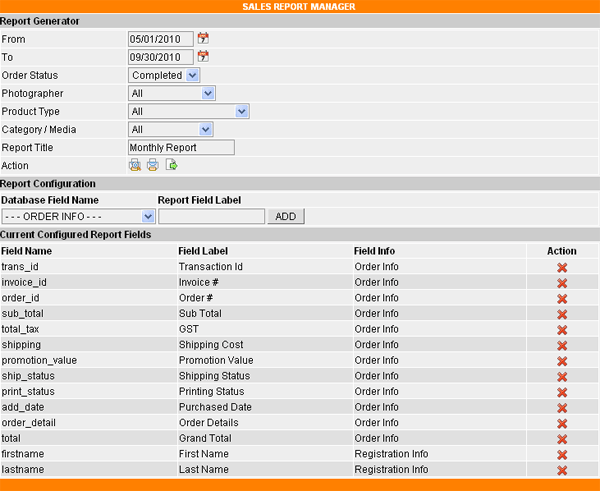
- Click on the Order Manager
- View Sales Reports
- Select the From date by clicking on the
 icon next to the From Date field. Select the Month and Year
from the dropdown menus and select a date from the calendar
to complete the selection.
icon next to the From Date field. Select the Month and Year
from the dropdown menus and select a date from the calendar
to complete the selection. - Select the To date by clicking on the
icon next to the To Date field. Select the Month and Year from
the dropdown menus and select a date from the calendar to complete
the selection.
- Select the Order Status of the Customer's orders (All, Completed or Pending).
- Select the Photographer from the drop down menu. When a particular photographer is selected, the system will only generate the report based on that photographer with the other selections.
- Select the Product Type from the drop down menu. The system will only generate the report based on the particular product type when select.
- Select the Category Path or Media ID from the Category / Media drop down when you want to generate the report based on this selection.
- Enter the Report Title. The report title is used to describe the report.
- Click on the Preview
icon to view the report.
The system will open a small window displaying all order summaries based on the selected date and the selected customization fields that you have configured in the "Current Configured Report Fields".
- Select the From date by clicking on the
- Print Sales Reports
- Select the From date by clicking on the
icon next to the From Date field. Select the Month and Year
from the dropdown menus and select a date from the calendar
to complete the selection.
- Select the To date by clicking on the
icon next to the To Date field. Select the Month and Year from
the dropdown menus and select a date from the calendar to complete
the selection.
- Select the Order Status of the Customer's orders (All, Completed or Pending).
- Select the Photographer from the drop down menu. When a particular photographer is selected, the system will only generate the report based on that photographer with the other selections.
- Select the Product Type from the drop down menu. The system will only generate the report based on the particular product type when select.
- Select the Category Path or Media ID from the Category / Media drop down when you want to generate the report based on this selection.
- Enter the Report Title. The report title is used to describe the report.
- Click on the Print
icon
The system will open a small window (with a print function enabled) displaying all order summaries based on the selected date and the selected customization fields that you have configured in the "Current Configured Report Fields".
- Select the From date by clicking on the
- Export Sales Reports
- Select the From date by clicking on the
icon next to the From Date field. Select the Month and Year
from the dropdown menus and select a date from the calendar
to complete the selection.
- Select the To date by clicking on the
icon next to the To Date field. Select the Month and Year from
the dropdown menus and select a date from the calendar to complete
the selection.
- Select the Order Status of the Customer's orders (All, Completed or Pending).
- Select the Photographer from the drop down menu. When a particular photographer is selected, the system will only generate the report based on that photographer with the other selections.
- Select the Product Type from the drop down menu. The system will only generate the report based on the particular product type when select.
- Select the Category Path or Media ID from the Category / Media drop down when you want to generate the report based on this selection.
- Enter the Report Title. The report title is used to describe the report.
- Click on the CSV Export
icon.
The system will open a small window that will allow you to Open or Save the Sales Report. The report will contain all order summaries based on the selected date and the selected customization fields that you have configured in the "Current Configured Report Fields". The export file is in .csv (comma separated value) format. You can open the exported file in Microsoft Excel® (or any other spreadsheet application).
- Select the From date by clicking on the
- Customize Sales Reports
Use this feature to customize the Sales Report layout. The system WILL NOT add these fields when you first install the software on your server. You will need to do this manually as described below before generating or exporting any sales reports. There are four data sections in the “Database Field Name”.
- Order Info
This section is predefined by the system so you can’t add or remove any fields from the drop down menu. - Registration Info
This information is collected when the customer registers to your site. If you add or remove fields from the registration form, the changes will be reflected in the dropdown menu. - Billing Info
This section is predefined by the system so you can’t add or remove any fields from the drop down menu. The billing information is collected during the customer checkout process. - Shipping Info
This section is predefined by the system so you can’t add or remove any fields from the drop down menu. The shipping information is collected during the customer checkout process.
- Click on the Order Manager
Sales Reports in the menu function.
- Select the field name in the "Database Field Name" drop down list.
- Enter the Report Field Label to describe the field name.
- Click the Add button, to add the new custom field to the report's layout.
- Delete custom fields that are not required, by clicking
on the Delete
icon for the target field.
- Order Info
- Launching Sales Reports
There are two methods to process
a particular order.
Variables that you could use in Printing Fulfillment XML data
| ORDER INFO. | |
| [order_info.order_name] | Order Name that is configured in the Payment Gateway |
| [order_info.order_id] | Purchase Order ID |
| [order_info.username] | Customer Username |
| [order_info.transaction_id] | Transaction ID that is returned from the payment gateway processor |
| [order_info.tax] | Order Tax Price |
| [order_info.shipping] | Order Shipping Cost |
| [order_info.sub_total] | Order Sub Total Amount |
| [order_info.promotion_amount] | Order Promotion Amount |
| [order_info.grand_total] | Order Grand Total Amount |
| [order_info.order_date] | Order Purchase Date |
| [order_info.invoice_id] | Order Invoice ID |
| [order_info.order_time] | Order Purchase Time (hh:mm:ss) |
| ORDER DETAIL INFO. | |
| [order_details.order_id] | Purchase Order ID, same as the [order_info.order_id] |
| [order_details.media_id] | Purchase Media ID |
| [order_details.photographer_username] | Purchase Media ID Photographer Username |
| [order_details.photographer_firstname] | Purchase Media Photographer First Name |
| [order_details.photographer_lastname] | Purchase Media Photographer Last Name |
| [order_details.product_name] | Purchase Stockbox Product Type for current Media ID |
| [order_details.product_label] | Purchase Stock Product Type Label for current Medai ID |
| [order_details.quantity] | Purchase Quantity |
| [order_details.price] | Media Price per Quantity |
| [order_details.total_price] | Purchase Price (Quantity x Media Price) |
| [order_details.order_date] | Order Date, same as the order_info.order_date |
| [order_details.order_time] | Order Purchase Time (hh:mm:ss) |
| [order_details.file_system_name] | Media File System Name |
| [order_details.file_display_name] | Media File Display Name |
| [order_details.file_path] | Media File Path |
| [order_details.original_file_path] | Media File Original Path |
| [order_details.original_file_name] | Media File Original Name |
| [order_details.bayphoto_ItemID] | Media Bay Photo Item ID (start from 1) |
| [order_details.bayphoto_product_name] | Media Bay Photo Product Name that is associated with Stockbox Product Name |
| [order_details.bayphoto_product_code] | Media Bay Photo Product Code that is associated with Stockbox Product Name |
| [order_details.bayphoto_billing_code] | Media Bay Photo Billing Code that is associated with Stockbox Product Name |
| [order_details.product_printing_code] | Media Frontline Printing Code (Batch Code) that is associated with Stockbox Product Name |
| ORDER BILLING INFO. | |
| [billing_info.order_id] | Order ID |
| [billing_info.username] | Customer Username |
| [billing_info.customer_name] | Customer Billing Name |
| [billing_info.first_name] | Customer Billing First Name |
| [billing_info.last_name] | Customer Billing Last Name |
| [billing_info.address1] | Customer Billing Address 1 |
| [billing_info.address2] | Customer Billing Address 2 |
| [billing_info.city] | Customer Billing City |
| [billing_info.state] | Customer Billing State |
| [billing_info.zip] | Customer Billing Zip Code |
| [billing_info.country] | Customer Billing Country |
| [billing_info.phone] | Customer Billing Phone |
| [billing_info.email] | Customer Billing Email Address |
| ORDER SHIPPING INFO. | |
| [shipping_info.order_id] | Purchase Order ID, same as order_info.order_id |
| [shipping_info.username] | Customer Registration Username |
| [shipping_info.customer_name] | Customer Shipping Name |
| [shipping_info.first_name] | Customer Shipping First Name |
| [shipping_info.last_name] | Customer Shipping Last Name |
| [shipping_info.address1] | Customer Shipping Address 1 |
| [shipping_info.address2] | Customer Shipping Address 2 |
| [shipping_info.city] | Customer Shipping City |
| [shipping_info.state] | Customer Shipping State |
| [shipping_info.country] | Customer Shipping Country |
| [shipping_info.phone] | Customer Shipping Phone |
| [shipping_info.email] | Customer Shipping Email Address |
| [shipping_info.comments] | Customer Shipping Comments |
| ORDER CUSTOMER REGISTRATION INFO. | |
| [customer_info.email] | Customer Registered Email Address |
| [customer_info.username] | Customer Registered Username |
| [customer_info.registration_form_field_name] | The registration form field name is the field name in the customer registration form field |
You could use any of the variables above in the XML format.
The system will replace the call tag with the actual value from the database.
CUSTOMER MANAGER
The displayed sort order of the Customers or related information can be changed by clicking on the column header title links.
Using the Customer Manager
-
Active
& Pending Customers
After a customer registers to your site, their account status will be either in Pending or Active status.
- Pending Customers are those that either have
not activated their account (if you are using the "Enable
New Account Email Validation" feature) or have been changed
from Active to Pending by you. If customers are in Pending mode
they are not able to access the check out page or account page,
but they are able to access the site to view the thumbnail or media
detail pages.
- Active customers are able to access all features
of the gallery, but not the administration or photographer's areas.
- By clicking on either the “Active Customers” or “Pending
Customers” link, the system will display the following screen.

- To configure user FTP server details for a particular customer, click on the
FTP Syndication icon.
The system will use this information for the FTP Syndication function
(Ent. version).
- To view and/or edit a customer's information,
click on the Edit
icon for the particular customer.
- To View the VIP Order History, click on the
 icon for the particular customer (Ent. version). This function is
only available when a customer has been assigned VIP status.
icon for the particular customer (Ent. version). This function is
only available when a customer has been assigned VIP status. - To view a customer's Sample Download history, click on
the
icon (Pro. & Ent. versions).
- To view a customer's Search Logs, click on
the
 icon (Pro. & Ent versions).
 - To change a customer's status to Pending, click
on the
icon.
- To change a customer's status to Active, click
on the
icon.
- To Delete a customer from the database, click
on the
icon.
- Pending Customers are those that either have
not activated their account (if you are using the "Enable
New Account Email Validation" feature) or have been changed
from Active to Pending by you. If customers are in Pending mode
they are not able to access the check out page or account page,
but they are able to access the site to view the thumbnail or media
detail pages.
- Email
Customers
Use this function to communicate with customers.
- Click on the Customers
Email Customers link in the main menu.
- Select the email format. You can choose from either HTML or Plain Text for the outgoing email.
- Enter the return email address into the "From" field. The return email address is the email address that customers would use if they wanted to reply to your message after receiving it.
- Select the customer group in the "To" drop down list. (Active Customers, Pending Customers or All Customers).
- Enter the Subject of the message.
- Enter the message body into the Message field.
- Click the Send button to send the message.
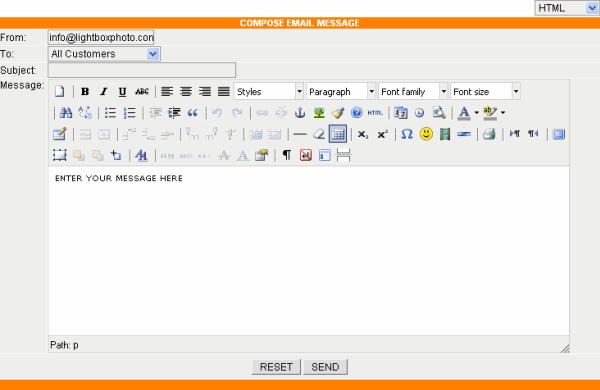
- Click on the Customers
- Registration
Form
The Stockbox system supports an unlimited number of form fields for the customer registration form. You can add more fields or remove existing ones that are not required for your gallery. If you wish to remove a field from displaying on the form, Stockbox suggests that you edit the field and make it inactive rather than deleting the field, as you may wish to use it at a later date. By default when the software is installed the system will add the following fields to the customer registration form. Please see the Registration section for more information.
Click on the Customers
Registration link in the main menu.
- firstname - Customer's first name
- lastname - Customer's last name
- address - Customer's physical address
- city - Customer's city
- state - Customer's state
- zip - Customer's postal code
- country - Customer's country
- phone - Customer's phone number
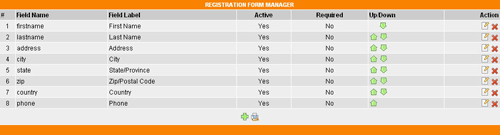
- Contact Mapping
There are a few places in the system that require customers to input information. This information may have already been collected during the registration process. Stockbox provides an option, which allows you to map these fields to the customer's registration form. With this mapping relationship the system will automatically pre-fill the customer’s data to the common defined fields, so that customers do not need to re-input data, which was already submitted.
Click on the Customers
Contact Mapping link in the main menu.Note: It is only necessary to make changes to this section if you remove any of the default Registration form fields and replace them with your own custom fields.
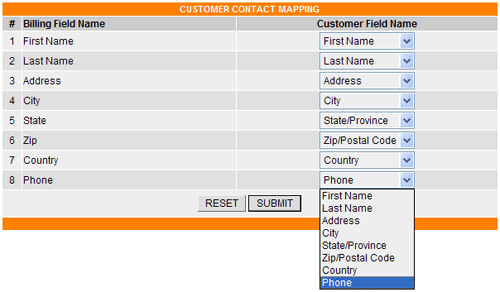
- Add New Customer
Within the admin control panel you can add a new customer to the system. The new customer will become active once you have submitted the data to the server. The system will not verify the email address even if you have set it to do so in the general configuration.
- Click on the Customers
Add Customer link in the main menu.

The system displays the dynamic fields from the registration form that you have configured in the Customer
Registration section. The username, password and email fields
are all required by the system. Fill in all relevant values into
the provided text fields and click the Submit button to add
the new customer to the system.
- Click on the Customers
- Online Users (Ent. version)
When the "Enable Online User Log" option in the Customer Configuration is selected, the system will log all users when they visit your site. This page will display all users that are currently viewing your gallery.
- Session ID
Visitor's current session ID. - Username
Visitor's username. When users login to the system, the username will be logged. - Current Page
The page the visitor is currently viewing. - Referred URL
The URL that the user visited before browsing to the current page. -
IP Address
Visitor's IP Address - Visit Time
Visitor's visit time - To view more details of a particular user, click on the
View Details
icon.
The system will list all pages that the selected user has browsed
in your gallery.
- To instruct the system to ignore a particular IP Address, click on the
Ignore IP
icon.
The system will not log user info for visitors from this IP once
the IP Address has been added to the Ignore IP Address List.
- To view all user's history click on the User Logs link. The "Maximum Number of Logs per User" is configured in the General Configuration.
- To View the Ignore IP address list click on the "Ignore IP" link. You are able to add or remove IPs from it as desired.
- To Delete a log from the database, click
on the Delete
icon.
- Session ID
- Temporary Password Requests
When users are requesting the recovery of a lost password in the gallery, the system will store the request in the database. The temporary password will be deleted once users have activated their new password by clicking on the link in the "Lost Password" email that the system sends out.
- Temporary Session
The Temporary Session is a session that Stockbox generates when a user sends their lightbox to a friend from the Private Gallery. You can delete any session on this page, but once it's been deleted the user's friend will not be able to access the private gallery. Therefore, you should only delete sessions that have been in the database for an extended period of time. You can configure the system to delete any session that is no longer valid, using the "Remove Private Gallery Temporary Session After" option in the General Configuration.
- VIP Customers
(Ent. version)
When users have been assigned VIP status, they are able to purchase download media from the gallery without needing to go through the checkout process.
- To assign VIP status to a particular user
Only the Administrator is able to set VIP status to a particular user by clicking on the Edit
icon for the particular user and tick the VIP User checkbox.
- View VIP user Order History (downloads)

When VIP users purchase or download media from the gallery, the system will create a new order and add it to the database as a regular order. You are able to see the order tax, shipping (if available), sub total and other information by clicking on the Order Id. The "Paid Status" would be marked as "Unpaid" so that you could bill customer later. To change the "Paid Status" to "Paid", simply click on the "Unpaid" link and the status will be switched to Paid.
- To assign VIP status to a particular user
-
Customer Export (Pro. & Ent. versions)
- To export customers registration data, click on the
Customer Export link from either the Customers
Active Customers or the Customers
Pending Customers sections.
Customer Export Configuration
- Use this section to tell the system which Registration Fields you want to collect.
- Database Field Name
These fields are from the Customer Registration section. - Export Field Label
Enter the label that you want for the selected field or leave it blank. When it's blank system will use the field name of selected field - Click ADD to add the new custom field to the export configuration. When a new field name is added it will display in the lower section. You can duplicate any field as desired.
- To remove an Export Field, click on the Delete
icon.
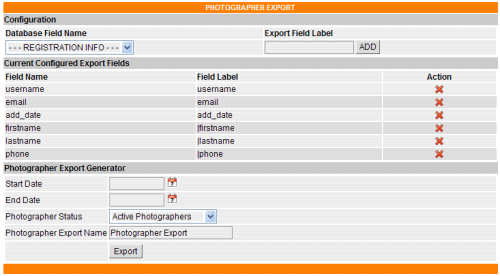
Customer Export Generator
- Enter the Start Date by clicking on the
icon. Select the Month and Year from the dropdown menus and select
a date from the calendar to complete the selection.
- Enter the End Date by clicking on the
icon. Select the Month and Year from the dropdown menus and select
a date from the calendar to complete the selection.
- Select the Customer Status (All, Active or Pending).
- Enter the Customer Export Name.
- Click on the Export button and the system will open a small window that will allow you to Open or Save the Customer Export. The export file is in .csv (comma separated value) format. You can open the exported file in Microsoft Excel® (or any other spreadsheet application).
- To export customers registration data, click on the
-
Customer Configuration
Within the Customer Configuration section you are able to configure the following.
- Click on the Customers
Configuration link in the main menu.

- Enable Agreement Checkbox on Customer Registration Form
When this option is enabled the system will require users to check the Agreement checkbox before being able to submit the registration data to your server. - Enable New Account Email Validation
When this option is enabled the system will send out a "Validation Email" to the user's registered email which will allow them to validate their email address. Once they validate their email address, the system will update their account status to "Active", allowing them to purchase media from the gallery. - Send Welcome Email to New Customer on Approval
When this option is enabled, the system will send out a "Welcome Email" to the user's registered email address when their account status changes to "Active". - Enable FTP Syndication in My Account Section
When this option is enabled, users are able to configure their remote FTP server and upload their purchased instant download files directly to their server. - Enable Online User Log
When this option is enabled, the system will log all visitors that access your gallery. - Minimum Number of Characters for Customer's Username
This is the minimum number characters that customer must use for their username. A value of 7 or greater is suggested.
Note: The system requires the "./config/config.inc.php" file to be writable in order for this function to work. You will need to change the file permission of the "config" directory and its files to 777 before using this function.
- Click on the Customers
MANAGE PHOTOGRAPHERS (CONTRIBUTORS) (Ent. version)
With an Ent. version you are able to allow photographers (contributors)
to upload and sell their own media on your site. The system calculates the
commission due to the photographer based on the sales and commission rate
that is set in the photographer configuration section. The system also generates
sales reports for each photographer and gives you full control over all
photographers and their submissions.
Before photographers are able to upload media to your server, they need
to register to the gallery system. After registering to the system, their
account status will either be in Pending or Active status,
depending on the setting that you have configured in the Photographers Configuration
section. The system provides a number of features that are described below
for you to manage the photographers (contributors).
- Pending Photographers are those that either have not activated their account (if you are using the Enable Photographer Email Validation feature) or have been changed from Active to Pending by you. If you want the photographers to remain in pending status until you manually approve them, then you will need to use the Enable Photographer Email Validation feature and remove the [LINK] call tag from the photographer_activate_email.txt template. If photographers are in Pending mode, they are not able to access the photographer's section, but they are able to access the gallery.
- Active Photographers are able to access all pages of the gallery and the photographer's section, but not the Admin Control Panel.
- Un-approved Media
This section lists all the media that have not yet been approved by you for inclusion in the gallery. Any un-approved media will not be displayed in the gallery.
- Click on the Photographers
Un-approved Media in the main menu to view all
un-approved media that are currently in the database.
- Click on the
icon to view the target media's details.
- Click on the
icon to approve the target media.
- Click on the
icon to delete the target media.
- Click on the Approve All hyperlink to approve
all un-approved media.
Note: Stockbox only displays the photographer's media in the gallery when their status is Approved.
- Click on the Photographers
- Active Photographers
- Click on the Photographers
Active Photographers in the main menu to show all
active photographers that currently reside in the database.
- To import a photographer hi-res image files to the database, click on the icon.
The system will list all hi-res files that are under the "upload/photographer-username"
on the next page.
- To view the photographer's details, click on the
icon.
- To set the photographer's payment status, click on the
icon.
- To view the photographer's sales reports, click on the
 icon.
icon. - To view the photographer's
Portfolio, click on the
icon
- To change the photographer's status to pending, click on the
icon.
- To delete a photographer from the database, click on the
icon. A deleted photographer is not able to access the photographer's
section.
- To email a particular Photographer, click on their email address.

- Click on the Photographers
- Pending Photographers
- Click on the Photographers
Pending Photographers in the main menu to show
all pending photographers that currently reside in the database.
- To view the photographer's details, click on the
icon.
- To set the photographer's payment status, click on the
icon.
- To view the photographer's sales reports, click on the
icon.
- To change the photographer's status to active, click on the
icon.
- To delete a photographer from the database, click on the
icon. A deleted photographer is not able to access the photographer's
section.
- To email a particular Photographer, click on their email address.

- Click on the Photographers
- Photographer Payment History Report
This page is used to display the Photographer's payment history. It also allows you to change the status from Not Paid to Paid.
- Order Id: The order id that includes the Photographers' media sales in it. Click on the link to view the order details.
- Sub Total: The order sub-total.
- Tax: Tax amount for the order.
- Commission Rate: The percentage of the sale that will be deducted before you pay the Photographer.
- Commission Value: The total amount of the sale that will be deducted before you pay the Photographer.
- Photographer Amount: The total amount that the Photographer will be paid for this order Id.
- Order Status: The status of the order. Completed means that payment for the order has been received from the customer.
- Paid Out Status: This indicates if the Photographer has been paid for the order.
- Total Unpaid Amount: The total amount that is owed to the Photographer.
- Payment Method: Here you can add details of how the photographer was paid (e.g. PayPal, Cheque, etc.).
- Payment Method Details: Here you can add details of the Payment Method (e.g. PayPal receipt number, Cheque number, etc.).
- Click on the Mark Paid button to change the
status from Not Paid to Paid.

- Photographer Sales Report
This page is used to display the Photographer's Sales Report.
- Order Id: The order id that includes the Photographer's media sale in it. Click on the link to view the order details.
- Sub Total: Sub Total amount of the Photographer's media sold.
- Rate: The commission rate is the percentage that you withhold from a sale before paying the Photographer.
- Commission: The total commission amount based on the total sale and commission rate.
- Photographer Amount: The total amount payable to the Photographer for this order Id.
- Order Status: The status of the order id, (Pending or Completed).
- Paid Out Status: The paid out status for the selected photographer.
- Payment Method: The payment method entered during the payout process will display here.
- Method Detail: The payment method details entered during the payout process will display here.
- Paid Date: The date that you changed the status
from Not Paid to Paid.

- Email Photographers
Use this function to send an email or newsletter to the photographers.
- Click on the Photographers
Email Photographers in the main menu.
- Select the email format. You can choose from either HTML or Plain Text for the outgoing email.
- Enter the return email address into the "From" field. The return email address is the email address that customers would use if they wanted to reply to your message after receiving it.
- Select the customer group in the "To" drop down list. (Active Photographers, Pending Photographers or All Photographers).
- Enter the Subject of the message.
- Enter the message body into the Message field.
- Click the Send button to send the message.
- Click on the Photographers
- Add Photographer
You can add a new photographer to the system using the Add Photographer function. The system will not verify the photographer's email address even if the “Enable Photographer Email Validation” option is set to do so in the configuration. The new photographer account status will be Active immediately after you click on the Submit button.
- Click on the Photographers
Add Photographer in the main menu.
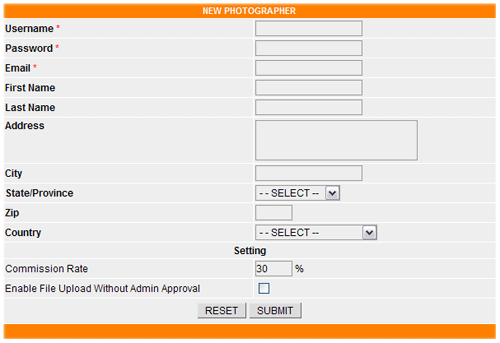
- Fill in all information to the relevant text fields.
- Click the Submit button to add the new photographer to
the database.
- Click on the Photographers
- Password Requests
When photographers request a lost password in the gallery, the system will store the request in the database. The temporary password is deleted once the photographer has activated their new password by clicking on the link in the "Lost Password" email that system sends out to them.
- Configuration
Use this function to configure the default settings that Stockbox will use when a new photographer signs up to your site. You can set the photographer's commission rate and require the administrator to approve newly uploaded media.
- Click on the Photographers
Configuration link in the main menu.
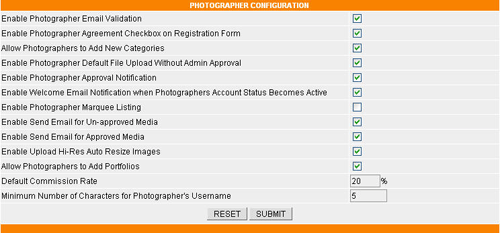
- Enable Photographer Email Validation
Check this box if you want to validate the photographer's email address before their registration is activated. Once a new Photographer registers to the system they will be emailed a link that will activate their account when clicked. If you want the photographers to remain in pending status until you manually approve them, then you will need to use this feature, but remove the [LINK] call tag from the photographer_activate_email.txt template.
- Enable Photographer Agreement Checkbox on Registration
Form
Check this box if you want to display the agreement checkbox on the photographer's registration form. Photographers must check this checkbox on the form to complete the registration process.
- Allow Photographers to Add New Category
When this option is enabled, the system will allow photographers to create new categories in the gallery.
- Enable Photographer Default File Upload Without Admin
Approval
Un-check this box if you want to approve each photographer's uploaded media (otherwise it will automatically be added to the gallery).
- Enable Photographer Approval Notification
Check this box if you want the system to send a notification email to your email address each time a photographer uploads new media to the system.
- Enable Welcome email notification when photographers
account status becomes active
Check this box if you want the system to send a welcome message to the photographer's registered email address when their account becomes active.
- Enable Photographer Marquee Listing
When this option is enabled, the system will display all photographers in the gallery where the [PHOTOGRAPHER] call tag is positioned in the gallery.tpl template. The photographers names will be displayed in scrolling marquee style list.
- Enable Send Email for Un-approved Media
When this option is enable, system will send photographer email when his/her media is remove from the Media Approval List
- Enable Send Email for Approved Media
When this option is enable, system will send you photographer email when his/her media has been approved.
- Enable Upload Hi-Res Auto Resize Images
When this option is enabled, the system will allow photographers to upload hi-res images to the Hi-res Auto Resize Folder in the photographer section. This feature will automatically generate the download files, the display files and the thumbnail files from the uploaded hi-res images. This option is only available when you have ImageMagick© Installed on your server and you have input the correct path in the Media Configuration. Also, the system only supports JPG or JPEG file formats when using this feature. Once you have completed the upload of the hi-res files to this folder, you must use the Import Hi-res
function to import these files
into the gallery.
- Allow Photographers to Add Portfolios
When this option is enabled, the system will allow photographers to add their portfolio to the system. However, their portfolio will remain in Hidden status until the admin changes the status to Active.
- Default Commission Rate
This commission rate is applied for the default setup. This percentage is the amount that will be withheld by you before the Photographer is paid for the sales of their images. Therefore, if the sales total is $ 100.00 and the percentage is set to 30%, then the system will calculate that the amount owed to the Photographer is $ 70.00. You can change this value for an individual photographer by editing their photographer's profile.
- Minimum Number of Characters for Photographer's Username
This is the minimum number characters that photographer must use for their username.
- Click the Submit button to save the changes.
- Click on the Photographers
- Registration
Using this function, Stockbox will collect the photographer's information. Please see the Registration section for more information. Although this functions in the same way as the Customer's Registration form, it is completely independent.
- Click on the Photographers
Registration in the main menu.
- Click on the Photographers
- Photographer Export
To export photographers registration data, click on the
Photographer Export link from either the Photographers
Active Photographers or the Photographers
Pending Photographers sections.
Photographer Export Configuration
- Use this section to tell the system which Registration Fields you want to collect.
- Database Field Name
These fields are from the Photographer Registration section. - Export Field Label
Enter the label that you want for the selected field or leave it blank. When it's blank system will use the field name of selected field - Click ADD to add the new custom field to the export configuration. When a new field name is added it will display in the lower section. You can duplicate any field as desired.
- To remove an Export Field, click on the Delete
icon.
Photographer Export Generator
- Enter the Start Date by clicking on the
icon. Select the Month and Year from the dropdown menus and select
a date from the calendar to complete the selection.
- Enter the End Date by clicking on the
icon. Select the Month and Year from the dropdown menus and select
a date from the calendar to complete the selection.
- Select the Photographers Status (All, Active or Pending).
- Enter the Photographers Export Name.
- Click on the Export button and the system will open a
small window that will allow you to Open or Save the Photographer
Export. The export file is in .csv (comma separated value) format.
You can open the exported file in Microsoft Excel®
(or any other spreadsheet application).
- Photographer Hi-res Import
This function allows you to import photographer hi-res images from photographer's directory under the "upload" directory to the system. When a new photographer is added to the system, it will automatically create a new folder under the "upload" folder with the photographer's username. You can take advantage of this feature, by creating an FTP account for each photographer and grant the permission on their folder only. If you are not sure how to create FTP accounts, you will need to contact your hosting provider for assistance. In doing so, each photographer would be able to use their FTP account to upload their hi-res images to your server. Using an FTP client to upload hi-res images to the server is more efficient than doing so via your web browser. The admin user or photographer is able to import the hi-res images to the gallery as desired once their hi-res images have been upload to the server.This feature will automatically generate the download files, the display files and the thumbnail files from the high-resolution images that are uploaded to the "upload" folder. This option is only available when you have ImageMagick© Installed on your server and you have input the correct path in the Media Configuration. Also, the system only supports JPG or JPEG file formats when using this feature. The system will only generate the download files when the uploaded hi-res image satisfies the minimum dimension that are configured in the Product Type section. When there is no instant download configured for a particular product type, the system would recognize it as a print or delivery product and it would not generate the download files for these product types. Also, if you don't have any product types added when importing the hi-res images to the gallery, the system won't be able to generate the download files and you will need to manually generate the download files for the display images later if you want to offer them.
Download Images will be generated based on the instant download dimensions that you have configured for the particular product type. A product type with no instant download dimensions will be recognized as print product, so no download image will be generated for that product type.
Display images will be generated based on the "Resize To" dimension that is configured in the Media Configuration section.
Thumbnails will be generated based on the Thumbnail Configuration that is in the Media Configuration section.
- Click on
the
Import Hi-res
icon for the particular photographer in the active photographer list.

- Click on the
icon to import the particular hi-res image.
- You are able to choose the available product types for the selected hi-res image and the category where the images will be displayed.
- Click on the SUBMIT button to import
the selected hi-res images to the
gallery. The system will generate the download files based on the
Instant Download Configuration that you
configured for the particular product type, in the Product
Manager
Product Types section..
- Click on
the
Import Hi-res
- Photographer Contact Mapping
The system needs the photographer's first name and last name to display in the gallery when you enable the "Enable Photographer Marquee Listing" option in the Photographer Configuration.
- Click on the Photographers
- Select the Mapping Field name in the drop down list and click on the SUBMIT button to save the changes.

LIGHTBOX MANAGER
When customers add media to their lightbox, the system stores the selected media information in the database along with the customer's information such as IP Address, username and date of the action. The lightbox manager section allows you to view all the information that was captured during this process. The displayed sort order of the Lightboxes or related information can be changed by clicking on the column header title links.
- User's Lightboxes
- Click on the Lightbox
User Lightboxes link in the main menu to view a listing
of all user's lightboxes.
- The Username column shows the visitor's username.
- The IP Address column shows the visitor's IP Address.
- The Added Date column shows the date the lightbox was created.
- Click on the
icon to delete the target lightbox session id and media.
- Click on the
icon to empty all of the lightboxes that are currently in the database.
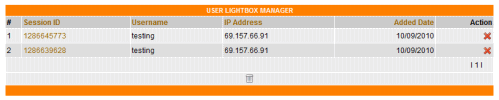
- Click on the customer's lightbox Session Id
to view its contents.
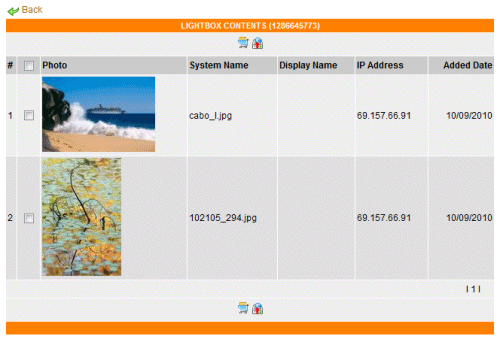
- With the Ent. version you are able to create a new order or upload the selected download files to a Remote FTP server.
- Select the images that you want to create an order for and
click on the Create Order
icon to create the new order.
- Select the instant download images that you want to upload to
the remote FTP server and click on the FTP Syndication
icon. You will be able to add the FTP login details on the
following screen.
- Click on the Lightbox
- Send Lightbox Logs
The Send Lightbox Logs allows you to manage the user's Send Lightbox Emails. On this page you can see where the email was being sent to and other related information.
- Click on the Session Id link to view the contents of the sent lightbox.
- With the Ent. version you are able to create a new order or upload the selected download files to a Remote FTP server.
- Select the images that you want to create an order for and
click on the Create Order
icon to create the new order.
- Select the instant download images that you want to upload to
the remote FTP server and click on the FTP Syndication
icon. You will be able to add the FTP login details on the
following screen.
- Click on the View Detail
icon to view the details of the sent email.
- You can delete a particular Send Lightbox
Log by clicking on the Delete
icon
for that log.
- Click on the
Empty
icon to empty all of the lightboxes that are currently in the database.
- Configuration
Use this configuration page to manage the lightbox section in the gallery.
- Click on the Lightbox
Configuration link in the main menu
- Maximum Number of Media for Each Lightbox
Enter the Maximum Number of media that you allow users to add to each lightbox. - Enable Multi-Lightbox Feature (Ent. version)
When this option is enabled, the "Require Login to Use Lightbox" and "Require Login to Send Lightbox" options are automatically enabled. The system will allow users to create as many lightboxes as desired in the gallery, but each lightbox still relies on the Maximum Number of Media for Each Lightbox value set above.
- Require Login to Use Lightbox
When this option is enabled, the system will require users to login before using the Lightbox Manager (Ent. version) or adding media to their active lightbox. - Require Login to Send Lightbox
When this option is enabled, the system will require users to login before sending their lightbox. - Enable Send Request a Quote Feature
(Ent. version)
When this option is available the "Request a Quote" icon will display on the Lightbox page of the gallery.
- Allow User Comments in Lightbox (Pro. & Ent.
versions)
When this option is enabled, the system will allow users to add comments to the media in their lightbox . The comments will be stored in the database until the user removes them from their lightbox.
- Enable "Add to Cart" Button in Lightbox
(Pro. & Ent. versions)
When this option is enabled, the system will allow users to purchase images directly from their lightbox. Users can add as many media to their lightbox as they want and then add them to their shopping cart directly from their lightbox, without first having to visit the media detail page for each image. This feature is designed to streamline the purchase process for images that users have already added to their lightbox. - User Lightbox Session Life (in days)
The system will remove any user lightbox contents from the database based on the value entered. If you don't want the system to remove the user lightbox contents, then you should enter 0 into the input field. The number of days is calculated from the date that the lightbox was created.
- Click on the Lightbox
SHOPPING CART MANAGER
The Shopping Cart Manager section allows you to control the customer's shopping cart media. When customers add media to their shopping carts, the system will keep these media until the order is either completed or the customers remove them from their cart. Each customer has their own unique session id associated with shopping cart. The displayed sort order of the Shopping Carts or related information can be changed by clicking on the column header title links.
- Click on the Shopping Cart link in the main menu to view a listing of all user's shopping carts.
- Click on the customer's shopping cart Session Id to view its contents.
- The Username column shows the customer's username.
- The Media Count column shows how many media that are in the particular shopping cart.
- The Record Date is the date the shopping cart record was added to the database.
- Click on the
icon to delete the target shopping cart session id and its contents
from the database.
- Click on the
icon to empty all shopping carts that are currently in the database.

BANNER MANAGER (Ent. version)
The Banner Manager allows you to add images to the system and have them displayed in a slide show on the gallery home page. The system only supports image formats for the banner.
Note: The default banner size is 713 px x 225 px (width x height). You should resize your images to this size prior to adding them to the system.
Adding Banner Images
- Click on the Banner Manager link in the main menu.
- Click on the Add
icon.
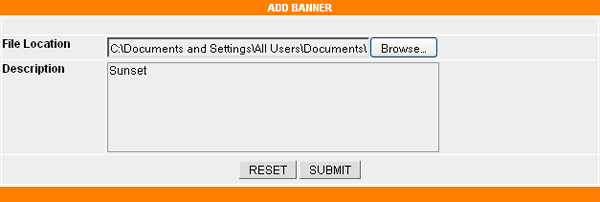
- Browse to banner image on your desktop computer.
- Enter the Description for this image or leave it blank.
- Click
on the SUBMIT button to upload the selected image and add it to the
system.
- Once images are added to the database, their default status will be Hidden. You will need to change this to status to Active by clicking on the Hidden link in order for it to be displayed in the gallery.
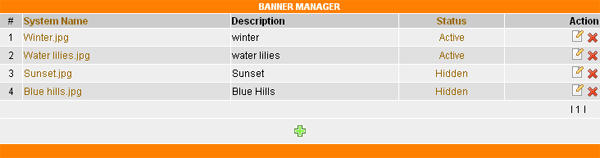
- To edit a particular image, simply click on the Edit
icon
for the selected image.
- To delete a particular image from the banner images, simply click on the
Delete
icon
for the selected image.
PORTFOLIO MANAGER (Ent. version)
The Stockbox system doesn't restrict what file format you can upload to the portfolio as long as you have opening code for it. You can add images, flash files or video to the portfolio. The system will use your opening code for the selected file format.
Add a New Portfolio:
- Click on the Portfolio Manager link in the main menu.
- Click on the Add Portfolio
 icon to add
a new portfolio.
icon to add
a new portfolio.

- Portfolio Category Name
The system will display this name to identify the particular portfolio. - Portfolio Category Icon
The system will display this icon in the Featured Portfolio section of the gallery. - Photographer Profile
Select the photographer that the portfolio belongs to, or you can click on the "Add Photographer Account Profile" to add a new photographer.
Portfolio Manager:

- Icon
The system will display this icon in the Featured Portfolio section of the gallery. - Portfolio Name
Click on the Edit
icon to change the Portfolio Name.
Photographer
This column displays the username of the photographer. - Featured
To feature a portfolio in the Featured Portfolio section, click on the NO link. - Status
When a new portfolio category or portfolio media are added to the system it will be assigned Hidden status. You will need to change this to status to Active by clicking on the Hidden link in order for it to be displayed in the gallery. - Action
- To Add or Edit Media to a portfolio, click on the
Add/Edit Portfolio Media
icon. There are two ways to add media to
the portfolio (see below for details).
- To Add Photographer Portfolio Profile, click on the
Add Photographer Portfolio Profile
 icon.
icon. - To Update Photographer Portfolio Profile Content, click on the
Update Photographer Portfolio Profile Content
 icon.
icon. - To edit a portfolio, click on the Edit
icon.
- To delete a portfolio, click on the Delete
icon.
Add Media to a Portfolio
There are two ways to Add Media to a particular portfolio.
1. From media in the gallery.
2. By uploading media from your desktop.
- Add Media from the Gallery
Before you can add gallery media to a portfolio, you will need to select them in the Media Manager.
- Click on the Portfolio Manager link in the main menu.
- Click on the
Add/Edit Portfolio Media
icon.
- Click on the
Add Portfolio Media from Gallery
 icon.
If you have not already selected media in the Media Manager
you will need to do so by clicking on the Add Media
icon.
icon.
If you have not already selected media in the Media Manager
you will need to do so by clicking on the Add Media
icon. - Browse to the target category that contains the portfolio images.
- Tick the checkboxes to select the media files and click on
the Global Add Media
icon
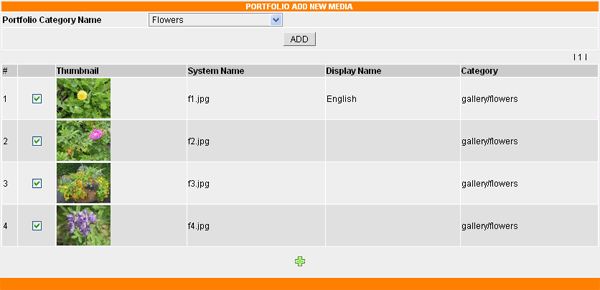
- Select the Portfolio Category in the Drop Down List. You must have created a portfolio category in order to add media to it.
- Click on the ADD Button to add the selected media to
the selected Portfolio.
- Add Media Manually
- Click on the Portfolio Manager link in the main menu.
- Click on the Add/Edit Portfolio Media
icon to add new
media to the portfolio.
- Click
on the Add Portfolio Media Manually
icon to add new media
to the portfolio.

- Click on the Browse button to select the media from your desktop computer.
- Enter a Description or leave it blank.
- Click on
the SUBMIT button to add the new media to the selected portfolio.
Add Portfolio Profile Content
- Click on the Portfolio Manager link in the main menu.
- To Add Photographer Portfolio Profile, click on the Add Photographer Portfolio Profile
- To Update Photographer Portfolio Profile Content, click on the Update Photographer Portfolio Profile Content

Profile- Enter your Profile Content and click on the SUBMIT button to save the changes.
Profile Media- To insert images into the Portfolio Profile Content, you will need to upload them first to the server by clicking on the Upload Profile Media
GENERAL CONFIGURATION
The General Configuration section contains the majority of the available configuration settings. There are other gallery configuration sections that the system uses which are listed at the end of the General Configuration section below.
Using the General Configuration section
- Click on the Configuration
General link in
the main menu.

- Mail Server Configuration
Stockbox can use either of two methods to send out mail. The Default Mail Server or SMTP Server.
- Default Mail Server
Stockbox recommends that you use the default mail server to send out mail to customers. No options are needed if you select to use the default mail server. - SMTP Server
If for some reason you don't have a mail system installed on your server, you can use the SMTP method. The system will need a little more time to send out emails if you are using this method. It needs time to connect to the SMTP Server before sending out emails. To use this method, select SMTP Server in the drop down list and fill in all the information for your SMTP mail server configuration in the text fields. Click the
icon to test the connection before saving the settings. If the entered
info is correct, you will receive an email that is sent to the email
address in the "Notification Email Address" text field.
- Default Mail Server
- Cookie Manager
When a customer visits the gallery, a cookie is saved on the customer's computer to keep track of their actions. Stockbox uses this cookie for the shopping cart and the lightbox session id.
- Cookie Lifespan (in days)
The time that the cookie will last on the customer's computer. The time is reset whenever the customer returns to the gallery. To change the lifespan of the cookies that are set by the system, enter a new value here.
- Cookie Lifespan (in days)
- User Session
Stockbox will automatically logout customers after the specified time has elapsed. This will prevent unauthorized access if the customer does not logout.
- Session Timeout (In Minutes)
Enter the desired value here. The default value is 30 minutes.
- Session Timeout (In Minutes)
- Execution Memory Limit
When the system is executing functions, it needs memory to allocate data. By default, the system is only able to allocate the memory buffer that is configured in the servers php.ini file. Sometimes, the system needs a larger memory buffer to execute a function like zipping all download files. You may need to increase this number to a larger value to avoid a memory allocation problem. Depending on your server's configuration, it may not allow you to set the memory buffer during run time, but most servers do allow it.
- Download Manager
- Enable Download Link Verification on Purchase
If this option is enabled and the product type is assigned with a instant download link, the system will check to make sure the assigned download link exists on the server. If it doesn't exist on the server, users will not able to purchase this product type. This option only works when the display and download files are on the same server where the Stockbox software is installed, it will not work with the Remote FTP server feature. - Maximum Download Zip Limit File Size When using memory buffer
This number will vary depending on your server and PHP "memory limit" configuration. When users are trying to download their order, the system will zip all of the downloaded files in the order and store them to the server memory. If the download files are large and your server has insufficient resources to handle them, the server will return an error. To prevent this from occurring, the system will zip all of the files when it detects that the download file size exceeds this configured value to the actual zip file on your server instead of using the server memory to allocate these files. This method will take longer than the Memory Allocation method and it will use extra space on your server to store the zip package, but it will prevent the out of memory issue. The default number is 32MB and if you experience an out of memory issues at this setting you should reduce this value. - Remove download links after # of days
Input the number of days that you want the system to maintain the active download links in the user's "My Account" area. After the specified number of days, the system will de-activate the links. The number of days are counted from the day after the customer made their purchase. - Download Readme File
You can specify the readme file that will be included with the zipped download file(s). The system will list all files in the ./template/language-name/ folder in the dropdown menu. By Default, it will ignore any files with a "tpl", "html", and "css" file type extension. If you would like to use one of these file types. then you will need to remove it from the IGNORE_README_EXT variable in the ./config/config.inc.php file.
- Enable Download Link Verification on Purchase
- Registration configuration
The system will use these configurations during the customer and photographer (Ent. version) registrations.
- Notify me when someone signs up
To be notified when some one signs up (registers), check this box, otherwise leave it un-checked. The notification email will be sent to the email address that is entered in the “Notification Email Address” field. The notification email contents can be modified by editing the notify.tpl template in the template section. - Notification Email Address
The system will use this email address to send the notification email when a new user signs up. - Webmaster Name
The system will use this name for the notification email.
- Notify me when someone signs up
- Invoice Configuration (Pro. & Ent. versions)
The system will use these configurations upon the completion of a customer's order.
- Enable Notification Invoice Email
If this box is checked, an invoice will be sent via email to you and to the customer when an order is completed. To disable this feature, un-check the box. The invoice email contents can be modified by editing the invoice.tpl template in the template section - Enable bcc Invoice
To bcc (blind carbon copy) the invoice email to another email address, tick this checkbox. - bcc Invoice Email Address
Enter the email address where the bcc email will be sent. This feature could be used to automatically send a copy of the invoice to your print shop or order fulfillment centre. - Mobile Notification Email Address
Enter the email address for your mobile phone. The system will send a new order notification to the mobile phone email address that you input. You can obtain the mobile phone email address through your service provider. - Enable Show Invoice Thumbnail
By checking this box, a thumbnail image will display on the invoice. - Enable Show Media Path
By checking this box, the category path will display on the invoice. - Invoice Start Number
Enter the starting value for the invoice number. The system will use this number as the starting value when a new order is created in the system. Any subsequent order will have the invoice number increased by one.
- Enable Notification Invoice Email
- Send To Friend
- bcc Admin a copy of SEND TO FRIEND email
Check this box to have a blind carbon copy of the sent message emailed to your notification email address. - Enable SEND TO FRIEND Logs
When this option is enable, the system will log the SEND TO FRIEND email to the database. You can view the log detail in the Media Manager
Send To Friend Logs and Lightbox Manager
Send Lightbox Logs sections.
- bcc Admin a copy of SEND TO FRIEND email
- Date Format Configuration
- Date Format: There are two types of date format
that you can choose from.
mm/dd/yyyy: The date will be displayed in month/day/year format.
dd/mm/yyyy: The date will be displayed in day/month/year format.
- Date Format: There are two types of date format
that you can choose from.
- Slide Show Configuration
- Enable Slide Show
To enable slide show in your gallery, tick this checkbox. Otherwise leave it unchecked. - Slide Show Timeout
Enter a value as desired (the value must be numeric). The lower the number, the faster the images are changed in the slide show. - Enable Slide Show Media Limitation
When users activate the slide show, the system will query all images in the selected category and output that data to the browser. If the selected category contains many images and your server has a low memory limit, it will return an error. To prevent this issue, you should enable this option. When this option is enabled, the system will only query the images on the current page for the slide show instead of the entire selected category of images.
- Enable Slide Show
- Currency Configuration
- Currency Symbol
Enter the desired currency symbol to be used. This currency symbol will be used throughout the system. - Currency Symbol Prefix
Before Price: The system will display the currency symbol before the price.
After Price: the system will display the currency symbol after the price. - Currency Decimal Separator
Choose the symbol you want to separate the decimal part of the price for your currency (e.g. 10.00 or 10,00).
- Currency Symbol
- Default Payment Method Configuration (Ent. version)
- Payment Option
Choose the Payment Options for your site. There are three options available as follows.
PPP Only: (Pay Per Purchase) If this option is selected, the system will only allow users to pay when checking out their order.
Subscription Only: If this option is selected, users are only able to checkout when they have purchased one of your subscription products and changed their Payment Method to the purchased subscription.
PPP & Subscription: If this option is selected, users are able to checkout regardless of whether they have purchased a subscription or not. The system will detect the appropriate payment method for your customer during the checkout process. - Default Payment Method
Choose the default payment method for your site. This option is only available when you choose PPP & Subscription for the Payment Option.
Subscription: the system will use the subscription option as the default payment method. If users have subscribed to your subscription, it will use the active subscription for the purchase. If the customer's subscription will not cover the order total, then the system will provide a PPP option for them to continue to checkout.
PPP: the system will use the PPP (Pay Per Purchase) option as the default payment method. If users have subscribed to one of your subscriptions and they wish to use that for their purchase, then they will need to switch to the active subscription before being able to checkout with their prepaid subscription.
- Payment Option
- System URL Path Configuration
- Gallery Landing Page
Select the Stockbox Gallery Page for your gallery landing page. This page (URL) will be loaded when users click on the HOME link or button of the gallery or when the user enters the gallery using the URL.. - Stockbox Full URL Path
In order for the system to function correctly, this URL PATH must have a valid path. The system should obtain the FULL URL during the installation process, but for some reason your server may return an incorrect path. You should only modify this URL if it's incorrect. The correct path is: http://www.yourdomain.com/path-to-stockbox, no forward slash at the end of the URL. - User Logout Redirect URL
Enter the FULL URL path where users will be redirected to upon logging out from their account. This URL will apply to all users, administrators, photographers and customers. - Home Public Breadcrumbs Link
Enter the path you want the "Home" breadcrumb link to be associated with. By default it will point to the index.php (main gallery page). If you want it to point to another page on your site, please enter the correct path into the input text field. Please provide the absolute path for Stockbox SEO compatibility. e.g. http://www.yourdomain.com/path-to-stockbox/index.php.
- Gallery Landing Page
- Meta Tag Default Configuration
- Gallery Page Title
Enter the default meta page title by clicking on the icon.
The page title will be displayed at the top of your web browser.
It will also display on the search results page of the search engines.
The page title is an important part of effective SEO. With the Pro.
& Ent. versions you can add dynamic data to the
category and media page titles in your gallery. - Gallery Meta Description
Enter the default meta description by clicking on the icon.
The meta description will be displayed on the search results page
of the search engines. With the Pro. & Ent. versions you can add
dynamic data to the category and media page meta descriptions in
your gallery. - Gallery Page Keywords
Enter the default meta keywords by clicking on the icon.
With the Pro. & Ent. versions you can add dynamic data to the category
and media page meta keywords in your gallery.
- Gallery Page Title
- Other Configurations
- Enable License Agreement Checkbox on Shopping Cart Page
By checking this box, the system will require users to tick the agreement checkbox on the shopping cart page before continuing to checkout their order. The agreement text can be edited in the Template Manager section. The template name is "checkout_agreement.tpl". - Enable Individual Logout
By default system will unset all current sessions when you logout in the current session. This including admin section, gallery section and photographer section. If you wish system to log you out from the session that you're current using then tick this checkbox. - Offline Form Credit Card
There are three options that you can choose from in the dropdown list.
Collect Credit Card & Other Payment Method: When this option is selected, the system will provide an option in the Offline Form which allows users to choose to not provide credit card information. You should only use this option if you accept other payment methods such as a bank transfer or you allow your customers to pay by cheque (check).
Collect Credit Card Only: When this option is selected, the system requires users to enter credit card information in order to submit an order. The credit information is encrypted before being stored in the database. To view the customer's credit card information you will need to go to the Order Manager section and click on the "Complete" or "Processing" hyperlink in the status column for the particular order.
Remove Credit Card Option: When this option is selected, the system will remove the credit card section from the Offline Form so that users are not required to enter their credit card info in order to submit an order. Users are only required to enter their personal info to submit order. - Enable Rollover Navigation Menu Button
By checking this box, the menu rollover feature will be enabled. To replace the rollover image (or the static menu image) you can simply upload new button images to the images folder while maintaining the existing file names. - Credit Card Expiration Year Range
This value will be used for the credit year range in drop down list for the offline form. - Enable IPTC Metadata Feature
Tick this checkbox when you want system to import IPTC metadata to the database when image is being imported to the database. If your media doesn't have IPTC metadata embed then you should not tick this checkbox, as this will reduce the loading time. - Enable IPTC Metadata Mapping
Tick this checkbox, system will auto map the IPTC metadata to the media property page when image being imported to the system. The IPTC metadata mapping is under the IPTC Configuration section. - Admin Panel Query Row Limit
Each time the system fetches data from the MySQL database, it will use this number to ask the DB to return the maximum number of rows. This number will be used throughout the admin control panel. - Remove Pending Orders After
When users checkout an order, the system will create pending orders in the database. These orders will remain in the database until users complete the checkout or the admin manually deletes them. Use this field to tell the system to delete these orders automatically based on the #of days. This would free up some server space. - Remove Private Gallery Temporary Session After
When users are using the Send to Friend feature in the private gallery, the system will create a temporary session and store it in the database. These sessions will remain in the database until you delete them. Use this field to tell the system to delete these session based on the # of days specified. When the session is deleted from the database, users will no longer be able to access to the gallery using that session ID. Enter 0 when you don't want system to delete them from the database. - Gallery Navigation Menu
There are three options for you to choose from.
- Use Gallery Navigation Menu Button with Rollover Option Enabled
When this option is selected, the system displays the navigation button in the gallery with Rollover option enabled. When you mouse over the navigation menu button it will change to the rollover button state. - Use Gallery Navigation Menu Button with Rollover Option Disabled
When this option is selected, the system will only display the navigation buttons in the gallery with no Rollover option enabled. When you mouse over the navigation button, it won't change to the rollover state. - Use Gallery Navigation Menu Dropdown
When this option is selected, the system will use a dropdown menu for the navigation menu function. You will be able to view the sub-menu items when you mouse over a particular menu button. This option is ideal for a site with many pages.
- Use Gallery Navigation Menu Button with Rollover Option Enabled
- Show Private Categories in the Public Gallery
By default, private galleries (protected categories) do not display in the Public Gallery, so users need to login the private gallery section in order to view their private galleries. When this option is checked, the system will list the Private Category name in the public gallery section and allow users to click on it to login. - Show Category with no Media
When this option is checked, the system will list the category in the gallery regardless of whether it contains media or not. - Maximum Number of Logs per User (Ent. version)
When the system stores user log data in the database, it will use this number to limit the number of rows to be logged for each user. Use this option to avoid filling all of the available MySQL database space. Enter 0 if you want the system to store the logs regardless of the amount of server space
used.
- Enable License Agreement Checkbox on Shopping Cart Page
Click on the SAVE button to save your new configuration settings.
GALLERY CONFIGURATION SECTIONS
- Administrator Configuration (Ent. version)
Administrator Configuration gives you options to enable or disable the Blacklisted IP feature, and manage the Malicious Characters feature for your gallery. To go to this configuration, click on the Administrator
Configuration link in the main menu.
- Customer Registration Configuration
The Customer Registration Configuration allows you to collect customer's information during the registration process. You can either tell the system to require a user's input for the specified field or have the user input optional. To go to this configuration section, click on the Customers Registration
link in the main menu.
- Customer Configuration
The Customer Configuration gives you an option to validate the customer email address, send a welcome email to customer upon approval and require users to read the Terms & Conditions before registering to your site. To go to this configuration, click on the Customers
Configuration link in the main menu.
- General Configuration
The General Configuration contains the majority of the available configuration settings. To go to this configuration section, click on the Configuration
General
link in the main menu.
- Invoice Configuration (Pro. & Ent. versions).
The Invoice Configuration allows you to control the target customer's registration form fields that will be displayed on the invoice page or in the invoice email that is sent to customers. To go to this configuration section, click on the Order Manager
Invoice Manager link in the main menu and then click on the
Invoice Configuration link.
- IPTC Configuration (Pro. & Ent. versions).
This IPTC Configuration allows you to control how the IPTC metadata information is displayed and utilized by the system. To go to this configuration section, click on the Media Manager
IPTC Configuration link in the main menu.
- Language Configuration (Ent. version)
Language Configuration gives you the option to set the language selection display style in the gallery. To go to this configuration section, click on the Language Manager
Configuration link in the main menu.
- Lightbox Configuration
Lightbox Configuration gives you options to manage user lightboxes. To go to this configuration section, click on the Lightbox
Configuration link in the main menu.
- Media Configuration
The Media Configuration allows you to set the media properties such as Quick Preview Info, Thumbnail size, Watermark, etc. To go to this configuration section, click on the Configuration Media
link in the main menu.
- News Configuration (Ent. version)
The News Configuration allows you to manage the way the News items are displayed by the system. To go to this configuration section, click on the Configuration
News link in the main menu - Payment Gateway Configuration
The Payment Gateway Configuration is used to tell the system which gateways will be available to users when they make a purchase. To go to this configuration section, click on the Payment Gateway link in the main menu.
- Photographer Registration Configuration (Ent. version).
The Photographer Registration Configuration allows you to collect the photographer's information during the registration process. This configuration is similar to the Customer Registration configuration, but they are completely independent. To go to this configuration section, click on the Photographers
Registration
link in the main menu. - Photographer Configuration (Ent. version)
The Photographer Configuration gives you options to validate the photographer's email address, require photographers to read the Terms & Conditions before registering to your site, enable new category creation in your gallery, set default commissions etc. To go this configuration section, click on the Photographers
Settings
link in the main menu. - Product Type Configuration
Product Type Configuration gives you options to configure the product type display style in the gallery, enable product options, subscriptions, virtual CD. To go to this configuration section, click on the Product Manager
Configuration link in the main menu.
- RSS Configuration (Pro. & Ent. versions)
The RSS Configuration allows you to manage the content feed settings. To go to this configuration section, click on the Configuration
RSS link in the main menu.
- Promotion Configuration (Pro. & Ent. versions)
Promotion Configuration gives you the option to enable or disable the promotion feature on your site. To go to this configuration, click on the Promotion
Configuration link in the main menu.
- Rights-Managed Configuration (Ent. version)
Rights-Managed Configuration gives you options to make adjustments to the license price. To go to this configuration section, click on the License Manager
Configuration link in the main menu.
- Sales Report Configuration (Pro. & Ent. versions)
The Sales Report Configuration allows you to tell the system to collect customer's registration, billing and shipping information and display them on the sales report. To go to this configuration section, click on the Order Manager
Sales
Reports link in the main menu.
- Search Configuration
Search Configuration gives you options to set the Search Method for the Quick Search function, configure options in the Advanced Search Form and other search options. To go to this configuration section, click on the Search Manager
Configuration link in the main menu.
- Shipping Configuration
The Shipping Configuration section allows you to set the shipping cost that the system will use during the checkout process. You can use this configuration section to set Flat Rate Shipping, Zone Shipping, etc. To go to this configuration section, click on the Shipping Manager
Configuration
link in the main menu. - Tax Configuration
The Tax Configuration allows you to set the tax method that the system will use to apply tax to customer orders. To go to this configuration section, click on the Tax Manager
Configuration
link in the main menu.
In order to be able to sell your media, you will need to create at least one product type. Stockbox supports an unlimited number of Product Types. You can use this function to create as many product types as you need and then using the Global Pricing feature you can assign a price to a product type (or multiple product types) for an entire category of images (or the entire gallery) or you can assign a price to the product type for each media individually (by editing the individual media) in the Media manager section. The system also supports instant downloads. This type allows your customers to instantly download a media file as soon as the payment has been completed. Please note: The Add to Cart button will not display until at least one product type has been assigned a price.
With the Ent. version you can also offer subscription products, packages of products and product options (e.g. Photo Frames) in your gallery.
- Product Types
Below are the steps required for you to create new product types.
- Click on the Product Manager
Product
Types.
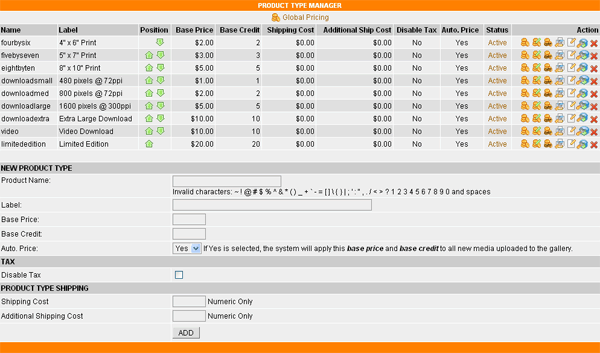
- Product Name
The product name is used by the system's database, so it should not contain any special characters, spaces or numbers.
e.g. !@#$%^&*()_+|}{":?><1234567890-=\][';,./
- Label
You can use this field to describe the Product Type. The product label is what the user will see in the gallery and it may contain special characters, spaces, numbers and even HTML code.
- Base Price
The system uses this value to pre-populate a base price in the Media Properties and Global Pricing sections.
Note: This base price will not apply to the media until you use the
Global Update Product Price & Credit feature to update all media.
- Base Credit (Ent. version)
The system uses this value to pre-populate a base credit value in the Media Properties and Global Pricing sections. You need to enter a value in this field in order to be able to create the product type. If you don't want to enter an actual value then you can just enter 0 (zero).
Note: This base credit will not apply to the media until you use the
Global Update Product Price & Credit feature to update all media.
- Auto. Price
When a product type is set to Auto. Price, system will automatically assign this product type with its base price and credit (Ent. version) to newly uploaded media. You should only use this option when the Product Type is available for all of your media.
Note: This only applies to new media, the existing media will not be affected.
- Disable Tax
If you don't need to tax customers for this Product Type, tick the checkbox. The system will not charge tax for items purchased with this product type.
- Shipping Cost & Additional Shipping Cost
Enter the shipping cost and additional shipping cost for this product type. The additional cost would be applied on the second and subsequent items with the same product type. To use the Product Type Shipping Cost, you must select "Use Product Type Shipping Method" in the Shipping Manager section of the admin control panel. Click here for other Shipping Methods.
- Click the Add button to add the new Product Type to the database.
Other Product Type Functions
- Product Type Status
The system only allows users to purchase a Product Type when its status is "Active". By default, newly created Product Types have an "Active" status. To change the status, click on the "Status Value" of the particular Product Type in the Status column. - Global
Pricing (Pro. & Ent. versions)
Use this function to assign pricing to selected Product Types, to selected categories of media in one operation. You can also use the same function to apply pricing to all Product Types, to all categories of media in one operation.
- Click on the Global Pricing link or its
icon at the top center of the Product Manager
Product Types section.

- All Product Type Checkbox
Tick this checkbox, to tick all of the current Product Type checkboxes at once. This will apply pricing to ALL Product Types. - Specific Product Type Checkbox
Tick the specific Product Type checkboxes that you want to apply pricing to. This will apply pricing only to the selected Product Types. - All Categories checkbox
Tick this checkbox, to tick all of the current category checkboxes at once. Pricing will be applied for all "checked" Product Types to ALL categories in the gallery. - Specific Category Checkbox
Tick the specific category checkboxes that you want to apply pricing to. Pricing will be applied for all "checked" Product Types only to the selected categories in the gallery. - Include Sub-Categories Checkbox
Tick this checkbox if you want the system to auto check or un-check all sub-categories of the selected category when the parent category is checked or un-checked. - Click the Submit Button to update the Base Price
and Base Credit for the selected Product Types to the selected
Categories.
Remove Products/Pricing
If you would like to remove a product type from display, you can enter a price of 0.00.
- Click on the Global Pricing link or its
- Product Type Price & Credit Update (Pro. &
Ent. versions)
This function is similar to the Global Pricing function, but instead, it only allows you to apply Global Pricing for the target Product Type only.
- Click on the Product Type Price & Credit Update
icon for the target Product Type
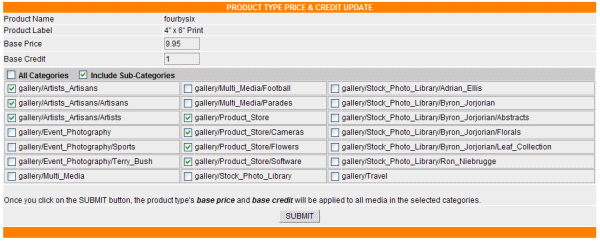
- Change the Base Price and Credit as desired.
- Tick any category checkboxes that you want to assign the
product pricing to and click the Submit Button. The system
will update all of the media in the selected categories with
the target Product Type's Base Price and Credit values.
Remove Products/Pricing
If you would like to remove a product type from display, you can enter a price of 0.00.
- Click on the Product Type Price & Credit Update
- Global Price Adjustment (Pro. & Ent. versions)
Use this function to adjust the existing pricing (or credit cost) for media with the target Product Type assigned, without interfering with other media that don't have the selected Product Type assigned.
- Click on the Global Price Adjustment
 icon of the particular Product Type in the Action Column

- Select the Price / Credit Adjustment Method. There
are two methods available.
Addition (+): The system will add the "Adjustment Amount" to the media's current price for the selected Product Type.
Subtraction (-): The system will subtract the "Adjustment Amount" to the media's current price for the selected Product Type. - Select the Adjustment Type for adjustment, Price or Credit (Ent. version).
- Enter the "Adjustment Amount", numeric only (no currency symbol).
- Adjustment Amount Options. There are two options available:
Fixed Amount: When the Fixed Amount option is selected, the system will add or subtract the entered value from the Product Type's current Price or Credit amount.
Percentage: When the Percentage option is selected, the system first calculates the new amount based on the value entered in the "Adjustment Amount" field and then Adds or Subtracts it from the current price for the selected Product Type. - Tick the "Set to ..." checkbox if you want system
to reset the Selected Product Type Price to 0 if the new adjusted
value is less than 0. This will prevent the possibility of having
a negative price.
Note: The system will not update media which are not assigned to the Selected Product Type. The system will record all the past adjustments in the database for future reference.
- Click on the Global Price Adjustment
- Product Type Discount Configuration (Ent. version)
Use this function to give discounts to customers that make bulk purchases.
- Click on the Discount Configuration
 icon for the particular Product Type.
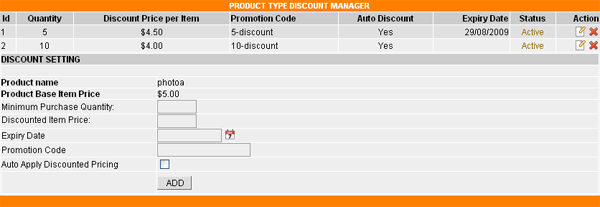
- Minimum Purchase Quantity
Enter the minimum quantity that the customer needs to purchase before the discount will be applied. - Discounted Price per item
Enter the discounted item price. This price will apply if the quantity purchased by the customer is equal to or greater than this value. - Expiry Date
Enter the date that the discount pricing will expire. - Promotion Code
Enter the Promotion Code. - Auto Apply Discounted Pricing
If this option is selected, the system will automatically apply the discounted pricing if the minimum quantity is purchased. The customer does not have to input a promotion code, but you will need to input a code when creating the discounted pricing so that the system can track when it is used. If this option is NOT selected, customers will need to enter the promotion code during the checkout process to have the discounted pricing applied to their purchase. - Status
when the discounted product pricing is setup, it will have a "Hidden" status by default. The discounted pricing will not be available until you click on the "Hidden" link to change the status to "Active".
- Note: You can create multiple discounts for the same
Product Type, based on different purchase quantities. The one
with the greater discount will be applied to the order.
- Click on the Discount Configuration
- Printing Code Configuration (Ent. version)
Use this function to assign the Print Fulfillment Product Codes that you have from the print provider to the Stockbox Product Type. When the system process the order via the print provider, it will use this code instead of the Stockbox Product Type name.
- Click on the
 icon for the particular product type to assign the printing code to
it.
icon for the particular product type to assign the printing code to
it. - Click on the
icon to Update Printing Code.

- Enter the Provider Product Code for the selected Stockbox Product
Type name and click the SUBMIT button to save.
- Click on the
- Instant Download Configuration
 (Ent. version)
Use this function to configure the instant download dimensions and its PPI for the Product Type. This configuration will be used for hi-res images import function. The system will only recognize a particular product type as an instant download type when it has an instant download configuration set to it. The download file will be generated based on the configuration that you set on this page.
- Longest Dimension
(pixels)
The system will resize the longest dimension of the hi-res image to the size entered in this field. The system will maintain the aspect ratio of the images during the resize process.
e.g. If you enter 500 Pixels and the hi-res image size is 1772px by 1186px. Then the system will re-size the image to 500px by 334px for its download file for this Product Type - PPI
The system will set this PPI to the download image when it resizes the original image. - Use Original File
Tick this checkbox when you want the system to use the original image for the download file. You must specify the "Resolution Minimum Value" when choosing this option. The system will only assign this product type when the hi-res image minimum dimension meets this minimum value.
- Click on the SUBMIT button to save instant download configuration.
- Longest Dimension
(pixels)
- Edit Product Type
- Click on the
icon for the particular Product Type
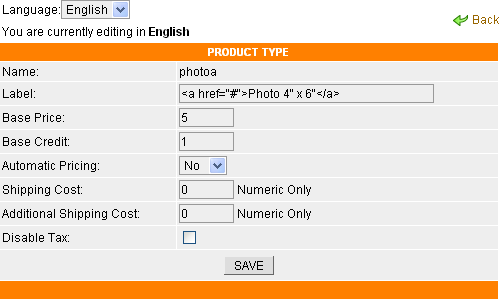
- Fill in all new values to the available fields and click
SAVE. With the Ent. version you are able to label the
Product Types in the other available languages by clicking on
the respective language in the Language drop down list.
- Click on the
- Delete Product Type
Click on the
icon for the particular Product Type to delete it. You will need
to confirm the Delete Action by clicking on the
icon on the confirmation page. Stockbox recommends that you should
set the particular Product Type to be "Hidden" (by clicking
on the "Active" link for that Product Type) instead of deleting
it from the database. This will prevent missing data errors if customers
have already purchased media with this Product Type.
- Product Type Position
To move a Product Type's position up or down in the display list, click on the or
or
 respectively. This is the order that the system will use to display
the Product Types on the media detail page of the gallery.
respectively. This is the order that the system will use to display
the Product Types on the media detail page of the gallery.
- Click on the Product Manager
- Product Options
(Ent. version)
This feature allows you to sell accessories for your product. You can use this feature to sell photo frames etc. Using the Product Options Manager you can create as many product options as required. Stockbox will display them in the gallery for customers to purchase. When displaying the media details page, the system checks for the product type and product options. If there are product options available for the target media’s product types, the system will display a button to allow the customer to purchase the available product options. Note: The Product Option feature is not available when a customer is using a subscription payment method.
Before using this feature, the system needs at least one product type to be created in the database.
- Click on the Product Manager
Product Options link in the main Menu.
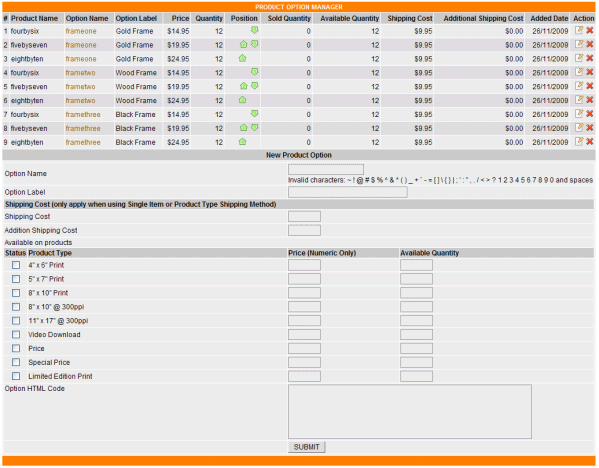
- Option Name
The Option name is used by the system's database, so it should not contain any special characters, spaces or numbers.
e.g. !@#$%^&*()_+|}{":?><1234567890-=\][';,./
- Option Label
You can use this field to describe the Product Option. The product label is what the user will see in the gallery and it may contain special characters, spaces and numbers.
- Shipping Cost & Additional Shipping Cost
Similar to the single item shipping or product item shipping calculation, the system will apply the same formula to calculate the shipping cost for this product option.
Note: the system only applies this shipping setting when you're using the "Single Item Shipping Method" or "Product Type Shipping Method" in the Shipping Manager section of the admin control panel.
- Available Products
You need to tell the system which product types are available for this new product option. The system will not allow a customer to purchase this product option if there are no product types associated with this product option. If you have correctly configured the product types, the system will display them here for you to set the price and their available quantities.
- Status
Check the check box if this new product option is available for this product type. - Product Type
The product type label. - Price (Numeric Only)
The price per item for this new product option. - Available Quantity
Product options available quantity. The system only allows customers to purchase if the sold quantities plus the customer's input quantities are less than the available quantity.
- Status
- Option HTML Code
The system requires you to input the Product Option HTML code. This HTML code is used to display in the gallery when a customer wants to preview it before purchasing. There are two tags that are required by the system.
- [MEDIAIMAGE]
The system will replace this tag with the actual media image.
- [OPTION_ADD_TO_CART]
The system will replace this tag with the "add to cart" button.
- Product Option Sample

- The following code was used to create the sample frame above.
The images used for the frame can be found in the sample_frame.zip
file in the images folder. The files should be uploaded to the
tmp folder, if you would like to use the sample frame on your
site. When you create a new frame, you can store the image files
in the location of your choice as long as you have the correct
file path in the html code.
<table border="0" cellspacing="0" cellpadding="0">
<tr>
<td align="left" valign="top"><img src="tmp/topleft.gif" alt="" width="22" height="22" /></td>
<td style="background-image:url(tmp/top.gif)"> </td>
<td align="right" valign="top"><img src="tmp/topright.gif" alt="" width="22" height="22" /></td>
</tr>
<tr>
<td style="background-image:url(tmp/left.gif)"> </td>
<td>[MEDIAIMAGE]</td>
<td style="background-image:url(tmp/right.gif)"> </td>
</tr>
<tr>
<td align="left" valign="bottom"><img src="tmp/bottomleft.gif" alt="" width="22" height="23" /></td>
<td style="background-image:url(tmp/bottom.gif)"> </td>
<td align="right" valign="bottom"><img src="tmp/bottomright.gif" alt="" width="22" height="23" /></td>
</tr>
</table>
<table border="0" cellspacing="0" cellpadding="0" align="center">
<tr><td align="center">[OPTION_ADD_TO_CART]</td></tr>
</table>
- [MEDIAIMAGE]
Other Product Option Functions
- To edit an existing product option click on the Edit
Icon.
- To delete an existing product option click on the Delete
Icon.
- Click on the Product Manager
- Product Subscriptions
(Ent. version)
You can use the subscription feature to offer customers the ability to subscribe to your gallery before purchasing products or instant download media. Once the customer has purchased a subscription they can then use it to make "purchases" without having to pay at the checkout. There are two types of subscriptions available.
- Duration Subscription
Customers who subscribe to this subscription type are able to purchase products or downloads for any media that has product types that are available for this subscription. Customers will not able to use a subscription if it has expired.
- Credit Subscription
This subscription type is similar to the “Duration Subscription”, but instead of checking for the expiration date, the system will check for available credits to use. The available credits are the customers Subscription Credits minus the used credits. The customers can’t use their subscription when their remaining credits are zero.
Note: If the product type is a delivery type then the customers will only need to pay for the shipping cost and not the media cost. If the product type is NOT a delivery type, then the customers will not be charged during the checkout process. Therefore, Stockbox recommends that you use the subscription product for instant download product types only, to avoid the customer having to pay for shipping charges upon checkout.
Using Subscription Functions
- Subscription Type
Type of subscription, Duration or Credit type.
- Subscription Name
Name of subscription. This name should not contain any spaces or invalid characters.
- Subscription Description
Description of the subscription. Use this field to describe this subscription. The system will use this description in the gallery instead of the subscription name.
- Subscription Price
Subscription price.
- Subscription Period / Credit Number
Depending on the Subscription Type selected, the system will display the Subscription Period or Credit Number field. If the subscription type is Duration, then the Subscription Period will be shown. Otherwise the Credit Number will be shown. If the Credit Subscription Type is selected the system will display the "Expire After" field to allow you to set the number of days after the purchase that the subscription will remain valid.
- Available on Product Type
Tick the desired product type for this subscription. The customers are only able to purchase or download any media that has this product type assigned to it.
- Click the Submit button to add the new Subscription.
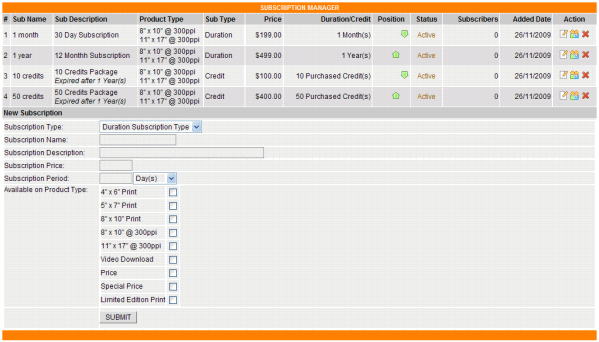
- To Delete an existing subscription click on the
Icon.
The system recommends that you should set the subscription status to "Hidden" instead of deleting it from the database. This will prevent missing data issues.
- To View subscribers for a particular
subscription click on the
 Icon
Icon
With this function you are able to view sales reports for the subscribers. The system also calculates the photographer’s commission, if customers used their subscription to purchase or download a photographer's media.
- To move a Subscription's position up or down in the display
list, click on the
or
respectively. This is the order that the system will use to display
the Subscriptions on the Products page of the gallery.
- To hide a subscription from users, click on the "Active"
hyperlink in the Status column.
Customers are not able to purchase a subscription when its status is "Hidden".
- To activate a "Hidden" subscription, click on the "Hidden" hyperlink in the Status column .
Merging Subscriptions
- The System only allows users to have one active credit
subscription at a time. When users purchase another credit
subscription while their current subscription is still active, the
system will merge the two subscriptions together so that there is
only one active credit subscription. The subscription which has
the longer expiration date will be used for the “merged to”
subscription.
Product Packages (Ent. version)
Use this feature to create Product Packages to sell a set of images for a set price.
- Click on the Product Manager
Product Packages link in the main menu.
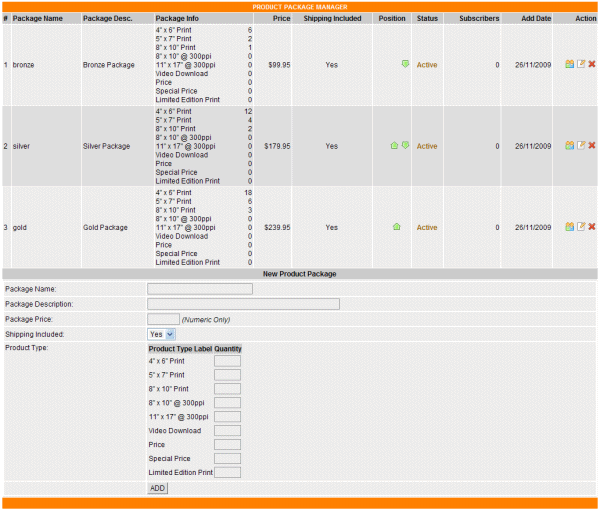
- Package Name
Name of the package. You should not use any invalid characters "~`!@#$%^&*()-_+=\|]}{["':;??><,." or spaces.
- Package Description
Description of package. Use this field to describe the package.
- Package Price
Price of package.
- Shipping Included
If your price already includes the shipping cost, select Yes otherwise select No. If "Yes" is selected, the system will not charge shipping during the checkout process, otherwise the system will charge the shipping cost based on the Shipping Method that you configured in the Shipping section.
- Product Type
Enter the quantity for the desired product type. The system will check to make sure that the quantity that is purchased by users matches the quantity entered. If all quantities match, then users will be able to check out their order.
- Click Add to add new product package
- Click on the
Icon to view its subscribers.
- Click on the
Icon to edit the particular product package.
- Click on the
Icon to delete the particular product package.
- Click on the "Active" hyperlink to hide the particular product package from users.
- Click on the "Hidden" hyperlink to display the particular product package for users to purchase.
- To move the position up or down in the display
list, click on the
or
respectively. This is the order that the system will use to display
the Subscriptions on the Products page of the gallery.
- Duration Subscription
- Virtual CD
(Ent. version)
Using the Virtual CD feature you can sell group of selected media as a package. You can add as many media to the Virtual CD as desired and assign a download link to it, or set it as a delivery type. The system also provides you with options to set the shipping cost and tax.
- New Virtual CD
- Click on the
icon on the Virtual CD Manager page.
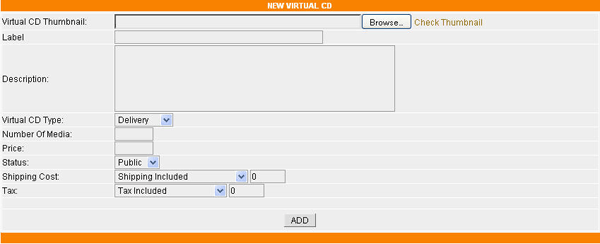
- Click Browse to choose a Virtual CD thumbnail image
from your desktop computer.
- Click the "Check Thumbnail" link to make sure the
thumbnail name is unique on the server.
- Enter the Virtual CD Label. The system will display
the label in the gallery for the name of the Virtual CD.
- Enter the Virtual CD Description. The system will
display the description on the Products page in the gallery.
- Select the Virtual CD Type. There are two types available,
Delivery and Download. When a Virtual CD is a delivery type,
the system won't ask for its media Product Type, but it allows
you to set the shipping cost for it. Alternatively, when a Virtual
CD is a download type, you must assign a download link to the
Virtual CD either as a "Single Download Package" or select the
Instant Download Product Type in the list. If the Product
Type option is selected, then you must make sure there is
a download file in the "download" directory for each media file
in the Virtual CD with the Selected Product Type prefix. The
hierarchy of the download links must be the same as you configured
for the other media in the gallery (you need to use the same
naming convention and category structure as when assigning download
links using the Global Enable
Download Links feature).
- Enter "Number of Media". The system only allows users
to purchase a Virtual CD when you have added the number of media
that matches this entered value.
- Enter the Virtual CD Price.
- Shipping Cost: this option is only available when
the Virtual CD is a Delivery Type. You can choose either the
Current Shipping Method, Fixed Price or No Charge.
- Select the Tax Method. You can either choose, Disable
Tax, Fixed Tax or Current Tax Configuration method.
- Click Submit to add the new Virtual CD. If all data
is valid, the system will create the new Virtual CD in the database
and it will be shown in the Virtual CD Manager which allows
you to update it later if needed. The status of the new Virtual
CD will be "Public", but you will not be able to sell
it until its number of media are filled.
- Click on the
- Add Media to Virtual CD
- Click on the
icon on the Virtual CD Manager page.
- To add media to a particular Virtual CD, click on the Add
Icon that is in the Action column of the particular Virtual
CD.

- to browse to sub categories or the media in a category,
click on the category name.
- to add all media in a particular category, click on the
Add
icon on the right side of the screen. The system will only add
the number of media to the virtual CD until its "Number of
Media" has not been reached. Once the number has been reached,
the system will ignore additional media.
- to add multiple categories to a Virtual CD, tick on the
checkbox for the particular categories and then click on the
icon.
- Click on the
- Virtual CD Media
To remove media from a Virtual CD, click on the
icon for the particular Virtual CD.
- Empty Virtual CD
To empty the contents of a Virtual CD, click on the
icon for the particular Virtual CD.
- Edit Virtual CD
To edit a Virtual CD, click on the
icon for the particular Virtual CD.
- Create Virtual CD Order
To create a Virtual CD order, click on the
icon for the particular Virtual CD. Fill in all the relevant info
in the next screen and continue to create the new order for your
customer.
- Delete Virtual CD
To delete a Virtual CD, click on the
icon for the particular Virtual CD. You will need to confirm the
action before the system deletes it.
- New Virtual CD
- Configuration
Use this function to configure the Gallery Product Types.
- Click on the Product Manager
Configuration
link in the main menu.
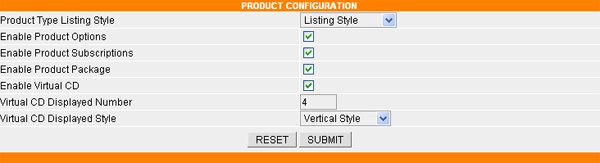
- Product Type Listing Style
Listing Style: the system will display the available Product Types in a list. With this method, customers are able to choose multiple Product Types for a particular media at the same time.
Drop Down Style: the system will display the available Product Types in a drop down list. With this method customers are only able to choose one Product Type for a particular media at a time. - Enable Product Options
When this option is enabled, the system will allow users to purchase Product Options (e.g. Photo Frames) for a particular media when its Product Type has an associated Product Option. - Enable Product Subscriptions
When this option is enabled, the system will allow users to purchase subscription products and use the purchased subscriptions to pay for their orders / downloads. - Enable Product Package
When this option is enabled, the system will allow users to purchase Product Packages and use them to pay for their choice of media based on the Product Package configuration. - Enable Virtual CD
When this option is enabled, the system will allow users to purchase Virtual CDs. - Virtual CD Display Number
Enter the number of Virtual CDs to be listed in the Virtual CD column in the gallery. - Virtual CD Display Style
Select the display style for virtual CD listing.
- Click on the Product Manager
LICENSE MANAGER (Ent. version)
With the Enterprise version you can use this section to create and assign Rights Managed (RM) licenses for your digital media.
You could think of the license as a tree which has multiple branches and each branch has its own price and sub-branches.
The license tree example below illustrates how the license function works:
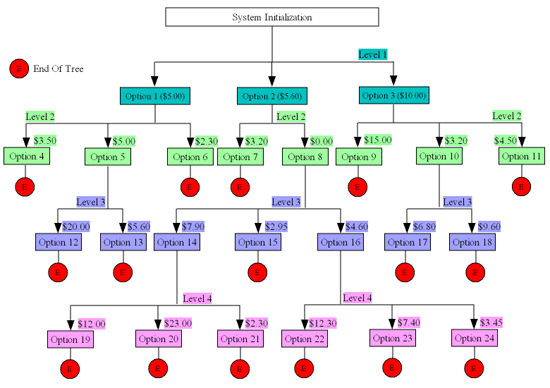
- The system displays all option(s) of the same level of the same
branch in the same drop down list. According to the above image,
Option 1, Option 2, Option
3 are in the same drop down list. The system also provides
the option to allow you to label the level option.
- The Option value is only displayed for a user to select if it has
a price of at least $0.00 or a positive number.
- The Option values are displayed based on their parent (rely
on) level. According to the above image, Option 4,
Option 5 and Option 6 are only displayed
in the drop down list of the Level 2 when users select
the Option 1 in the Level 1 drop down
list. The Option 9, Option 10,
Option 11 are displayed when users select Option
3 in the first level drop down list.
- The cost of the selected license is a SUM of all
the selected Options in the license tree. According
to above image the cost for Option 2
Option 8
Option 16
Option 22
is $22.50.
- The E presents for End of Tree, no other option
values will be displayed when this option value is selected.
- Stockbox only allows users to add the RM media to the basket if
all the license options in all drop down menus have been selected.
- Stockbox initializes the drop down option value with all of the options for the parent (rely on) level. According to the above image the Option 1, Option 2, Option 3 are pre-filled in the level 1 drop down list. The other level drop down lists will display N/A (not available).
There are three steps to configure the RM License Calculator feature.
- License Data (set options)
License data, is data that will be displayed in the drop down list for customers to select, based on the license that you created.
- License Manager (set pricing)
The License Manager allows you to create the license by assigning a value (cost) to the license data that was entered in the License Data section.
- Set Media License Type
You will need to set the media license type to Rights Managed for all media that you want to utilize the Media License Manager feature.
- Use the License
Data section to set license options (Ent. version)
- Click on the License Manager
License Data link in the menu function.
- License Option Label is a label that is used to describe the data in the License Option Value field (e.g. Image Use).
- Rely On: Each drop down list must rely on a
parent option level.
The TOP level means the data in this drop down list will be initially filled with the value that is entered in the License Option Value for users to choose from. - License Option Value are values that are used
for this License Option.
You can enter more values as long as they are separated by a ";" semicolon (e.g. Retail Products;Editorial;Multimedia;Advertising;Display/Signage;Internal Company Use;Marketing). - Click the Submit button to save the changes.
Note: If the Option level will not be used by all options in the level that it is set to "Rely On", then an Option value of None should be added.
The following is an example license setup with nine option levels:
Option1:
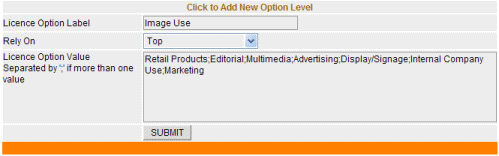
Option 2:

Option 3:
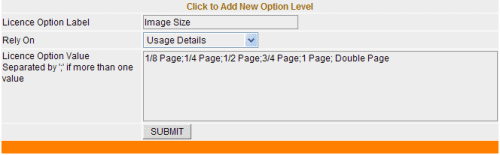
Option 4:
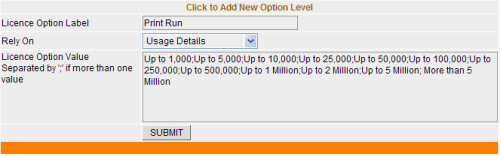
Option 5:
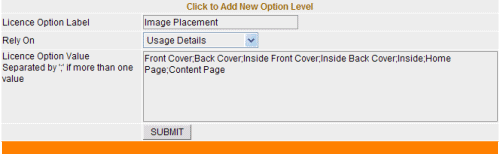
Option 6:
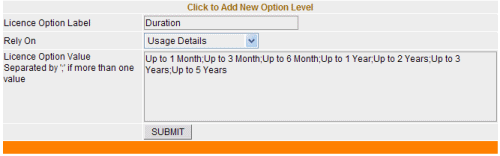
Option 7:
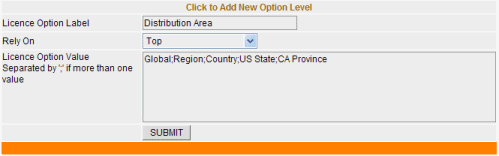
Option 8:

Option 9:
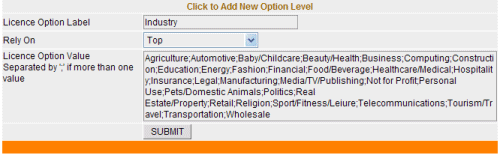
The following image shows the Option Level Manager with the nine option levels created above:
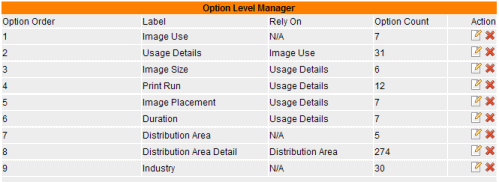
- To edit an existing License Data Option, click on the
icon of the target license option.
- To delete an existing License Data Option, click on the
icon of the target license option.
Note: all data for this license option will be removed from the database. Stockbox will also remove data from License values that you have already created.
- Using the example in the image above:
- The Image Use, Distribution Area and Industry will be initially filled with options when the license is displayed to the user.
- The Details Of Use options will only be filled when the customer selects an option from the Image Use field.
- The Image Size, Print Run, Placement and Duration will only be filled with options once the customer has selected an option from the Details Of Use field.
- The Distribution Area Detail will be filled
when the customer selects an option from the Distribution
Area field.
- The License Option selection displayed in the user interface
for a RM image will look like the following.
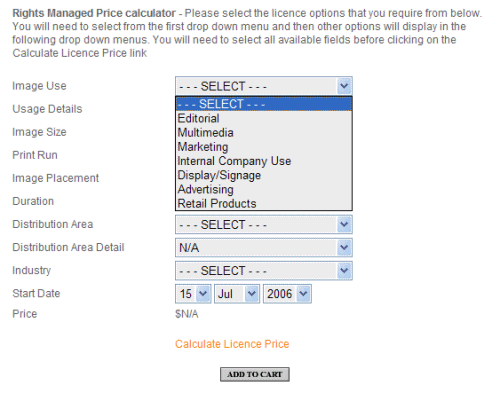
- The Start Date drop down lists are added by the system to allow
users to select the starting date of the license use.
- Click on the License Manager
- Use the License
Manager to set pricing for the license options (Ent. Version)
This feature only applies to the Ent. version. The License Manager section relies on the License Data section. If you have not configured and input the License Data Options in the License Data section, please do so before using this section. Once you have configured the license options in the license data section you can now add pricing to the options. In this example we will add a pricing value of $ 0.00, for demonstration purposes. You can add your own values as required.
- Click on the License Manager
License Manager link in the main menu.
- Stockbox will display all the license data options that are in the Main (TOP) level.
- Price the target license tree.
- Click the Submit button to submit the license price.
- You are only able to browse to its sub-option when its price
is $0.00 or greater than $0.00.
Note: If a sub-option does not apply to the parent option then 0.00 should be entered for the "None" value.
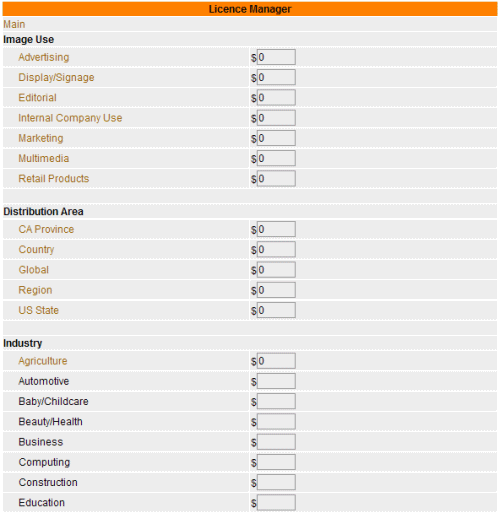
- Once the Main level options have be priced (with at least a
$ 0 value), the sub level options can be priced by clicking on the
main option. For this example we will follow the Advertising option
and price the sub-options (by clicking on the Advertising link in
the screen above).

- After clicking on the Consumer Magazine link in the screen above,
further options are displayed (see below).

- The screen below is displayed after clicking on the Double Page
link. This is the end of the tree as there are no more options relying
on the Double Page option level.

- The license price is calculated when customers select all the
data in the license tree that you created.
- The Price is the total price of the tree that the customer selected.
- Click on the License Manager
- Set Media License
Type
By default all uploaded media has the media license type set to N/A. You will need to set the media license type to Rights Managed for media that will use the Media License Manager feature.
- To set the Media License Type individually:
- Click on the Media Manager
Media Manager link in the main menu.
- Browse to the target category.
- Click on the
icon to edit the target media.
- Enter all information into the provided text fields.
- Select the Rights Managed option in the Media License Type drop down list.
- Click the Submit button to set the License Type to this selected Media.
- Continue for other media as required.

- Click on the Media Manager
- To set the Media License Type for an entire category:
Stockbox also allows you to set the License Type for all media in the target category at once using the Global Update function in the Media Manager section.
- Click on the Media Manager
Media Manager link in the main menu.
- Browse to the target category.
- Click on the
icon.
- Click on the Rights Managed in the drop down list.
- Click the Submit button to set all media
of the target category to the selected Media License Type.
- Click on the Media Manager
- To set the Media License Type individually:
-
Import License Data
Using this feature, you can import an existing license to the Stockbox system. Before importing license data to the system, you must ensure that your data is a valid MySQL query (.sql file format) and you should also backup your current database data before proceeding. The import file must only contain three tables, vss_license_data, vss_license_levels, and vss_license_price. The system will empty data from the existing license tables and replace it with the new data values.

To import the license data, click on the Browse button to browse to your local .sql file and click on the SUBMIT button. The system will empty the above tables from the database and import new data from the file selected.
-
Adjust License Price
With this feature you can adjust the current pricing of an existing license tree. The system will add or subtract the adjustment amount to the existing configured pricing according to the options below. The adjustments will be reflected in the gallery when a customer makes a purchase using the RM pricing calculator.
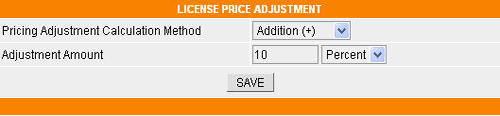
Select the Pricing Adjustment Calculation Method in the drop down list. There are two methods available. If the Addition option is selected then system will add the Adjustment Amount to the current price of the license tree, otherwise the system will subtract it from the current price.
Enter the Adjustment Amount and select either the "Fixed" or "Percent" option in the drop down list.
e.g.
Selected License Price is: $100
the License Adjustment was configured as follows
- Addition
- 10
- Percentage
Then the new displayed price would be as follows
Adjustment Price is 100 * 0.1 = 10
the new price is 100 + 10 = $110.
-
Quote Request Logs
The Quote Request Logs section will display all user license requests that have been submitted from the gallery. To delete a particular license, simply click on the Delete icon.
-
License Configuration
- Don't Display Rights-Managed Pricing Calculator
When this option is enabled, the system will remove the license selection and "Add to Cart" button from the rights-managed media detail page. Users won't be able to make license selections or purchase this media from the gallery. - Enable License Selection in media "Request a Quote"
When this option is enabled, the system will display the license selection on the Request a Quote page in the gallery. Users are able to select the license from the drop down list before sending their request. The request will be logged in the database and you can view the user license request history in the Quote Request Logs section.
- Don't Display Rights-Managed Pricing Calculator
PROMOTION MANAGER (Pro. & Ent. versions)
This section allows you to add a new promotion or delete an existing one. The Promotion Code can either be created and given out to customers to enter during the checkout process or it can be created to be automatically applied if the purchase amount meets the defined criteria. The promotion can be an exact amount or a percentage of sales.
To create a new promotion code:
- Click on the Promotions link in the main menu.
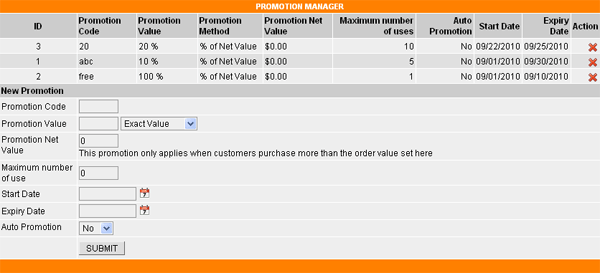
- Enter the Promotion Code in the promotion code field. The system will only apply the discount to the purchase if the Promotion Code is a match (it is not case sensitive).
- Enter the Promotion Value. This is the amount that you want to give as a promotion (discount), if the code entered by the customer is verified by the system. Select if you want the Promotion to be an Exact Value or a % of Net Value (total before tax and shipping).
- Enter the Promotion Net Value. The Net Value will be used to determine if the promotion code can be used for this purchase (minimum order total to qualify for the promotion). Stockbox will only apply the discount to the purchase if the customer's purchase is greater than or equal to the Promotion Net Value.
- Enter the Maximum number of Uses for this promotion. The system will only allow a user to use this promotion until the maximum value is reached.
- Select Auto Promotion
If Yes is selected, Stockbox will apply the promotion code automatically if the conditions set above are met. The customer does not have to input a code, but you will need to input a code when creating the promotion code so that the system can track when it is used.
If No is selected, the customers will need to enter the promotion code during the checkout process to have the discount applied to their purchase. - Enter the Start Date by clicking on the
icon.
Select the Month and Year from the dropdown menus and select a date
from the calendar to complete the selection. The Promo. Code will not
be active before this date.
- Enter the Expiry Date by clicking on the
icon.
Select the Month and Year from the dropdown menus and select a date
from the calendar to complete the selection. The Promo. Code will not
be active after this date.
- Click the Submit button to add the new promotion
code.
e.g.: You enter:
Promotion code: XYZ123
Promotion value: 25 You also need to select the promotion method in the dropdown list (Exact Value).
Promotion net value: 125
Auto promotion: No
In this example the system will only deduct the promotion value from the customer's purchase if they purchase at least $125 (before tax and shipping). The promotion value is calculated based on the selected promotion method. If the promotion method is "Exact Value", the system will deduct the exact value entered in the promotion value field. Otherwise the promotion value will be calculated based on the specified percentage of the net value.
100% Discounts to offer FREE products or downloads
You can create a discount of 100% which will allow customers to download files for free, or you can allow them to download now and invoice them later.
Promotion Configuration:

- Enable Promotion Code
Tick this checkbox to enable the promotion code feature in your gallery. - Enable Multiple Promotion Codes on the same Purchase
Users are able to use multiple promotion codes for the same order when this option is enabled.
SHIPPING MANAGER
Stockbox can charge customers a shipping cost during the checkout process. The shipping cost is based on the shipping configuration that is set in the Shipping Configuration section. There are five shipping options that are available for you to choose from.
- Disable Shipping Feature
- Use the Single Item Shipping Method.
- Use the Flat Rate Shipping Method.
- Use the Flat Rate Zone Shipping Method (Pro. & Ent versions).
- Use the Product Type Shipping Method (Pro. & Ent versions).
Configuration
Before configuring the shipping cost for your gallery you need
to tell the system which shipping method you are going to use. Use this
function to set the shipping method for your gallery.
- Click on the Shipping Manager
Configuration link in the main menu.
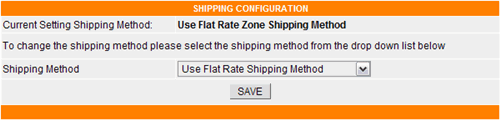
- Shipping Method
The shipping method is the method that the system will use for all orders.
- To change the Shipping Method select the method in the Shipping
Method drop down list and click the SAVE button.
- Disable Shipping Feature
If you don't offer any products that require shipping, you can select this option in the Shipping configuration section. Stockbox will not charge shipping on any purchases.
-
Use Single Item Shipping Method
If you want to charge a shipping cost based on each individual media purchased then this option should used.
Note: You need to enable the Single Item Shipping Method setting in the Shipping Configuration in order for this function to work.
- Click on the Media Manager
Media Manager link in the main menu.
- Browse to the category that contains the desired media.
- Click on the
icon to edit the media's properties.
- Enter the Shipping value.
- Enter Additional Item Shipping value.
- Click Submit to set the shipping cost for this media.
- The Additional Item Shipping Cost value is only applied on the
second and subsequent item for this media. e.g. a customer adds
3 of the same media to their shopping cart where the Shipping Cost
and Additional Shipping Cost are $5 and $3 respectively. Stockbox
will calculate the shipping cost as follows:
Total Shipping Cost = 5 + (3-1)*3 = $11.00
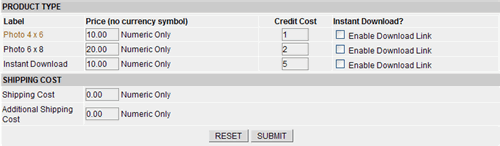
- Click on the Media Manager
- Use Flat Rate Shipping Method
The flat rate shipping manager section allows you to set a flat rate for shipping cost based on the total amount of the customer's order before tax is added, instead of assigning individual shipping values in the media manager.
Note: You need to enable the Flat Rate Shipping Method setting in the Shipping Configuration page in order for this function to work.
- Click on the Shipping Manager
Flat Rate Shipping link in the main menu.
- Enter a Price From value.
- Enter a Price To value.
- Enter a Shipping Cost for this range.
- Click the Add button, to add the new flat rate shipping range.
- To remove a range, click on the
icon.
You can create as many ranges as necessary. Stockbox charges customers based on the purchase total before tax.
e.g. You create the flat rate shipping as follows:
The Price From and Price To are $0.00 and $49.99 respectively with a shipping Cost of $10.00.
The $10.00 will only be applied if the customer purchases items that total between the $0.00 - $49.99.

- Click on the Shipping Manager
- Use Flat Rate Zone Shipping Method (Pro. & Ent.
versions)
The zone shipping is similar to the flat rate shipping method except it allows you to set different shipping costs for different geographical zones. Customers need to select their shipping zone during the checkout process. The cost is calculated based on customers zone selection.
Note: You need to enable the Flat Rate Zone Shipping Method setting in the Shipping Configuration page in order for this function to work.
- Click on the Shipping Manager
Zone Shipping link in the main menu.
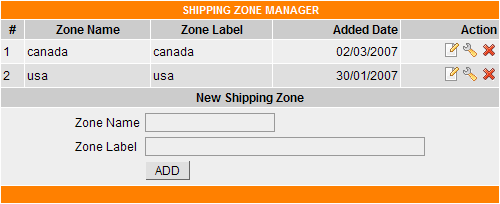
- Zone name
The zone name must be unique for every zone. It should not contain any invalid characters or spaces. - Zone Label
Using this field to describe this zone. The system will use this label to display to users for selection. - Click Add button to add the new zone .
- Click on the
icon to edit an existing shipping zone.
- Click on the
icon to delete an existing shipping zone.
- Click on the
icon to set the cost for the target zone.
Zone Configuration
- Click on the
icon to launch the Shipping Zone Configuration page.

- Enter a Price From value.
- Enter a Price To value.
- Enter a Shipping Cost for this range.
- Click the Add button to add the new flat rate shipping range.
- To remove a range, click on the
icon.
If you have correctly configured the shipping zone, the system will display the available zone options in a drop down menu on the shopping cart page.

- Click on the Shipping Manager
- Use Product Type Shipping Method
The Product Type Shipping Method allows you to charge the shipping cost based on a Product Type. You should have at least one Product Type existing in the database in order to use this feature.
Note: You need to enable the Product Type Shipping Method setting in the Shipping Configuration page in order for this function to work.
- Click on the Product Manager
Product Types link in the main menu.
- Click on the
icon to edit an existing Product Type (or you can add a new one
if needed).
- Enter the Base Price for this product type.
- Enter the Base Credit value for this product type.
- If you want to disable Tax on this product type tick the Disable Tax checkbox.
- Enter the Shipping Cost for this product type.
- Enter the Additional Shipping Cost for this
product type. The Additional Shipping Cost is only applied on the
second and subsequent items with the same product type.
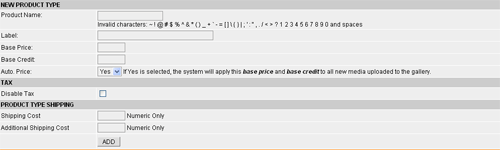
- Click on the Product Manager
TAX MANAGER
The Tax Manager section allows you to tax any order based on a defined set of variables. The available variables are drawn from the registration form fields. Tax will be applied (if the user's registration details match the defined variables) to the order total after any discounts have been applied but before any shipping charges are added.
There are two tax methods that Stockbox uses:
- Sales Tax (added) Method - this method applies an additional amount of tax to the order total.
- Sales Tax (included) Method (VAT system) - this method includes the tax amount in the order total.
- Configuration
Use this configuration section to tell the system which tax method it should use in the gallery.
- Click on the Tax Manager
Configuration link in the main menu.
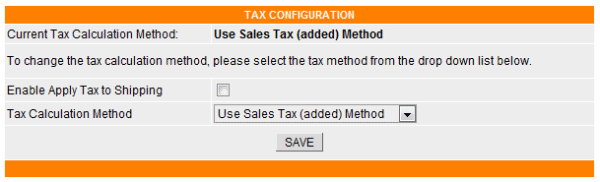
- Enable Apply Tax on Shipping (Pro. & Ent. versions)
When this option is enabled, the system will also apply tax on the Shipping Cost as well as the Product cost.
- Tax Calculation Method
The Tax Method is the method that Stockbox uses to tax customers. There are three options available:
- Disable Tax System
The system will not tax any order if this option is selected. - Use Sales Tax (added) Method
The system will tax customers based on the total purchase amount and the settings that you configured in the Use Sales Tax (added) section. - Use Sales Tax (included) Method (VAT
system)
The system will separate the already included tax from the sub total. The amount that is calculated is based on the settings that you have configured in the Sales Tax (included) manager section.
- Disable Tax System
- Click on the Tax Manager
-
Sales Tax (added) Method
You need to choose the "Use Sales Tax (added) Method" method in the Tax Configuration section for this function to work.
- Click on the Tax Manager
Sales Tax (added) link in the main menu.

- If you don't see any values in the first drop down list (firstname), please see the Registration Form section to configure the form.
- Select the value in the first drop down list.
- Select the value in the second drop down list (operand).
- Enter the value that will be matched to the customer's entered value. The system will only work correctly if the value is an exact match. We recommend that you should use a drop down type for this form field, so that customers are only able to select the value that you have entered here, instead of entering their data into a field.
- Enter the tax percentage value.
- Click the ADD button to add the more tax criteria.
e.g. Assuming that you want to charge the customers who are in the State of Illinois (IL) 8.5%, all other states 5% and outside of the United States 0% then do the following. We assume you have the State and Country fields setup in the Registration Form section.
Creating IL State Tax
- Select the State in the first drop down list.
- Select Equal in the second drop down list.
- Enter IL to the third text box field. We assume that IL is in the State drop down list that you initially entered when creating the registration form.
- Enter 8.5 to the Then Charge field.
- Click the ADD button.
Creating Other State's Tax
- Select the State in the first drop down list.
- Select Not Equal in the second drop down list.
- Enter IL in the third field text box.
- Enter 5 to the Then Charge field.
- Click the ADD button.
Creating Other Countries Tax (Outside US)
- Select Country in the first drop down list (We assume that you have the country drop down field in the registration form).
- Select Not Equal in the second drop down list.
- Enter USA in the third field text box (We assume that the USA value is in the Country drop down list that you initially entered when creating the registration form).
- Enter 0 to the Then Charge field.
- Click the ADD button.
- Click on the Tax Manager
- Sales Tax (included) Method (VAT system)
VAT is similar to the Sales Tax (added) method, but instead of adding sales tax to the sub total, the system will separate the already included tax from the sub total. The system uses the following formula to calculate the VAT.
Total Tax = A1 – A1 / (100% + A2)
A1 = order sub total cost
A2 = tax percentage
e.g.
A1 = $100
A2 = 8.5 %
Total tax = 100 – 100 / (100% + 0.085) = 100 - 100 (1 + 0.085) = $7.83
The Sales Tax (included) Method uses the same configuration function as described above in the Sales Tax Manager configuration section.
PAYMENT GATEWAYS
The Payment Gateway Section allows you to configure and set up the payment gateway(s) that will be used to process the customer purchases during the checkout process. You can offer more than one gateway for your customer's to use if desired. You will need to open accounts with the gateway providers that you wish to use.
Stockbox supports the following payment gateways.
- PayPal & PayPal Pro Gateway (US & International)
- 2Checkout Gateway (US & International)
- SagePay (Protx) - VSP Form & Direct Gateway (UK Based Company)
- Skipjack Gateway (US Based Company)
- VeriSign Payflow Link Gateway (US Based Company)
- WestPac Gateway (AU Based Company)
- WorldPay Gateway (UK & International)
- PayGate Gateway (South African Based Company)
- Paystation Gateway (New Zealand Based Company)
- Przelewy Gateway (Polish Based Company)
- Webstream Gateway (US Based Company)
- Echo Gateway (US Based Company)
- Concord Gateway (US Based Company)
- LinkPoint Gateway (US Based Company)
- Authorize.Net Gateway (US Based Company)
- Payment Express Gateway (NZ Based Company)
- ANZ Egate Gateway (Australian Based Company)
- eProcessing Network Gateway (US Based Company)
- WTC PayEx Gateway (Scandinavian based Company)
- Beanstream Gateway (Canadian Based Company)
- Chase Paymentech (US Based Company)
- Moneris (Canadian Based Company)
- Secure Hosting (UK Based Company)
- eWay (Australian, NZ and UK based Company)
- Suomen Verkkomaksut Oy (Finnish based Company)
- Click and Buy (International)
- ePDQ (UK Based Company)
- Moneybookers (International)
- Google Checkout (US and UK Based Company)
- Robokassa (Russian Based Company)
- Netbanx (UK Based Company)
- cajAstur (Spanish Based Company)
- Offline Processing (For Manual Offline Processing)
The following payment gateways re-direct the customer to the gateway's secure server to process the transaction. These gateways do NOT require a secure certificate (SSL) to be installed on your site. The other advantage of these gateways is that they may have free setup and no (or low) monthly fees. These gateways are available in in all versions of Stockbox.
- PayPal Gateway
- 2Checkout Gateway
- Protx - VSP Form
- VeriSign Payflow Link Gateway
- Skipjack Gateway
- WorldPay Gateway
- WestPac Gateway
- PayGate Gateway
- Paystation Gateway
- Przelewy Gateway
- Webstream Gateway
- ANZ Egate Gateway
- Secure Hosting
- Suomen Verkkomaksut Oy
- Click and Buy
- ePDQ
- Moneybookers
- Google Checkout
- Robokassa
- Netbanx
- cajAstur
- PayPal Pro
- Concord Gateway
- LinkPoint Gateway
- Protx VSP Direct Gateway
- Echo Gateway
- Authorize Net Gateway
- Payment Express Gateway
- eProcessing Gateway
- WTC PayEx Gateway
- Beanstream Gateway
- Chase Paymentech
- Moneris
- eWay
- Offline Processing
Below are a few companies that offer SSL certificates.
Payment Gateway Configuration
- Click on the Payment Gateways link in the main menu.
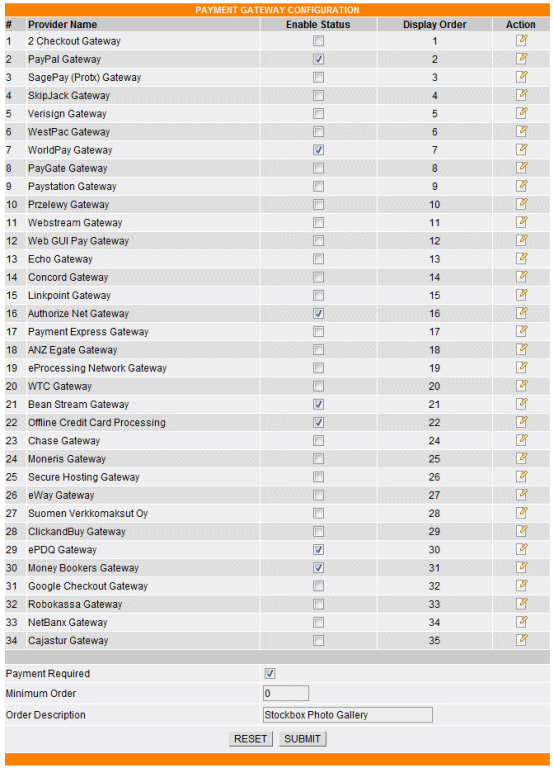
- Tick all the gateways that you wish to use for payment processing (you will need to setup an account with each one that you wish to use). Stockbox will display these selections for customers to choose from on the checkout confirmation page.
- Tick the Payment Required checkbox. If this checkbox is not checked, then instead of being taken to the payment processor, the customer will be taken upon checkout directly to their "My Account" area. If they have ordered an instant download product, this is where it will be made available for download. If you want to offer ALL of your products and/or downloads for FREE, then you should leave this box un-checked.
- Enter the Minimum Order Amount. Stockbox will only process the order if the total meets the Minimum Order Amount. Otherwise the customer will be prompted to continue shopping.
- Enter the Order Description for the purchase. Stockbox sends the Order Description to the payment processor.
- Click the Submit button to save the configuration.
- Click on the
icon to edit the configuration for the target gateway.
- To view details of how to set up each payment gateway click on the
icon in each of the payment gateway configuration sections.
Once the payment processor receives the payment from the customer, the
processor writes back to the Stockbox system confirming that the payment
was received. This updates the status in real time of the order in the admin
area from Pending to Completed and the
customer will be re-directed to their "My Account" area.
Here, the customer will see a summary of their transaction and they can
print a copy of their invoice (Pro. & Ent. versions). If their purchase
included an instant download product, then they will be able to download
their order using the link provided.
TEMPLATE
CUSTOMIZATION
The look and feel of the gallery is highly customizable by editing the set
of html templates and CSS listed below. Any html editor can be used for
this purpose, e.g. Dreamweaver©,
Microsoft Expression© etc. It is suggested that you make a copy of the templates in
a temporary folder before editing. That way, you will be able to experiment with modifications
without worrying about "loosing" template defaults. The standard set of
templates can be used "out of the box", edited to match an existing look
and feel or you can replace the existing templates with new ones that you
have created from the "ground up". Some templates have dynamic "call tags"
and they can be moved within the template or deleted as desired. Please
note that if you remove a call tag from a particular template, the feature
related to that template will not be available in your gallery.
We can also provide an affordable solution to match the look and feel of
the gallery to your existing website or create a new look and feel based
on your specified requirements. To receive a quotation, please forward your
design requirements via the
Help Desk and we will respond accordingly.
Below are some items that are required by the system.
- Predefined call tags
You should not remove the predefined call tags from the templates unless you wish to remove the dynamic feature produced by the tag. You should exercise caution when removing tags, as you could remove features that will adversely affect the way the gallery functions. The tags are predefined variables surrounded by square brackets, e.g. [GALLERY]. Stockbox will replace these tags with dynamic content created by the system. - JavaScript
You must not remove any JavaScript that is included in the templates after the installation. The system will not work if the JavaScript is removed. - CSS
You should not remove any CSS tags that are in the templates unless you have experience in creating and calling your own CSS.
There are two template directories that Stockbox uses. Gallery
Templates in the template folder and Smarty
Templates in the tpl folder. If you can't find any particular template
below in your Template Section, it means that your version doesn't use this
template.
Before outputting the gallery contents to the user's browser, the system
processes the data from the MySQL database and inserts it into the smarty
templates. Then, the predefined call tags in the main gallery templates
are replaced with the Smarty template output. Modifying "Smarty Templates"
requires knowledge of the Smarty Engine. if you're not familiar with "Smarty
Template System", we suggest that you should use system's default smarty
template set.
- Gallery Templates
All gallery templates are located in the “template” directory. You can modify these html templates via the Template Manager section of the admin control panel or by editing in any html editor such as Dreamweaver©. These templates contain predefined call tags that are described below.
- 404.tpl (Pro. & Ent. versions)
This template is be used when users are trying to access a page that is does not exist in the system. The system will return a 404 " page not found" error before displaying this page to the user's browser. There are no predefined call tags available in this template.
- activate_email.txt
The system will use this template for the activation email that is sent to end-users if the “Enable New Account Email Validation” option is checked in the General Configuration. There are three predefined tags in this template. The system uses a plain text format for this template, no HTML code is allowed.
- [USERNAME]
The system will replace this call tag with end user's username.
- [ACTIVATE_CODE]
The system will replace this call tag with the activation code. The activation code is generated by the system and the customer needs to input this code when validating their email address. If the code is valid, then the system will activate their account (Active status), otherwise it will not be activated. - [LINK]
The system will replace this call tag with an activation link that allows users to click on it to validate their email address.
- [USERNAME]
- agreement.tpl
When you enable the “Enable Agreement Checkbox” in the General Configuration section, this template will be used to display your agreement details. You will need to input your site agreement (terms etc.) to this template and it's contents will display on the customer's registration form. No predefined tags are available for this template.
- category.tpl
This template is used to display each media category. There are four predefined tags in this template.
- [DISPLAYNAME]
The system will replace this call tag with the category display name (if one is entered) or the system name by default. - [CATEGORYDETAIL]
The system will replace this call tag with the category media count. - [LASTMODIFIED]
The system will replace this call tag with the date of last modification. - [DESCRIPTION]
The system will replace this call tag with the category description.
- [DISPLAYNAME]
- category_template_sample.tpl (Pro. & Ent versions)
This template is sample template for the Category Template feature.
- cb.css
This file is used to control the dynamic content and layout of photographers area. By default, the photographer_home.tpl uses this style sheet for its layout style. There are a few ways to detect the CSS Style. The basic way is to view the page source, then find the "class" that applies to the tag you are looking for. The second way is using the Web Developer add-on for Firefox. You can install it here: https://addons.mozilla.org/en-US/firefox/addon/60. After installing this add-on, you can click on CSS
View Style Information (or press Ctrl+Shift+Y) and then select the part that you want to view CSS style information for.
- checkout_agreement.tpl
This template is used when users click on the "I have read and agree to the terms and conditions specified in this agreement" link on the shopping cart page. To enable this option you need to enable the "Enable License Agreement Checkbox on Shopping Cart Page" option in the General Configuration.
- confirm.tpl
This template is used on the last checkout page. You can use this template to tell customers what they should expect after their purchase. There are no predefined tags for this template.
- contact_mail.tpl
The system uses this template to create the email message when customers submit messages via the contact form on the Contact Us page. There are five predefined tags for this template.
- [FIRSTNAME]
The system replaces this call tag with the customer's input data for the first_name field on the contact form. - [LASTNAME]
The system replaces this call tag with the customer's input data for the last_name field on the contact form. - [PHONE]
The system replaces this call tag with the customer's input data for the phone field on the contact form. - [EMAIL]
The system replaces this call tag with the customer's input data for the email field on the contact form. - [COMMENTS]
The system replaces this call tag with the customer's input data for the comments field on the contact form.
- [FIRSTNAME]
- featured_category.tpl (Ent. version)
The system uses this template for the home page in the featured category section. There is one predefined call-tag [CATEGORY_ICON] and the system will replace this call tag with the featured category thumbnail.
- gallery.css
This file is used to control the dynamic content and layout of your gallery. By default, the gallery.tpl template uses this style sheet for its layout style. There are a few ways to detect the CSS Style. The basic way is to view the page source, then find the "class" that applies to the tag you are looking for. The second way is using the Web Developer add-on for Firefox. You can install it here: https://addons.mozilla.org/en-US/firefox/addon/60. After installing this add-on, you can click on CSS
View Style Information (or press Ctrl+Shift+Y) and then select the
part that you want to view CSS style information for.
- gallery.tpl
Most pages in the gallery utilize this template for its content, except the Home page (Ent. version), Portfolio (Ent. version), and all static pages. "Static Pages" are those is in the Templates & CM
Static Content Manager
section. There are seventeen predefined call tags for this template.
- [PAYMENTMETHOD_LINK]
(Ent. version)
The system will replace this call tag with the Payment Method link when the gallery is displayed. The contents of "Payment Method" link is in the "./tpl/english/others/user_switch_payment_method.tpl" template. This feature allows customers to switch the payment methods used to make purchases. - [PREVIEW_TOGGLE] (Pro. & Ent. versions)
The system will replace this call tag with the Quick Preview Toggle Link when the gallery is displayed. The contents of "Quick Preview Toggle" link is in the "./tpl/english/media_manager/preview_media_toggle_link.tpl" template. - [SHOPPINGCARTSTATS]
The system will replace this call tag with the customer's shopping cart details. The contents of the "Shopping Cart Stats" is in the "./tpl/english/others/user_shopping_cart_stats.tpl" template. - [KEYWORDSEARCH]
The system will replace this call tag with the Quick Search form when the gallery is displayed. The contents of the "Quick Search" form is in the template "./tpl/tpl/english/others/user_quick_search_form.tpl" template. - [ADVANCED_SEARCH_LINK] (Pro. & Ent versions)
The system will replace this call tag with the Advanced Search link when the gallery is displayed. The contents of the "Advanced Search" link form is in the template "./tpl/english/user_advanced_search_link.tpl" template. - [PRIVATE_LOGIN] (Pro. & Ent. versions)
The system will replace this call tag with the Private Login link when the gallery is displayed. The contents of the "Private Login" link is in the "tpl/english/others/private_login.tpl" template. - [PHOTOGRAPHER_LOGIN] (Pro. & Ent. versions)
The system will replace this call tag with the Photographer Login link when the gallery is displayed. The contents of the "Photographer Login" link is in the "tpl/english/others/photographer_login.tpl" template. - [CATEGORYDROPDOWN]
The system will replace this call tag with the gallery categories. There are two display options for the gallery categories.
- Drop Down List Style
The system displays the gallery categories in an drop down list. - Listing Style
The system displays the gallery categories in a listing style. - Category Smarty Template
The contents of "Category Listing" is in the "./tpl/english/others/user_main_cat.tpl" and "tpl/english/others/user_sub_categories.tpl" templates.
- Drop Down List Style
- [FEATURED_MEDIA_RSS] (Pro. & Ent. versions)
The system will replace this call tag with the Featured Media RSS Icon when the gallery is displayed. The contents for the "Featured Media" RSS link is in the "tpl/english/rss/user_featured_media_rss.tpl" template. - [FEATUREDMEDIA] (Pro. & Ent. versions)
The system will replace this call tag with the gallery featured media. You can change the number of featured media that are displayed in this area by changing the "Featured Media Display Number" in the Media Configuration section. You can also change the setting to have the featured media displayed vertically in a column or horizontally in a row. The contents of the "Featured Media" is in the "./tpl/english/others/user_featured_media.tpl" template. - [VIRTUAL_CD_RSS] (Ent. version)
The system will replace this call tag with the Virtual CD RSS link when the gallery is displayed. The contents for the "Virtual CD RSS" link is in the "tpl/english/rss/user_featured_virtual_cd_rss.tpl" template. - [VIRTUAL_CD] (Ent. version)
The system will replace this call tag with the "Virtual CD" products when the gallery is displayed. The contents of the "Virtual CD" products is in the "tpl/english/others/user_featured_virtual_cd.tpl" template. - [PORTFOLIO] (Ent. version)
The system will replace this call tag with all featured portfolios when gallery is displayed. The contents for each "Featured Portfolio" is in the "template/english/portfolio_thumbnail.tpl" template. - [PHOTOGRAPHER_LISTING_RSS] (Ent. version)
The system will replace this call tag with the Photographer RSS link when gallery is displayed. The contents of the "Photographer RSS" link is in the "tpl/english/rss/user_photographer_list_rss.tpl" template. - [PHOTOGRAPHER] (Ent. version)
The system will replace this call tag with the "Featured Photographer Listing" when the gallery is displayed. The contents of the "Featured Photographer Listing" is in the "./tpl/english/others/user_photographer_list.tpl" template. - [PREDEFINDED_KEYWORD] (Ent. version)
The system will replace this call tag all of the predefined keywords that are entered in the Search Manager
Pre-defined Keywords section. - [GALLERY]
This is a main call tag of the gallery contents and it can't be removed from the template. The system will replace this call tag with the dynamic gallery data.
- [PAYMENTMETHOD_LINK]
(Ent. version)
- home.tpl (Ent. version)
This template is used for the home page. By default, there are ten call tags for this template, but you can include other call tags that are defined in the gallery.tpl template above.
- [BANNER]
The system will replace this call tag with the Active Banner Images in the Banner module. - [LATEST_NEWS]
The system will replace this call tag with the latest news contents. The latest news contents is in the "template/english/latest_news.tpl" template. - [MOST_POPULAR]
The system will replace this call tag with the most popular media thumbnail. The most popular media feature is configurable in the Media Configuration section. - [NEW_ADDITIONS]
The system will replace this call tag with the new additions media thumbnail. The new additions feature is configurable in the Media Configuration section. - [FEATURED_CATEGORY]
The system will replace this call tag with four randomly featured categories. The Featured Category status is changeable in the Media Manager section. - [KEYWORDSEARCH]
The system will replace this call tag with the Quick Search form when the gallery is displayed. The contents of the "Quick Search" form is in the template "./tpl/tpl/english/others/user_quick_search_form.tpl" template. - [ADVANCED_SEARCH_LINK] (Pro. & Ent versions)
The system will replace this call tag with the Advanced Search link when the gallery is displayed. The contents of the "Advanced Search" link form is in the template "./tpl/english/user_advanced_search_link.tpl" template. - [PRIVATE_LOGIN] (Pro. & Ent. versions)
The system will replace this call tag with the Private Login link when the gallery is displayed. The contents of the "Private Login" link is in the "tpl/english/others/private_login.tpl" template. - [PHOTOGRAPHER_LOGIN] (Pro. & Ent. versions)
The system will replace this call tag with the Photographer Login link when the gallery is displayed. The contents of the "Photographer Login" link is in the "tpl/english/others/photographer_login.tpl" template. - [VIRTUAL_CD] (Ent. version)
The system will replace this call tag with the "Virtual CD" products when the gallery is displayed. The contents of the "Virtual CD" products is in the "tpl/english/others/user_featured_virtual_cd.tpl" template. - Other call tags please see the
gallery.tpl template above.
- [BANNER]
- invoice.tpl (Pro. & Ent. versions)
This template is used when customers want to view or print an order invoice. Also, the system uses this template to send an order invoice to customer and administrator when the “Enable Notification Invoice Email” option is enabled on in the General Configuration. There is only one predefined tag for this template.
- [INVOICE]
The system will replace this call tag with the order invoice.
Note: If you add images to this template, make sure that you use the absolute path to the image file. e.g. src="http://www.your-domain.com/images/admin/english/logo.jpg" or you should include the [URL] tag in the path to the image file. e.g. src="[URL]/images/admin/english/logo.jpg".
- [INVOICE]
- latest_news.tpl
This template is used in the Latest News section on the home page. There are two call tags for this template.
[TITLE]: Latest new title.
[SHORT_CONTENTS]: Latest News short contents.
The latest news feature is configurable in the News Manager section.
- main.tpl
This is the main gallery template and anything that you change or add to this page will display on every page in the gallery
You MUST NOT REMOVE the following javascript and CSS calls from the template code
<title>[SEO_TITLE]</title>
<meta name="description" content="[SEO_META_DESCRIPTION]" />
<meta name="keywords" content="[SEO_META_KEYWORDS]" />
<meta http-equiv="author" content="Stockbox Photo (TM) Gallery Software - www.stockboxphoto.com - Do not remove this line" />
<meta http-equiv="Content-Type" content="text/html; charset=utf-8" />
<meta http-equiv="imagetoolbar" content="no" />
<script language="javascript" type="text/javascript">
var $self = "[URL]";
var $language = "[LANGUAGE_DIR]";
</script>
<script language="javascript" src="scripts/scripts.js" type="text/javascript"></script>
<link rel="stylesheet" href="template/english/gallery.css" type="text/css" />The [SEO_TITLE], [SEO_META_DESCRIPTION] and [SEO_META_KEYWORDS tags will be replaced by the default meta tags. You can change the default meta tags in the "Meta Tag Default Configuration" section of the General Configuration.
- [LANGUAGE] (Ent. version)
The system will replace this call tag with the language selector feature, if your site supports more than a language. The contents of the "Language Selector" is in the "./tpl/english/language/user_select_language.tpl" template. - [MEMBERACCOUNT]
The system will replace this call tag with the visitor's account welcome message when the gallery is displayed. The contents of the "Member Information" form is in the template "./tpl/english/media_manager/user_member_account_info.tpl" template. - [PRIVATE_LOGOUT]
The system will replace this call tag with the Private Gallery Logout when one has logged in the private gallery. The contents for the private gallery login link is in the tpl/english/others/private_logout.tpl template.
- [MENU]
The system will replace this call tag with the gallery navigation menu buttons or drop down menu. You can replace the included menu buttons with your own using the " Nav. Menu Manager" feature or by uploading new image files to the images directory, while maintaining the same file names (these new files will overwrite the existing files). With the Pro. & Ent. versions you can also use the Templates & CM
Static Content Manager to add extra content pages to
your gallery. When adding a new page, the system will also add
a button to the gallery navigation menu. If you have the Std.
version or if you wish to add buttons or links to the menu that
link to pages outside of the Stockbox system, you will need
to remove the [MENU] call tag and replace the dynamic
menu with a static menu of your own. You will have
to use the same URL paths (see below) that are currently being
used for the existing dynamic menu.
- <a href="index.php" > Home</a>
- <a href="index.php?module=media&pId=101" > New Media</a>
- <a href="index.php?module=lightbox&pId=100" > Lightbox</a>
- <a href="index.php?module=product_type&pId=100">Products</a>
- <a href="index.php?module=customer&pId=100" > My Account</a>
- <a href="index.php?module=basket&pId=100" > Shopping Cart</a>
- <a href="index.php?module=company&pId=100" > Ordering Info</a>
- <a href="index.php?module=company&pId=102" > Contact Us</a>
- <a href="index.php?module=company&pId=101"
> About Us</a>
- [BODY]
This is a main call tag of the system contents and it can't be removed from the template. The system will replace this call tag with the dynamic gallery data.
- [LANGUAGE] (Ent. version)
- malicious_error.tpl (Ent. version)
This template is used when the system detects input data containing malicious characters as defined in the in the Administrator Malicious Characters section.
- media.tpl
This template is used to display the thumbnail image for each display image. There are six predefined tags for this template.
- [FILENAME]
The system will replace this call tag with the media thumbnail image. - [DISPLAYNAME]
The system will replace this call tag with the file system name or display name (whichever is present). - [LIGHTBOX]
The system will replace this call tag with the "Add Lightbox" or "Remove Lightbox" icon. - [LINK]
The system will replace this call tag with the "Get Link" Icon. The contents of the "Get Link" icon is in the tpl/english/others/link.tpl.tpl template - [SHARE_LINK]
The system will replace this call tag with the "Share Link" icon. The contents of the "Share Link" icon is in the tpl/english/others/user_share_link.tpl template
- [ADDTOCART]
The system will replace this call tag with the "Add to Cart" icon. - [LIGHTBOXCOMMENTS] (Pro. & Ent. versions)
The system will replace this call tag with the "Add Media Comments" icon. This only applies on the lightbox page. The system will replace this tag with an empty string on the other pages. - [PRODUCTTYPE] (Pro. & Ent. versions)
The system will replace this call tag with the available Product Types and the Add to Cart button on the Lightbox page if the "Enable "Add to Cart" Button in Lightbox" has been activated in the Lightbox Manager section. The system will only display the media product type if it has been assigned a price greater than zero. - Floating IPTC tags - Optional Call Tag - (Pro. &
Ent. versions)
This feature allows you to place the individual IPTC field calls anywhere on the template and in any order. For example if you wanted to display the Caption and Keywords only (in that order), then you will add the following to this template.
Caption: [caption]
Keywords: [keywords]Click here to see a list of available IPTC call tags.
- [FILENAME]
- media_detail.tpl
This template is used to display the media detail (enlarged display image) page.
- [CATEGORY_BREADCRUMB_LINK]
The system will replace this call tag with the category breadcrumb link. The contents for the category breadcrumb link is in the tpl/english/others/user_category_breadcrumb.tpl template - [RETURN_TO_THUMBNAIL_PAGE]
The system will replace this call tag with the "Return To Thumbnail" Icon. The contents for "Return to Thumbnail Page" is in the tpl/english/media_manager/user_return_thumbnail.tpl template. - [GOOGLE_MAP_URL] (Ent. version)
The system will replace this call tag with the "Google Map" Icon. The contents for the "Google Map" icon is in the tpl/english/others/user_google_map.tpl template. This icon is only available when image has a value in the "Google Map URL" in the Media Properties. - [SENDTOFRIEND]
The system will replace this call tag with the "Send to Friend" icon. When customers click on this icon, the system will display the "SEND TO A FRIEND" form to allow customers to send the selected media to their friends. - [SENDREQUEST] (Ent. version)
The system will replace this call tag with the "Request a Quote" icon. When customers click on this icon, the system will display the "REQUEST A QUOTE" form to allow customers to send a quote request to the Administrator. -
[SAMPLEDOWNLOADLINK] (Pro. & Ent. versions)
The system will replace this call tag with a "Download Sample File" icon. The sample image download file must reside in the same location as the target display file. You need to name the sample download file as follows:
media name: media.jpg
sample download file: sample_media.jpg
Note: If you use the batch upload feature in the Media Manager you can select to upload the "Sample Files" so that you do NOT have to prefix the files prior to uploading them as they will be automatically prefixed by the system. The system will only display the "Download Sample File" icon if it detects the sample download file on the server. If there is a sample download file, it allows customers to click on the download icon to download the sample media file. This feature can be used to offer "watermark free comp images". - [ZOOMIFY] (Pro. & Ent. versions)
The system will replace this call tag with the Zoomify™ icon. The contents for Zoomify™ icon is in the tpl/english/others/user_zoomify_icon.tpl template. This icon is only available when a particular media has a Zoomify™ link attached to it. You can add a Zoomify™ link for your media in the Media Manager section. - [LIGHTBOX]
The system will replace this call tag with the "Add Lightbox" or "Remove Lightbox" icon. - [LINK]
The system will replace this call tag with the "Get Link" icon. The contents for "Get Link" icon is in the tpl/english/others/link.tpl.tpl template - [SHARE_LINK]
The system will replace this call tag with the "Share Link" icon. The contents of the "Share Link" icon is in the tpl/english/others/user_share_link.tpl template
- [FILENAME]
The system will replace this call tag with the enlarged display image. - [OTHER_PLAYERS]
(Pro. & Ent. versions)
The system will replace this call tag with a link to allow a user to view the current selected media with another media player if another has been configured in the Media Manager
Media File Type section. - [PRODUCTTYPE]
The system will replace this call tag with the available Product Types and the Add to Cart button. The system will only display the media product type if it has been assigned a price greater than zero. You can use the Product Manager section to add or remove product types. - [REFERENCE_ID] (Pro. & Ent. versions)
The system will replace this call tag with the media reference ID. - [DISPLAYNAME]
The system will replace this call tag with the file system name or display name (whichever is present). - [AUTHOR]
The system will replace this call tag with the media's author. - [COPYRIGHT]
The system will replace this call tag with the media's copyright info. - [HIT]
The system will replace this call tag with the number of hits (image views). You can edit this value in the Global Update section. - [LASTMODIFIED]
The system will replace this call tag with the media's last modified date. Anytime you edit the media properties, the system will update the last modified date to the date it was edited. - [ADD_DATE]
The system will replace this call tag with the date the media was added to the system. - [LICENSETYPE] (Ent. version)
The system will replace this call tag with the license type. The four available options are, Royalty Free, Rights Managed, Rights Managed with no Calculator or Royalty Free & Rights Managed. - [MEDIATYPE] (Ent. version)
The system will replace this call tag with the media type. The media type is changeable on the Media Properties page or the Global Update section. - [MEDIARELEASE] (Ent. version)
The system will replace this call tag with the media release status. The media release status is changeable on the Media Properties page or the Global Update section.
- [BLACK_WHITE] (Ent. version)
The system will replace this call tag with the Black & White status of the media. The "Black & White" status is changeable on the Media Properties page or the Global Update section. - [MEDIAORIENTATION] (Ent. version)
The system will replace this call tag with the media orientation. The system will automatically determine if the image is either, Horizontal, Vertical, Square or Panorama, but the orientation is also changeable on the Media Properties page or the Global Update section. - [SOLD_NUM] (Pro. & Ent. versions)
The system will replace this call tag with the number of times an item from the particular media have been sold. - [DESCRIPTION]
The system will replace this call tag with the media's description. The media description is changeable on the Media Properties page or the Global Update section. - [KEYWORD] (Pro. & Ent. versions)
The system will replace this call tag with the keywords section. The media keywords are changeable on the Media Properties page or the Global Update section. - [IPTC] (Pro. & Ent. versions)
The system will replace this call tag with the image's IPTC info. The display order is fixed, but individual fields can be turned on/off in the IPTC configuration section. You can also specify which fields will be searchable.
Floating IPTC tags
This is an alternative method to display the IPTC metadata. This feature allows you to place the individual IPTC field calls anywhere on the template and in any order. For example if you wanted to display the Caption and Keywords only (in that order), then you will add the following to this template.
Caption: [caption]
Keywords: [keywords]For this method, you will have to remove the [IPTC] call tag and replace it with the individual IPTC tags. The available call tags are listed below.
[object_name]
[edit_status]
[priority]
[category]
[supplementary_category]
[fixture_identifier
[keywords]
[release_date]
[release_time]
[special_instructions]
[reference_service]
[reference_date]
[reference_number]
[created_date]
[originating_program]
[program_version]
[object_cycle]
[byline]
[byline_title]
[city]
[province_state]
[country_code]
[country]
[original_transmission_reference]
[headline]
[credit]
[source]
[copyright_string]
[caption]
[local_caption]
- [CATEGORY_BREADCRUMB_LINK]
- media_detail_with_tab.tpl (Pro. & Ent. versions)
This template is similar to the media_detail.tpl but instead of displaying the IPTC metadata on the same page, the system will display the IPTC metadata on other tab. The call tags are the same as the media_detail.tpl template above. The system only uses this template when you enable this option in the Configuration Media
section. You can use this template option
to prevent the need to scroll down the page to view the IPTC metadata.
- media_preview.tpl (Pro. & Ent. versions)
The system uses this template when customers "mouse over" a media thumbnail image. This feature needs to be enabled in the Configuration Media
section.
- [FILENAME]
The system will replace this call tag with the media preview image. - [DISPLAYNAME]
The system will replace this call tag with the media display name or system name. - [AUTHOR]
The system will replace this call tag with the media's author. - [COPYRIGHT]
The system will replace this call tag with the media's copyright details. - [LICENSETYPE] (Ent. version)
The system will replace this call tag with the license type, "Royalty Free", "Rights Managed", “Rights Managed with no Calculator” or "Royalty Free & Rights Managed". - [MEDIATYPE] (Ent. version)
The system will replace this call tag with the media type. - [HIT]
The system will replace this call tag with the number of hits (image views). - [LASTMODIFIED]
The system will replace this call tag with the media's last modified date. - [ADD_DATE]
The system will replace this call tag with the date the media was added to the system. - [MEDIARELEASE] (Ent. version)
The system will replace this call tag with the media's release status.
- [FILENAME]
- mobile_order_notify.tpl (Ent. version)
The system uses this template to send a new order notification to the mobile phone email address that you input into the General Configuration. You can obtain the mobile phone email address through your service provider. The system will not use this template if a mobile email address is not detected. There are eight predefined tags for this template. The system uses plain text format for this template, therefore no HTML code is permitted.
- [ORDER_ID]
The system will replace this call tag with the new order id. The order id is generated when customers checkout their orders. - [CUSTOMER_USERNAME]
The system will replace this call tag with the customer's username. - [SUB_TOTAL]
The system will replace this call tag with the order's sub total. - [TAX]
The system will replace this call tag with the amount of tax calculated for the order. - [SHIPPING]
The system will replace this call tag with the order's shipping cost. - [PROMOTION]
The system will replace this call tag with the promotion value that was applied to the order. - [GRAND_TOTAL]
The system will replace this call tag with the order's grand total. - [PURCHASED_DATE]
The system will replace this call tag the date that the order was created.
- [ORDER_ID]
- news.tpl (Ent. version)
This template is used for each news item on the News page.
[TITLE]: The system will replace this call tag with the news title.
[SHORT_CONTENTS]: The system will replace this call tag with the news short contents.
- news_details.tpl (Ent. version)
This template is used for News Detail page.
[TITLE]: The system will replace this call tag with the selected news title.
[CONTENTS]: The system will replace this call tag with the selected news contents.
- notify.tpl
If the “Notify me when someone signs up” is enabled in the General Configuration, the system will use this template to notify you when customers submit their new registration details to your server. This template can be configured differently depending on the information that you want collect from the customer. The system uses html format for this template.
e.g. If you add a field name 'fax' to the registration form, then you will need to add the [fax] call tag to this template. Stockbox will replace this call tag with the customer's fax number.
- password_email.txt
The system uses this template when customers are requesting to “Recover a lost password”. There are two predefined call tags for this template. The system uses plain text format for this template, no HTML code is allowed.
- [USERNAME]
The system will replace this call tag with the customer's username. - [PASSWORD]
The system will replace this call tag with the customer's password.
- [USERNAME]
- photographer_activate_email.txt (Ent.
version)
If the “Enable Photographer Email Validation” option is enabled in the Photographer Configuration section, the system will use this template when a photographer registers to your site. There are three predefined tags for this template. The system uses plain text format for this template, no HTML code is allowed.
- [USERNAME]
The system will replace this call tag with the photographer's registered username. - [ ACTIVATE_CODE]
The system will replace this call tag with the activation code. The activation code is generated when a photographer submits their registration details. - [LINK]
The system will replace this call tag with the activation link. The photographer needs to click on this link to activate their account.
- [USERNAME]
- photographer_agreement.tpl (Ent. version)
This is similar to the Customer Agreement feature. When you enable the “Enable Photographer Agreement Checkbox” option in the Photographer Configuration section, this template will be used to display your agreement details. You will need to input your site agreement (terms etc.) to this template and it's contents will display on the photographer's registration form. No predefined call tags are available for this template.
- photographer_approval_notify.txt (Ent.
version)
If the photographer's “Enable Photographer Approval Notification” option is enabled, the system will use this template to notify you when a photographer uploads new media to your server. The system uses plain text format for this template, no HTML code is allowed. There are four predefined tags for this template.
- [MEDIA_NAME]
The system will replace this call tag with the file system name or display name (whichever is present). - [MEDIA_CATEGORY]
The system will replace this call tag with the media category. - [MEDIA_PATH]
The system will replace this call tag with the media's actual file path. - [APPROVED_STATUS]
The system will replace this call tag with the media approval status. The approval status is set based on approval status setting in the photographer's profile.
- [MEDIA_NAME]
- photographer_home.tpl (Ent. version)
The system uses this template for the photographers home page. There are two predefined call tags for this template. This template uses the cb.css style sheet.
- [MENU]
The system will replace this call tag with the photographer's navigation menu. - [CONTENTS]
The system will replace this call tag with the contents of the photographer's section.
- [MENU]
- photographer_notify.tpl (Ent. version)
If the “Notify me when someone signs up” is enabled in the General Configuration, the system will use this template to notify you when photographers submit their new registration details to your server. This template can be configured differently depending on the information that you want collect from the photographers. The system uses plain text format for this template, no HTML code is allowed.
e.g. If you add a field name 'fax' to the registration form, then you will need to add the [fax] call tag to this template. Stockbox will replace this call tag with the photographer's fax number.
- portfolio.tpl (Ent. version)
This is the main template for the portfolio module. This template is used before the system outputs the data to the main.tpl template. All predefined call tags are similar to the gallery.tpl template above, except the system will replace the [GALLERY] call tag with the selected portfolio. When the portfolio page is called the first portfolio will be loaded.
- portfolio_thumbnail.tpl (Ent. version)
This template is used for the Featured Portfolio section.
[PORTFOLIO_THUMBNAIL]: The system will replace this call tag with the portfolio thumbnail.
[DISPLAY_NAME]: The system will replace this call tag with the portfolio display name.
- readme.txt
By default this file will be included in the zip file that the user will download after their purchase is complete. This template can be used to include your usage/license details (or any other information that you want to provide) for the end-user. You can specify a different file to be included in the download zip package by changing the setting in the General Configuration section. You must upload your file to the template/english folder via FTP in order for it to display in the General Configuration section.
- request_lightbox_quote.tpl (Ent. version)
The system uses this template to send an email to the gallery administrator with the details of the lightbox quotation request. There are five predefined tags for this template. The system uses HTML format for this template. Note: If you add images to this template, make sure that you use the absolute path to the image file. e.g. src="http://www.your-domain.com/images/admin/english/logo.jpg" or you should include the [URL] tag in the path to the image file. e.g. src="[URL]/images/admin/english/logo.jpg".
- [WEBMASTER_NAME]
The system will replace this call tag with the gallery administrator's name (as input in the General Configuration). - [SENDERNAME]
The system will replace this call tag with the input name. - [MESSAGE]
The system will replace this call tag with the input usage details. - [PHONE]
The system will replace this call tag with the input phone number. - [LINK]
The system will replace this call tag with a clickable link. The link allows you to click to go back to your gallery to view the media.
- [WEBMASTER_NAME]
- request_media_quote.tpl (Ent. version)
The system uses this template to send an email to the gallery administrator with the details of the media quotation request. There six predefined tags for this template. The system uses HTML format for this template. Note: If you add images to this template, make sure that you use the absolute path to the image file. e.g. src="http://www.your-domain.com/images/admin/english/logo.jpg" or you should include the [URL] tag in the path to the image file. e.g. src="[URL]/images/admin/english/logo.jpg".
- [WEBMASTER_NAME]
The system will replace this call tag with the gallery administrator's name (as input in the General Configuration). - [SENDERNAME]
The system will replace this call tag with the input name. - [USAGE]
The system will replace this call tag with the input usage details. - [PHONE]
The system will replace this call tag with the input phone number. - [LINK]
The system will replace this call tag with a clickable link. The link allows you to click to go back to your gallery to view the media. - [MEDIA]
The system will replace this call tag with the media's actual display image.
- [WEBMASTER_NAME]
- send_activate_password.tpl
This template is used when users request a new password from your site.
- [USERNAME]
The system will replace this call tag with the username of the requested user. - [PASSWORD]
The system will replace this call tag with the temporary password. - [ACTIVATE]
The system will replace this call tag with a randomly generated activation code that users will need input in order to activate their temporary password. - [URL]
The system will replace this call tag with the URL link that allows users to click in order to activate their temporary password.
- [USERNAME]
- send_approval_status.tpl (Ent. version)
The system uses this template to send an email to the contributor to notify them that their submitted category or media has been approved or un-approved. There is only one predefined tag for this template. The system uses HTML format for this template. Note: If you add images to this template, make sure that you use the absolute path to the image file. e.g. src="http://www.your-domain.com/images/admin/english/logo.jpg" or you should include the [URL] tag in the path to the image file. e.g. src="[URL]/images/admin/english/logo.jpg".
- [CONTENTS]
The system will replace this call tag with the approval details.
- [CONTENTS]
- send_lightbox_email.tpl
The system uses this template to create the email used when customers send their lightbox to their friends. There are four predefined tags for this template. The system uses HTML format for this template. Note: If you add images to this template, make sure that you use the absolute path to the image file. e.g. src="http://www.your-domain.com/images/admin/english/logo.jpg" or you should include the [URL] tag in the path to the image file. e.g. src="[URL]/images/admin/english/logo.jpg".
- [FRIENDNAME]
The system will replace this call tag with the customer's friend's name. - [SENDERNAME]
The system will replace this call tag with the customer's name. - [MESSAGE]
The system will replace this call tag with the customer's message. - [LINK]
The system will replace this call tag with a clickable link. This link allows the customer's friend to click on it to go back to your site and view the contents of the sent lightbox.
- [FRIENDNAME]
- send_order_details.tpl (Pro. & Ent. versions)
The system uses this template when you manually send order details to a customer. The email will be sent to the email address on the Order Details page. There are two predefined call tags for this template.
- [MESSAGE]
The system will replace this call tag with the message that you input. - [ORDER_DETAILS]
The system will replace this call tag with the selected order details.
- [MESSAGE]
- send_portfolio_email.tpl (Ent. version)
This template is used when a user sends the selected portfolio to their friends.
- [FRIENDNAME]
The system will replace this call tag with the customer's friend's name. - [SENDERNAME]
The system will replace this call tag with the customer's name. - [MESSAGE]
The system will replace this call tag with the customer's message. - [ICON]
The system will replace this call tag with the selected portfolio thumbnail image. - [LINK]
The system will replace this call tag with a clickable link. This link allows the customer's friend to click on it to go back to your site and view the selected portfolio.
- [FRIENDNAME]
- send_to_friend_email.tpl
The system uses this template to create the email used when a customer sends a selected media to their friends. The system uses HTML format for this template. There are five predefined tags for this template. Note: If you add images to this template, make sure that you use the absolute path to the image file. e.g. src="http://www.your-domain.com/images/admin/english/logo.jpg" or you should include the [URL] tag in the path to the image file. e.g. src="[URL]/images/admin/english/logo.jpg".
- [FRIENDNAME]
The system will replace this call tag with the customer's friend's name. - [SENDERNAME]
The system will replace this call tag with the customer's name. - [MESSAGE]
The system will replace this call tag with the customer's message. - [LINK]
The system will replace this call tag with a clickable link. The link allows the customer's friend to click to go back to your gallery to view the media. - [MEDIA]
The system will replace this call tag with the media's actual image. Note: If the image is sent in the email it will no longer be protected by the "image protection" features. If you don't want to send the image in the email, you should remove this tag from the template.
- [FRIENDNAME]
- user_account_info.tpl
This template is used for the "My Account" page. This page shows the customer's order history and also allows customers to download any instant download orders. The customer can also use links on this page to edit their profile or to logout from the system. There are no predefined tags for this template.
- virtual_cd_order_details.tpl (Pro. & Ent. versions)
This template is used when customers want to view the details of a Virtual CD order in their "My Account" section. Note: If you add images to this template, make sure that you use the absolute path to the image file. e.g. src="http://www.your-domain.com/images/admin/english/logo.jpg" or you should include the [URL] tag in the path to the image file. e.g. src="[URL]/images/admin/english/logo.jpg".
There is only one predefined call tag for this template.
- [ORDER_DETAILS]
The system will replace this call tag with the order details.
- [ORDER_DETAILS]
- welcome_new_member.tpl
The system uses this template to send out a "welcome email" to the customer's registered email address if the "Enable Welcome New Customer Email" option is enabled in the General Configuration. There are two predefined tags for this template, plus dynamic tags that draw from the customer's registration form. The system uses plain text format for this template, no HTML code is allowed
- [USERNAME]
The system will replace this call tag with the customer's username. - [PASSWORD]
The system displays the text ## Hidden ## instead of the user's actual password. - Dynamic tags
If you add a new field name such as 'fax' to the customers' registration form, then you will need to add the tag [fax] to this template. Stockbox will replace this call tag with the customer's fax number.
- [USERNAME]
- welcome_new_photographer.tpl (Ent. version)
The system uses this template to send out a "welcome email" to the photographer's registered email address if the "Enable welcome email notification when photographers account status becomes active" is enabled in the Photographer Configuration section. There are two predefined tags for this template, plus dynamic tags that draw from the photographer's registration form. The system uses plain text format for this template, no HTML code is allowed.
- [USERNAME]
The system will replace this call tag with the photographer's username. - [PASSWORD]
The system displays the text ## Hidden ## instead of the photographer's actual password. - Dynamic tags
If you add a new field name such as 'fax' to the photographers' registration form, then you will need to add the [fax] call tag to this template. Stockbox will replace this call tag with the photographer's fax number.
- [USERNAME]
- 404.tpl (Pro. & Ent. versions)
- Smarty Templates
Stockbox version 4.00 and above utilizes the smarty template engine for its gallery templates. All smarty gallery templates are located in the tpl folder and its modules directories. You should have prior working knowledge of the Smarty Template Engine before attempting to modify any of these templates. It is recommended that you make a backup of the tpl folder before editing any of the Smarty templates, so that the original files can easily be replaced should problems occur. Please note that requests to modify the smarty templates, or the resolution of issues caused by changes to the smarty templates are not covered by standard support.
- template_type:
There are three types of templates that you need to be aware of:
- Any file that begins with "admin_" is used by the admin control panel. These templates do not need to be edited.
- Any file that begins with "cb_" is used by the photographers section. These templates do not need to be edited.
- Any file that begins with "user_" is used
by public and private galleries. You can change the gallery
layout by editing the smarty templates, but you must know how
the Smarty engine works before doing so.
- module_name_prefix: This is the first two letters
of the module name. You can determine the page's module_name_prefix
by the module variable in this page's URL's query
string. e.g. If the URL is http://www.yourdomain.com/your_folder/private_gallery.php?module=media&pId=101&start=0,
then the module variable is media, so the module_name_prefix
will be "me".
Note: If there are two or more modules that have a similar name to the first module name, then the module_name_prefix name will add a letter for each similar module name. e.g. The modules list have two module names that are similar to each other, they are company and config modules, so the module_name_prefix for company is co and the module_name_prefix for config is con.
- pId: Similar to the module_name_prefix, the
pId can also be found in the URL query string.
If there is no pId in the query string, the default value of
100 will be used.
- template_name: The last template_name prefix
will only be used if the three prefixes before it coincide .e.g.
the tpl/english/media_manager folder have more than one
user_me_102 file, so first file will be user_me_102.tpl,
the second will be user_me_102_download_link.tpl
and so on.
The template name structure: <template_type>_<module_name_prefix>_<pId>_<template_name>.tpl.
template_type = user
module_name_prefix = me
pId = 102
template_name = download_linkTherefore the corresponding Smarty template is tpl/english/media_manager/user_me_102_download_link.tpl
Please use the following links to view a detailed guide on which Smarty templates control the specific sections of the gallery.
- template_type:
The Static Content Manager allows you to manage the 'static' info pages in your gallery. During the installation, the system will automatically create three static pages (About Us, Contact Us and Order Info) in the system. A 'static' page is an extra page for static (non gallery) content that you can use to provide additional information on other products or services that you offer.
- Static Content Manager
- Click on the Templates & CM

- About Us
This page content is used for the About Us page in the gallery.- Contact Us
This page content is used for the Contact Us page in the gallery.- Order Info
This page content is used for the Order Information page in the gallery.
- Add a New Static Content Page (Pro. & Ent. versions)
With the Pro. and Ent. versions you are able to add as many static pages to the system as you wish. Once they have been added to the system, you can link to them directly using the link that system generates in the Static Contents Manager page, or you can create a new menu button or navigation drop down button and link it to the new static page that you created. The URL for the static page will displayed in the URL list when you create the page.
- Click on the Add
icon to add
a new static page to the system.
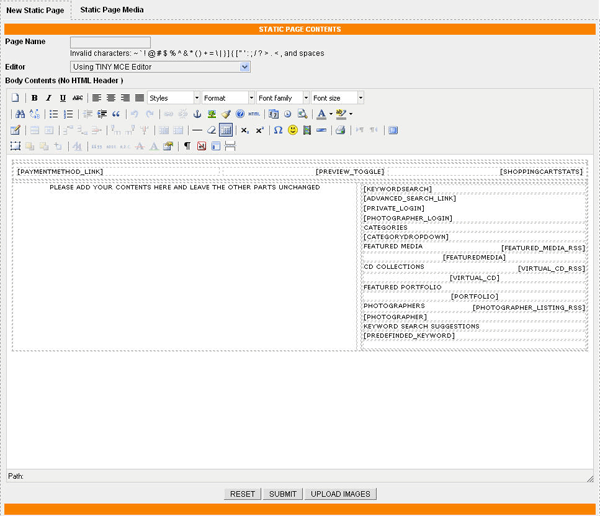
- The system will use the "gallery.tpl" as
the default layout for the new static page.
You should only add your contents to the "PLEASE ADD YOUR..." section and leave other parts as
they are. However you can remove call tags if you don't want the
corresponding feature to be displayed on the new static page. You are not able to add the header or footer to the static page,
as the system uses only one header and footer for the entire site. The header and footer are in the
main.tpl template and all content for the static page will be
loaded into the [BODY] call tag in the main.tpl template when the page is called
by the user.
- To insert images into a static page you will need to upload them first
to the server using the "Upload Static Page Media" icon. Your uploaded images
will be displayed in the "Static Page Media" tab
and you can also view the actual URL for the image. You will need to
insert the URL into the "Image URL" field that will be
displayed after clicking on the Insert / edit Image icon in the
Tiny MCE Editor menu.
- Click on the Add
- Edit a Static Content Page
- Click on the Edit
icon
for the particular page that you would like to edit.

- Note:
You should not remove any call tags from the page unless you don't want to use that feature in the selected template.
- To insert images into a static page you will need to upload them first
to the server using the "Upload Static Page Media" icon. Your uploaded images
will be displayed in the "Static Page Media" tab
and you can also view the actual URL for the image. You will need to
insert the URL into the "Image URL" field that will be
displayed after clicking on the Insert / edit Image icon in the
Tiny MCE Editor menu.
- You are not able to add the header or footer to the static page,
as the system uses only one header and footer for the entire site. The header and footer are in the
main.tpl template and all content for the static page will be
loaded into the [BODY] call tag in the main.tpl template when the page is called
by the user.
- Click on the Edit
You can add as many news items as you wish to the system. All active news items will be listed on the News page in the gallery.
- Click on the News Manager link in the main menu.
- To specify that a particular news is to be featured, click on the No link in the Featured column. The Featured News will be listed on the home page in the Latest News section. Only one featured news item can be specified at a time.
- Click on the Status link to change the status of the particular news item to be Hidden or Active. Only active news items will be displayed in the gallery.
- Click on the Edit icon to edit
a particular news item.
- Click on the Delete icon to delete
a particular news item.
- Click on the Upload icon to upload images to the server for later use
in your news articles.
- Click on the
Add
icon to add a new news item to the system.
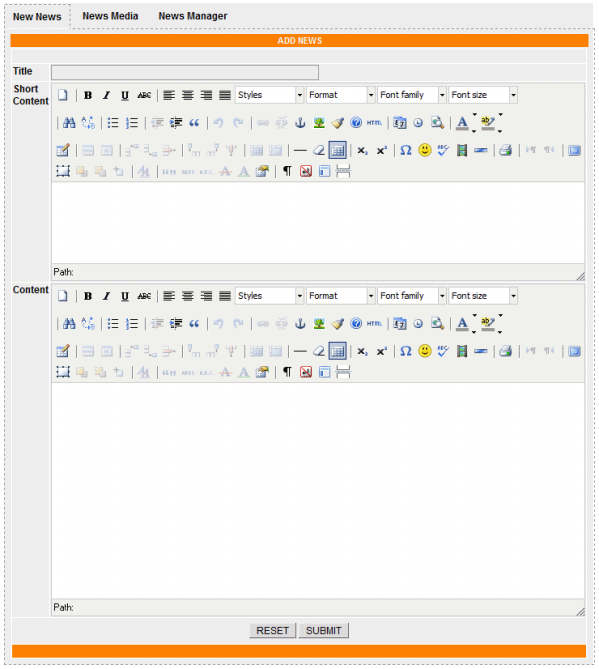
- Enter the news Title.
- Enter the Short Content. The short content will be used as the news summary.
- Enter the full Content. The full content will be used when users click on a particular news item to view the full details.
- To insert images into a news item you will need to upload them first
to the server by clicking on the Upload News Media
icon. Your uploaded images will be displayed in the "News
Media"
tab and you can also view the actual URL for the image. You will need
to insert the URL into the "Image URL" field that will be
displayed after clicking on the Insert / edit Image icon in the
Tiny MCE Editor menu.
- Click on the SUBMIT button to add a new
News item to the system. The status of the new News item will be
Hidden and you will need to change this to Active before it
will display in the gallery.
- To configure how the system handles the News items in the gallery,
click on the
Configuration link.
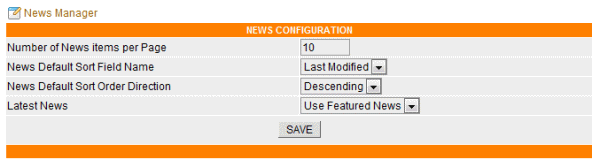
- Number of News items per Page
Enter the number of news to be listed on the News page. - News Default Sort Field Name
Select the default sort field name that will be used to sort the displayed news items on the News page. - News Default Sort Order Direction
Select the default sort order direction that will be used to sort the displayed news items on the News page. - Latest News
Select the latest news option that the system will use for the Latest News section on the home page.
- To go back to News Manager click on the "News Manager" tab.
There are three Gallery Navigation Menu options available for you to choose from in the General Configuration.
-
- Use Gallery Navigation Menu Dropdown
- Use Gallery Navigation Menu Button with Rollover Option Enabled
- Use Gallery Navigation Menu Button with Rollover Option Disabled
- Gallery Navigation Menu Button
When this option is selected, system will use the Button Navigation Menu for the gallery navigation menu. Since you can't have sub-menu items when using this option, it is not recommended when you want to add many static information pages to your gallery.

- You can change the default button images with your own by uploading your images to the "images/english/" folder to overwrite the existing button images. For other languages you must upload them to the "images/language-name" folder. When you add a new language to the system, a new folder will be created inside the images folder with the new language name.
Add New Navigation Menu Button (Ent. version)
- Click on the
Add Menu Button
Icon in the Gallery Navigation Menu Button Manager page.
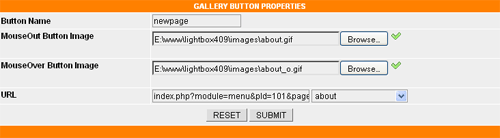
- Enter the Button Name.
- Select the Mouse Out Button Image for the new navigation button. This button image will be used when the user moves their mouse off the button image.
- Select the Mouse Over Button Image for the new navigation button. This button image will be used when the user moves their mouse over of the button image.
- URL - You can either enter the URL directly into the input field or select the page in the next drop down list. The pages in the drop down list are all internal static pages that you have added in the Static Contents Manager and also the Stockbox default pages.
- Click on the SUBMIT button to add the new navigation button to the system.
- Gallery Navigation Menu Dropdown
When this option is selected, you can group several navigation menu items into one dropdown menu.

- The drop down navigation menu layout is controlled by the CSS file
called gallery.css file. Look for the /*** start css_menu_dropdown ***/ section.
- Using the Navigation Menu Dropdown option, you can categorize gallery
menus into one menu group.
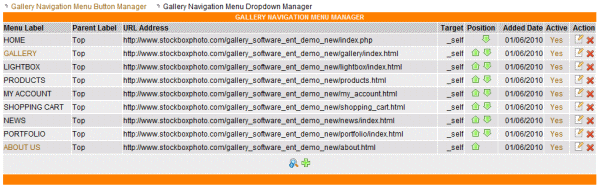
The HOME, GALLERY, LIGHTBOX, PRODUCTS, MY ACCOUNT, SHOPPING CART, NEWS (Ent. version), PORTFOLIO (Ent. version) and ABOUT US menus items are installed automatically when the Stockbox system is installed on your server.
- Menu Label
The system uses this label in the menu navigation item label. - Parent Label
When a particular menu label is under another parent label other than the TOP label, users must mouse over the parent label to see this sub menu item label. - URL Address
The URL Address that links to this menu label. - Target
Your web browser uses this option to open the URL in a new window, current window or parent window. - Position
Position of menu item label. - Added Date
The date that the label was added to the system. - Active
The system only displays a menu item label when its status is Active.
- To Edit a particular menu item label, click on
the
icon.
- To Delete a particular menu item label, click on
the
icon.
- To Add a new menu label to the system, click on
the
icon.
- To View the navigation menu layout, click on the
icon.
- Menu Label
Add New Navigation Menu
- When adding a new navigation menu item, the system will ask you for the parent group (level). The "Top" is the main group and any menu item that is in the TOP group will be displayed when the gallery is displayed in your web browser. Other groups (levels) will be displayed when you mouse over the parent group label like the GALLERY menu in the above screen shot.

- Group Label - Enter the group label for the new navigation menu item. The system will use this label in the navigation menu in the gallery. You can update it for the other languages (if applicable) later once it has been added to the system.
- URL - You can either enter the URL directly into the input field or select the page in the next dropdown list. The pages in the dropdown list are all internal static pages that you have added in the Static Contents Manager and also the Stockbox default pages.
- Target -
Select the target command in the drop down list.
The system will use this value for the target in the <a> tag.
_self: Browser will open the new page in the current window.
_parent: Browser will open the new page in the parent window.
_top: Browser will open the new page at the top of window.
_blank: Browser will open the new page in a new window. - Parent Group - Select the parent group for this new menu. If this menu is under any group besides the TOP group, then users must mouse over that navigation menu before being able to access this new navigation menu item.
- When adding a new menu group label, the status will be "Hidden" until you change the status in the Gallery Navigation Menu Manager section.
- Click on the SUBMIT button to add the new menu item.
- The drop down navigation menu layout is controlled by the CSS file
called gallery.css file. Look for the /*** start css_menu_dropdown ***/ section.
ADMINISTRATOR
This section can be used to add more administrative users to the database to manage your gallery. Using this feature you can create "Admin" users that can have full or limited management privileges.
- Administrator
Profile
Any administrator can access this page to update their profile.
- Click on the Administrator
Admin Profile link in the main menu function.
- Fill in all provided text fields.
- Click on the SUBMIT button to save the changes.

- Click on the Administrator
- Administrative
Groups
Use this feature to create new administrative groups for you gallery.
- Click on the Administrator
Administrative Groups link in the main menu.
- By Default there are two user groups available, master and user. The Master group is used for the admin users and the user group is used for customers. It is not possible to delete these groups from the database.
- To add more admin groups to Stockbox, check all boxes for the privileges that are needed and add a Group Name (do not leave spaces in the group name). Click on the Add button, to add the new group to the database.
- To delete an admin group, click on the
icon for the target admin group.
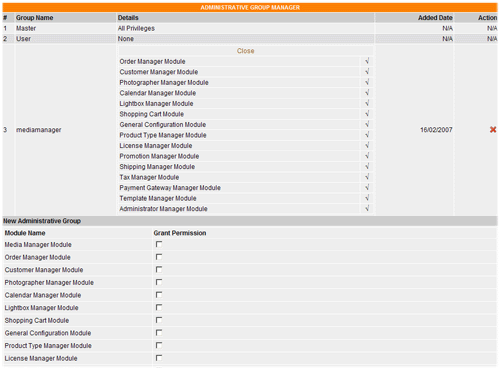
- Click on the Administrator
- Administrative
Users
Use this feature to add more administrator's to the gallery system.
- Click on the Administrator
Administrative Users link in the main menu.
- Fill in all provided text fields and click the Submit
button to add the new admin user. The new admin user must
be assigned to an administrative group. If you don't have any administrative
groups configured, please add the new administrative group by clicking
on the
icon.
- To delete an existing admin user, click on the
icon for the target admin user.
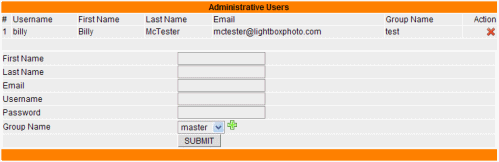
- Click on the Administrator
- Manage Blacklisted IP
This feature allows you to manage your IP Blacklist. Using this feature you can allow or restrict one or multiple IP Addresses to access your Public Gallery Modules.
- Blacklisted IP Address: Enter the IP address that you want to blacklist. Example: 127.0.0.1
- Module: Choose the modules that you want to restrict access to from the Public Gallery by clicking on the respective checkboxes.
- Click the Submit button to add your Blacklisted IP Address.
- The
icon
shows that the related Module is blocked.
- Click on the
icon
if you want to delete your Blacklisted IP Address.
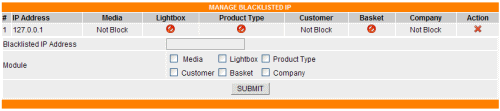
- Malicious Character Manager
This feature allow the system to delete, replace, or return errors when users input malicious characters.
- Click on the Administrator
Malicious Characters
link in the main menu
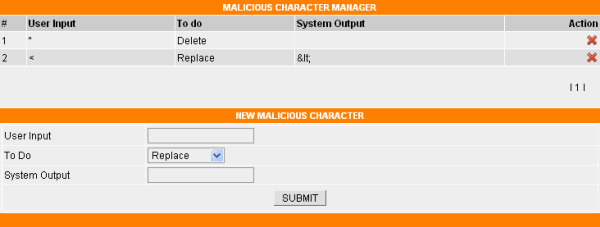
- Delete Option
When this option is set for a particular character, the system will delete the configured character from the input data before executing the user's requested action. - Replace
When this option is set for a particular character, the system will replace the configured character with the new output character before executing the user's requested action. - Return Error
When this option is set for a particular character, the system will return an error to the user's browser when it detects the malicious character that you configured in this section.
- Click on the Administrator
- Password Requests
The system will list all the password requests for the admin users. Anyone who requests the admin user password will be logged and their IP Address will display on this page. You can find out their location by clicking on the IP Address link.
- Media Statistics (Ent. version)
The Media Statistics feature provides you with traffic statistics for your gallery. In order for the system to log user's activities, you must enable the "Enable Media Stats Logs" option in the Media Configuration.
- Configuration
- Enable Blacklisted IP Address Checking
The system will activate the Blacklisted IP Address function when this option is enabled. - Enable Malicious Character Checking
The system will activate the Malicious Character checking function when this option is enabled. - Allow Admin Users Access to New Private Categories
When this option is enabled, the system will automatically add the admin users as Access Users to any newly created private categories.
- Enable Blacklisted IP Address Checking
ORDER DETAILS
Depending on the customer's orders, the system will display the order details differently. There are three order detail formats.
- PPP (Pay Per Purchase) order details
PPP orders are orders that customers purchase and pay for via a payment gateway during the checkout process. By viewing the order details, you will find all information that relates to the selected order id.

- Subscription order details (Ent. version)
Subscription orders, are orders that customers placed using their pre-purchased subscription to pay for the order. Customers need to purchase a subscription that you offer on the Products Page in the gallery before using it to pay for a new order. Related order details section lists all orders that used this purchased subscription during the checkout.
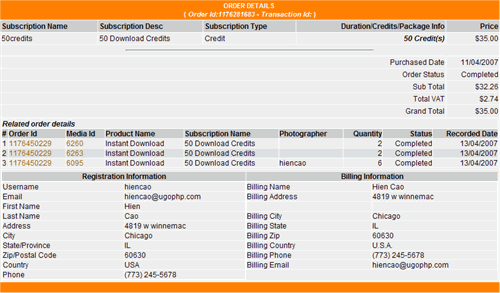
- Package order details (Ent. version)
Package orders are orders that customers used their pre-purchased packages to pay for their purchase. The customers need to first purchase a package that you offer on the Products Page in the gallery before using it to pay for their order. The Related order details section lists all orders that used this purchased package during the checkout.

- Virtual CD order details (Ent. version)
Click on the
Virtual CD Details link to view the image details.
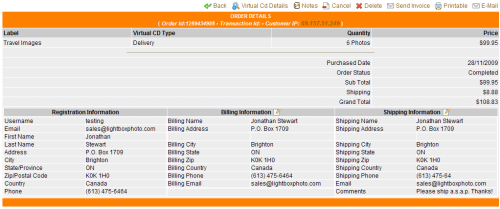
Other Functions
- To go back to Order Manager page, click on the
 Back link.
 - To add notes to the selected order, click on the
Notes link.
- To change the order's status (Cancel or Complete), click on the
Cancel or
Complete link respectively.
- To delete the selected order from the database, click on the
Delete link.
- To send an invoice to the customer's email address, click on the
Send Invoice link.
- To print the order details, click on the
Printable link.
- To email the order details to others, click on the
E-Mail link.
SUBSCRIPTION REPORT
You are only able to view a subscription report when it has expired or when
its credits are used up. The system displays a full report of the selected
subscription on this page. It even calculates the commissions for each photographer
if customers have purchased a photographer’s media.
To view a subscription report:
- Click on the Product Manager
Product Subscriptions link in the main menu.
- Click on the View Subscribers
icon.
- On the Subscribers page, click on the report
icon.
The system calculates the total credits and credit price as follows:
- Duration Subscription
The Credit Price is the Subscription Price divided by the Total Credits. The Total Credit is a sum of all credits that customers used from the activation date, to the date before the expiration date. - Credit Subscription
The Credit Price is the Subscription Price divided by the Credit Amount. The Credit Amount is the number that was assigned when the subscription was created.
The system uses the Credit Price multiplied by the media credit cost and its quantities to get the media price. When it has a media price then it uses the same formula to calculate the photographer’s commission. If you are using the VAT system for tax, the system will divide the VAT amongst all photographers.
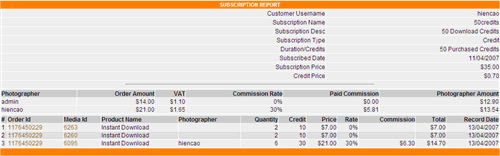
PACKAGE REPORT
You are only able to view package report after it has been used. This is similar to the subscription report.
To view a package report:
- Click on the Product Manager
Product Packages link in the main menu.
- Click on the View Subscribers
icon.
- On the Subscribers page, click on the report
icon.
The total credit is a sum of all credits of the purchased package.
The credit price is a result of a package cost divided by total credit used. The system uses the credit price multiplied by the media credit cost and its quantities to get the media price. When it has the media price then it uses the same formula to calculate the photographer’s commission. If you are using the VAT system for tax, the system will divide the VAT amongst all photographers.
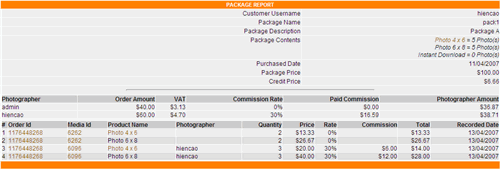
PRICING
MEDIA
By default any media that you upload to the system will be displayed for
viewing by customers. However, the customers will not be able to add items
to their shopping cart unless you apply a price to a product type for that
media. There are various ways to price your media.
- You can use the Global Pricing feature in the Product
Manager
Product
Types section to apply a price to multiple Product Types for selected
categories, or to all categories of media.
- You can use the Product Type Price & Credit Update pricing
feature in the Product Manager
Product
Types section to price media by Product Type.
- You can use the Category Auto Price feature in the Media Manager section to auto assign pricing to new media uploaded to the selected categories.
- You can price Selected Media by selecting them in the Media Manager section.
- You can assign pricing to Individual Media by editing the particular
media in the Media Manager section.
- Global Pricing (Pro. & Ent. versions)
Use this function to assign pricing to selected Product Types, to selected categories of media at one time. You can also use the same function to apply pricing to all Product Types, to all categories of media at one time.
- Click on the Global Pricing link or its
- All Product Type Checkbox
Tick this checkbox, to tick all of the current Product Type checkboxes at once. This will apply pricing to ALL Product Types.- Specific Product Type Checkbox
Tick the specific Product Type checkboxes that you want to apply pricing to. This will apply pricing only to the selected Product Types.
- All Categories checkbox
Tick this checkbox, to tick all of the current category checkboxes at once. Pricing will be applied for all "checked" Product Types to ALL categories in the gallery.- Specific Category Checkbox
Tick the specific category checkboxes that you want to apply pricing to. Pricing will be applied for all "checked" Product Types only to the selected categories in the gallery.- Include Sub-Categories Checkbox
Tick this checkbox if you want the system to auto check or un-check all sub-categories of the selected category when the parent category is checked or un-checked.
- Click the Submit Button to update the Base Price and Base Credit for the selected Product Types to the selected Categories.
Remove Products/Pricing
If you would like to remove a product type from display, you can enter a price of 0.00.
- Product Type Price & Credit Update (Pro.
& Ent. versions)
This function is similar to the Global Pricing function, but instead of allowing you to select multiple Product Types together, it only allows you to apply the Global Pricing for the Selected Product Type only.
- Click on the Product Type Price & Credit Update
icon for the particular Product Type.
- Change the Base Price and Credit as desired.
- Tick any category checkboxes that you want to assign the product pricing to and click on the Submit button. The system will update all of the media in the selected categories with the target Product Type's Base Price and Credit values.
- Click on the Product Type Price & Credit Update
Remove Products/Pricing
If you would like to remove a product type from display, you can enter a price of 0.00.
- Category Auto Price and Credit Configuration
(Pro. & Ent. versions)
Use this configuration to disable the automatic pricing function set in the Product Manager Product
Types section or enable the automatic pricing function for a particular
Product Type to selected categories.
- Click on the
- System Path
This is the path of the target category.- Disable Automatic Pricing on this Category
To disable the "Auto Price" on the target category tick this box. To Enable Auto Pricing, this box should remain un-checked.- Including Sub-categories
To apply the same setting to the subcategories of the target category, tick this box. The settings will be applied once the action is completed by clicking on the Apply icon.- Product Type
Tick the Product Types that you want to "Auto Price" in the target category. The system will auto price the configured base price and base credit for all future media that are uploaded to the target category.- Click on the Apply icon to set the new configuration.
- Pricing Selected Media
To apply pricing for multiple selected media, you will first need to select the particular media in the Media Manager by ticking the checkbox in the second column in the Media Listing section.
- Click on the Media Manager
- Select the particular media.
- Click on the
- Update Type
Select the update type you want to apply from the dropdown list. The "Credit" Type is only available in the Ent. version.- Price / Credit (Ent. version)
Enter a price or credit cost that will be set to all media in the selected category for the specified product type.- Product Type
Select the product type that you wish to assign a price to.
- Click on the Update button to update the pricing/credit values.
Remove Products/Pricing
If you would like to remove a product type from display, you can enter a price of 0.00. This can be applied to a category or for the entire gallery by using the Global Pricing feature in the Product Manager section.
- Individual Pricing of images:
- Click the Media Manager
- Browse to the category where the media you want to set the price for is located.
- Click on the Edit
- If this Product Type is an instant download type, tick the "Enable Download Link" checkbox. The Enable Download Link will popup a small window to allow you to assign the download file to this media's product type. You should assign the download link before entering the pricing values.
- Enter the price to the media's Product Type field. The price must be numeric (no currency symbol).
- Enter the Shipping Cost and Additional Item Shipping Cost, if you want to charge a shipping cost based on the single item shipping method.
- Click the Submit button to assign a price to the media's product type.
- Remove Products/Pricing
If you would like to remove a product type from display, you can enter a price of 0.00.
SAMPLE DOWNLOAD FILES (Comp. Images)
With the Pro. and Ent. versions you can offer a sample download
file for any media. This feature can be used to offer "watermark
free comp images". There are three options that are available
for you to choose from in the Media Configuration.
- Use Displayed Media: Use this option if you want the system to use the display image for the sample download file.
- Use "sample_" prefix Media: Use this option if you
want the system to use a different image (other than the display image)
for the sample download file. You must create the sample download file
and prefix it with "sample_" (without the quotes) and then upload it
via FTP to the same directory where the corresponding display file is located.
Note: If you use the batch upload feature in the Media Manager
you can select to upload the "Sample Files" so that you do NOT
have to prefix the files prior to uploading them as they will be
automatically prefixed by the system.
e.g.
Media Name: beautiful_sunset.jpg
Media Path: gallery/landscape/beautiful_sunset.jpg
Then the sample download file must be as follows:
Sample download file name: sample_beautiful_sunset.jpg
Its path: gallery/landscape/sample_beautiful_sunset.jpg
The system will display a Download Sample
icon on the Media Detail page for the corresponding image if it detects the sample file on the server.
- Disable Sample Download: Use this option to disable the sample download feature in your gallery.
LANGUAGE FILES
The Stockbox language files are located in the language folder and its module directories. You can use this section to translate the displayed text into a foreign language or to customize certain items for your particular gallery. There are three types of language files.
- Admin Control Panel Section
Any file that begins with "admin." is used in the admin control panel.
- Gallery Section
Any file that begins with "user." is used for the gallery section.
- Contributors (photographers) Section (Ent. version)
Any file that begins with "cb." is used for the photographer's section.
You can also change some additional language items through the Smarty templates that reside in the tpl/english directory and its module directories.
The Ent. version has a multi language feature
that allows you to offer additional languages for your customers to
select from.
RSS FEEDS (Pro. & Ent. versions)
RSS is an acronym for Really Simple Syndication or Rich Site Summary. It allows users to get the latest updates to your gallery content through the RSS feed URL. There are seven RSS Feed URLs that the Stockbox system supports.
Click on the Configuration
RSS
link in the main menu.
- Featured Media RSS
- Featured Media RSS
Disable: The system will remove the RSS Feed icon in the Featured Media column in the gallery.
Use Current Featured Media Setting: The system will use the same method that you have configured in the Featured Media section of the Media Configuration when users click on the Featured Media RSS Feed Icon.
List all Featured Media: The system will list all Featured Media in the database when users click on the Featured Media RSS Icon. - RSS Title
Thes system will use this title for the Featured Media RSS page. - RSS Description
The system will use this description for the Featured Media RSS page.
- Featured Media RSS
- Category Listing RSS
- Category Listing RSS
Disable: The system will remove the RSS Feed icon on the Category listing page.
Use Current Gallery Listing Page: The system will use the current contents of the selected category for the the Category RSS Feed Page.
List all Contents of current viewed category: The system will list all contents (sub-categories, media) of the current viewed category for the Category RSS page. - RSS Title
Use Default Title: The system will use the default title that you enter in the RSS Default Title field for the Category RSS page title.
Display Name: The system will use the category display name for the Category RSS page title.
Description: The system will use the category description for the Category RSS page title. - RSS Description
Use Default Description: The system will use the default description that you enter in the RSS Default Description field for the Category RSS page description.
Display Name: The system will use the category description for the Category RSS page description.
Description: The system will use the category description for the Category RSS page description. - RSS Default Title
The system will use this default title when you choose the "Use default title" option in the RSS Title option. - RSS Default Description
The system will use this default description when you choose the "Use default description" in the RSS Description.
- Category Listing RSS
- Virtual CD RSS
- Virtual CD RSS
Disable: The system will remove the RSS Feed icon from the Virtual CD column in the gallery.
Use Current Virtual CD Listing Option: The system will use the current setting that you have configured in the Virtual CD Configuration when generating the Virtual CD RSS page.
List all virtual CD: The system will list all Virtual CD on the RSS page. - RSS Title
The System will use this title for the Virtual CD RSS page title. - RSS Description
The system will use this description for the Virtual CD RSS page description.
- Virtual CD RSS
- Photographer Listing RSS
- Photographer Listing RSS
Disable: The system will remove the RSS Feed icon from the Photographers column in the gallery.
Use current featured photographer listing option: The system will use current settings of the photographer listing option when generating the Photographer Listing RSS page. - RSS Title
The system will use this title for the Photographer Listing RSS page title. - RSS Description
The system will use this description for the Photographer Listing RSS page description.
- Photographer Listing RSS
- New Media RSS
- New Media RSS
Disable: The system will remove RSS Feed icon from the New Additions page in the gallery.
Use the current New Media listing page: The system will generate the New Media RSS page based on the number of media on current page of the New Additions listing page.
List all media: The system will list all media on the New Additions pages for the New Media RSS page. - RSS Title
The system will use this title for the New Media RSS page title. - RSS Description
The system will use this description for the New Media RSS page description.
- New Media RSS
- Popular Media RSS
- Popular Media RSS
Disable: The system will remove the RSS Feed icon from the Most Popular page in the gallery.
Use the current Popular Media listing page: The system will generate the Popular Media RSS page based on the number of media on the current page of the Most Popular media listing page.
List all media: The system will list all media on the Most Popular page for Popular Media RSS page. - RSS Title
The system will use this title for Popular Media RSS page title. - RSS Description
The system will use this description for the Popular Media RSS page description.
- Popular Media RSS
- News RSS
- News RSS
Disable: The system will remove the RSS Feed icon from the News page in the gallery.
Use the current News listing page: The system will generate the News RSS page based on the number of current news items that are on the News listing page.
List all media: The system will list all news on the News page for the News RSS page. - RSS Title
The system will use this title for the News RSS page title. - RSS Description
The system will use this description for the News RSS page description.
- News RSS
Click on the SAVE button to save the changes.
When these options are enabled in the RSS configuration section, the
system will display the RSS feed icon in the respective section in the
gallery. Users can click on the icon to obtain the Feed URL.
REGISTRATION
The dynamic registration feature allows you to add, edit, or delete registration form fields. There are three fields already included in the registration form that are required by the system. These are username, password and email address. These are required by the system to track the customer's activity and orders.
- To view the current customer registration form fields, click on
the Customers
Registration in the main menu.
- To view the current photographer form fields, click on the
Photographers
Registration in the main menu (Ent. version).
- To view the current registration layout click on the
icon in the registration view page.
- To delete an existing form field from the database, click on the
icon for the target form field. When you delete the form field from
the database, all of the customer data captured will be deleted from
the database. We recommend that you make the field inactive, rather
than delete it. Any inactive form fields will not display on the registration
form.
- To move a field up or down in the list, click on the
or
icons
respectively.
- To edit an existing form field, click on the
icon for the target form field. You can't change the field name once
it has been created. With the Ent. version, you can edit the data for
other languages by selecting the other language in the language drop
down list.
- To add a new form field to the current registration form, click
on the
icon in the registration view page.

- Field Name
The database name of the field. The name should not contain any invalid characters such as ~ ! @ # $ % ^ & * ( ) + \ | } { [ ] " : ; > . < , ? / 1 2 3 4 5 6 7 8 9 0 or spaces. - Field Type
There are five field types available in the drop down-list. They are TEXT, SELECT, TEXTAREA, RADIO and CHECKBOX types.
- TEXT
Use this field type to collect data from your customers. It is useful for collecting items such first name, last name, address, phone numbers etc. - SELECT
Use this field type when you want your customers to select from a set of available options in a drop down menu. It's good to use this type for States and Countries. This field type is also useful if you are requiring matches to charge tax. This method will avoid user input error and therefore allow an exact match. - TEXTAREA
Use this field type to collect a large amount of data from your customers. It's good to use this field type to collect customer comments or feedback. - RADIO
Using this field type gives customers no choice on input data. - CHECKBOX
Use this field type for a simple YES (check the box) answer to a question.
- TEXT
- Default Value
The field's default value. This value will be displayed initially. If the SELECT type is selected, each value should be separated with a ; (semi colon) and the last value should also end with a ; (semi colon).
If the CHECKBOX or RADIO type is selected then the true value is 1 and the false value is 0. Enter 1 to make the box checked as default, otherwise leave it blank or enter 0 for the default value. - Field Size
Field size is the width of the field. - Max Size
Max size is the maximum number of the characters allowed to be entered. - Active
To make a field active on the form, check this box. - Required
To make a field required, check this box. Once the box is checked users must input data into this field. - Error if contains
The script will check for errors based on any entered character: ex ~~!@#$%^&*()+=|\}]{["':;?/>,< These can be removed if not required, but at least one character must remain. - Field Label
Label of the field (this will be displayed to the end-user). - Display Error
This error message will be displayed if an error (as defined above) is detected. - Submit
To add the new field, click the Submit button.
Configuration
section.You can use this registration form function to create as many form fields as you need. Active fields will be displayed for the customers in the registration form. The data submitted is stored in the database for shipping and billing purposes.
FTP SERVER
This feature allows you to run the Stockbox installation on one server, while storing the high resolution download files on another server. This method should be considered a secondary option as Stockbox needs time to obtain the files from the other server before allowing customers to download it. Therefore it will take twice as long for this action to complete compared with the same action if the download files were stored on the same server.
To use this function you need to setup the FTP information for each category. Stockbox will use this configuration information to connect to the remote server and obtain the downloaded files.
Setup FTP information (Ent. version)- Click on the Media Manager
Media Manager link in the main menu.
- Browse to the target category.
- Click on the
icon for the target category.
- Fill in all FTP info to the provided text fields.
- SSL FTP Connection: check this box if your server requires an SSL connection.
- Port #: By Default the port number is 21 for most FTP servers. Enter the port number to this field if yours is different.
- Click the GET button to check the entered data.
If the information entered is correct you should see the same as the
screen shot below.
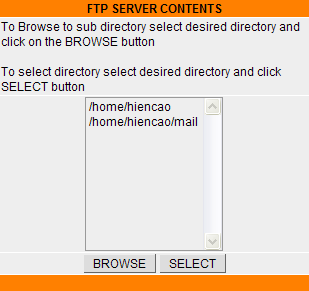
- You need to select the remote directory that holds the download files for the selected category.
- To browse to a subcategory, select the category in the popup window and click the BROWSE button.
- To select the directory that holds the download files for the selected category, click the SELECT button.
- The path of the selected directory will be filled in the Category Remote Directory text field when the popup window is closed.
- Click the Submit button to set the FTP info for the selected category.
SAFE MODE
Stockbox requires the safe_mode variable to be turned off when adding new categories or media through the browser based admin area. To check the status of the safe_mode variable, run the info.php file that comes with the Stockbox package http://www.yourdomain.com/path-to-stockbox/info.php. Replacing the yourdomain.com with your domain name and path-to-stockbox to the path of where Stockbox is installed.
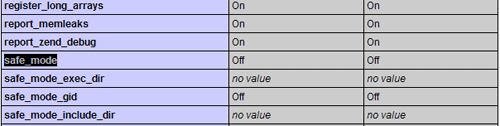
When the info.php file is run from your web browser, you
should see the above screen shot. Look for the safe_mode
variable and make sure that it's Off. If it's On, please ask your hosting
provider to turn it Off.
SMTP SERVER CONFIGURATION
If you experience problems with your default mail server, you can use this feature to send mail. The SMTP server generally takes longer to send out email compared with the default mail server, so it is recommended that you use the Default Mail Server if available.
To configure the SMTP Mail Server:
- Click on the General Configuration
link in the main menu.
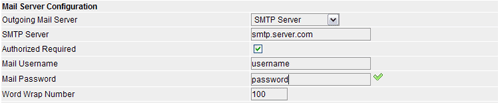
- Select SMTP Server in the Outgoing Mail Server drop down list.
- Enter SMTP Server info.
- Check the Authorization Required checkbox if your SMTP server requires you to login before sending mail.
- Enter username for this SMTP Server.
- Enter password for this SMTP Server.
- Enter Word Wrap Number.
- Click on the
icon to test if the entered information is correct. If it is, you will
receive an email that is sent to the email address in the "Notification
Email Address" text field .
- Click on the Submit button to save the changes.
MEDIA CONFIGURATION
This section allows you to configure the gallery thumbnails, watermarks, etc., etc...
Click on the Configuration
Media
link in the main menu.- New Media Method
Select the New Media Method from the drop down list. There are two methods that are available:
Use Given Date: When this option is selected, the system will list all media on the "New Additions" page that were added to the system on the same date or any date after the date entered in the "Enter Date to be considered new" field.
Use # of Days: when this option is selected, the system will list all media on the "New Additions" page that were added to the system within the specified number of days in the "Enter Number of days to be considered new" field, prior to the current date.
- Enter Date to be considered new
You can either enter the date in the displayed format or click on the
icon to open the date selection window. Select the month and year from
the drop down menu and then click on the calendar date to complete the
date selection. The system will use this date to determine which images
will be displayed in the "new media" section of the website.
Images added to the system prior to the date submitted will not be displayed
in this section.
- Enter Number of days to be considered new
Enter the number of days from the current date that you want the system to consider media to be new in the "New Additions" section.
- Thumbnail Prefix Name
This name will be prefixed to the image filename to create the thumbnail filename. This is how the gallery matches the thumbnails to the larger display images. e.g. If the display image is image1.jpg then the thumbnail generated (using the default value) by the system, will have a filename of gallery_image1.jpg. The thumbnails generated by the system will be saved in the same folder as the larger display images.
- Thumbnail Generation Method
There are two methods that are available for you to choose from:
Fixed Size: when this option is selected, the system will generate thumbnails for your display images based on the fixed size that is input in the "Thumbnail Size" Field. The thumbnail size would be calculated base on the longest dimension (side) of your images. The system will calculate the other thumbnail dimension proportionally base the Fixed Size.
Percentage: when this option is selected, the system will generate thumbnails for your display images by reducing the original display image by the percentage that is configured in the "Reduce from its original size" field.
- Thumbnail Size
Enter the fixed thumbnail size. This configuration is only applied when the "Fixed Size" option has been selected in the "Thumbnail Generation Method" field.
- Reduce from its original size
The thumbnail size will be created based on this percentage reduction. Therefore, to create a smaller thumbnail you will have to input a larger number (more reduction). This configuration is only applied when "Percentage" has been selected in the "Thumbnail Generation Method" field.
Original image Percent setting Resulting thumbnail 500 px 50% 250 px 500 px 60% 200 px 500 px 70% 150 px 500 px 80% 100 px 350 px 50% 175 px 350 px 60% 140 px 350 px 70% 105 px 350 px 80% 70 px
- Overwrite Thumbnail Enable
Check this box if you want to be able generate a new size of thumbnail and have the previous file replaced (overwritten). This feature is designed to allow you to experiment with different size thumbnails until the desired size is achieved. Once the desired percentage reduction is determined, the overwrite enable box should be un-checked. Otherwise, it can cause a server time out before the operation completes in a large category of images. For large galleries, it is recommended that the existing thumbnails are deleted from your server using your FTP client and then generate new thumbnails.
- Auto Generate Thumbnails on New Media
Check this box and the thumbnail images will automatically be generated (according to the size specified above) when new media are brought into the system using the Auto Detect feature. Make sure that you have set the folder permissions to 777 before using the Auto Detect Feature, otherwise the thumbnails will not be generated.
- Enable Auto Resize Image for New Images
Tick this option if you want the system to auto resize the displayed image to the "Resize To" size, when new media are brought into the system using the Auto Detect feature. Make sure that you have set the folder AND file permissions to 777 before using the Auto Detect Feature, otherwise the thumbnails will not be generated.
- Resize To
This feature is not recommended for a large category of images, or for very large files, as the server may timeout before the operation completes. If a blank page is displayed, please continue refreshing the screen until the message "Action Performed Successfully" is shown. This indicates that the resize image process is complete. It is more efficient to run a batch process to resize your images for display prior to upload.
Enter the new size here if you want to resize any image which is larger than the size set here. The system will resize the longest dimension of the images to the size entered in the configuration page. The system will maintain the aspect ratio of the images during the resize process.
e.g. If you enter 500 Pixels and the image size is 1772px by 1186px. Then the system will re-size the image to 500px by 334px. Using this feature helps you to resize all images to the same width or height. We suggest a size of 500 pixels wide for your display images. However, you can have your images display at whatever size you prefer.
Note: images can't be recovered to their original size after resizing. So please make sure that you backup all images before doing so. Before using this feature, you must ensure that all image folders and files have permissions of 777 (r/w/e).
- Watermark Type
There are two types available, Image or Text.
- If the Image option is selected, the system
will use the image that is shown in the line Watermark Image
or Logo for the watermark.
- If the Text option is selected, the system will
use the Watermark text string for the watermark.
- To view a demo of how the image looks after
it has been watermarked, click on the
icon.
- If the Image option is selected, the system
will use the image that is shown in the line Watermark Image
or Logo for the watermark.
- Transparency Value
This value can be changed to adjust the transparency of the watermark that is applied to the image. The default value is 30. The higher the number the less transparent the image. You can view the effect of changing this value by clicking on the
icon to use the watermark demo feature.
- Watermark Image or Logo
Click on the
icon to upload a new image to be used for watermarking.
- Click on the Browse button, to browse to the image on your local machine.
- Click on the Upload button to upload the new image to the server.
- The new image will replace the existing image and it will be used once it has been upload to the server.
- Watermark Text
Enter the text string that you wish to apply to the display images.
- Watermark text Font size
Enter the Font Size for the Watermark Text if you have selected the Text watermark option.
- Watermark Text Color (No # symbol)
Enter the HEXADECIMAL color value (No # symbol) for the text color that you want to use for the watermark text string.
- Watermark position
Enter the position that will be used to place the watermark image or text on the display image.
- Auto Watermark on New Images
Tick this option if you want the system to auto watermark your display images when new media are brought into the system using the Auto Detect feature. Make sure that you have set the folder AND file permissions to 777 before using the Auto Detect Feature, otherwise the images will not be watermarked.
- ImageMagick® Configuration (Ent. version).
Before using the Media Utilities function you need to input a valid ImageMagick® path. If you don’t have ImageMagick® installed on your server, please visit the ImageMagick® web site to download and install this package before configuring this section. If you are unable to install ImageMagick®, then you will need to ask your host to do this for you.
- ImageMagick® Path
The ImageMagick® path is a path that you provide during the ImageMagick® installation. Please ask your host for this path if you are unsure.
- Click on the
icon to test the input path.
- ImageMagick® Path
- Sample Download Media Type (comp. images) (Pro.
& Ent. versions).
The Sample Download feature can be used to offer "watermark free comp images". There are three options that are available.
Use Displayed Media: Use this option if you want the system to use the display image for the sample download file.
Use "sample_" prefix Media: Use this option if you want the system to use a different image (other than the display image) for the sample download file. You must create the sample download file and prefix it with "sample_" (without the quotes) and then upload it to the same directory where the corresponding display file is located.
Disable Sample Download: Use this option to disable the sample download feature in your gallery.
- Require Login To Download Sample Media (comp.
images) (Pro. & Ent. versions).
Check this checkbox if you want to require users to login before downloading sample download files.
- Enable Zip Function for Sample Download
Check this option if you want the system to zip the sample download file before allowing the user to download it. Use this option if your sample download files are in an uncompressed format.
- Ignore Sample Download File Extension
This option is only applied when you choose the "Use "sample_" prefix Media" option in the "Sample Download Media Type" field. Tick this checkbox and the system will ignore the difference between the display and the sample download the file extensions. e.g. If you have .jpg display images and you have .tiff sample download files, then you will need to check this box.
- Category Display Style
There are two ways to display the main categories of your gallery.
Listing Style: Stockbox displays the main categories in a listing format.
Dropdown Style: Stockbox displays the main categories in a drop down menu format.
- Enable Category Tree Menu (Pro. & Ent. versions)
Enabling this option will make your Category Listing menu expandable and collapsible.
- Expand Category Tree Upon Loading (Pro. & Ent.
versions)
Check this option if you want the system to expand all categories (inc sub-categories) in the gallery category tree listing section when the gallery is first displayed. You should avoid using this option if you have more than two category levels. If there are many category levels in your gallery, it will use a lot space in the gallery which could affect the gallery layout. This option is only applied when the "Category Listing Style" is selected in Listing Style option.
- Number of Category Columns Per Page
The number of category columns that will be displayed per page.
- Category Default Sort Field Name
System Name: Category listings will be sorted based on its system name.
Display Name: Category listings will be sorted based on its display name.
Last Modified: Category listings will be sorted based on its last modified date.
Sort Order Value: Category listings will be sorted based on its order value that you enter in the Media Manager.
Random: Category listings will be sorted randomly.
- Category Default Sort Order Direction
Ascending: Category listings will be sorted in ascending order (lowest to highest).
Descending: Category listings will be sorted in descending order (highest to lowest)
- Show Category Listing Stats
Check this checkbox if you want the category stats to be displayed in the gallery next to the category name. The category stats display how many categories and media are in the displayed category.
- Show Category Bar Stats
By checking this box, the bar containing the category stats XX Media in XX Categories will be displayed. To remove this bar, un-check the box. The appearance of this bar can be modified in the CSS file in the template folder.
- Show Category Breadcrumb Links
By checking this box, the bar containing the category links (breadcrumbs) will be displayed. To remove this bar, un-check the box. The appearance of this bar can be modified in the CSS file in the template folder.
- Enable Category Stats Logs (Ent. version)
Check this checkbox when you want the system to log user info when they are browsing to a particular category. The category statistics are in the Media Manager
Media Statistics section.
- Use "Random Image" For All Categories with No Icon
Assigned (Pro. & Ent. versions)
When this option is selected, the system will use a random thumbnail from the particular category for its category icon when there is no icon assigned to that particular category.
- Number of Featured Category Rows (Ent. version)
Enter the number of featured category rows to be used in the home page.
- Number of Featured Category Columns (Ent. version)
Enter the number of Featured category columns to be used in the home page.
- Most Popular Media Sort Method (Ent. version)
There are three values available.
User Most Hit: When this option is selected, the system will list the most popular media based on the number of hits. The media with the most number of hits (views) will be displayed first.
User Most Sold: When this option is selected, the system will list the most popular media based on the number sold. The most sold media will be displayed first.
Use Random Featured Media: When this option is selected, the system will list the most popular media using featured media list randomly.
- Featured New Additions Method (Ent. version)
Use Random Media of New Additions: When this option is selected, the system will randomly pick one media in the new additions media list to be displayed in the featured "NEW ADDITIONS" section on the home page.
Use Latest Media of New Additions: When this option is selected, the system will use the latest media in the new additions media list to be displayed in the featured "NEW ADDITIONS" section on the home page.
- Enable Featured Media (Pro. & Ent. versions)
Tick this checkbox if you want to enable "Featured Media" in your gallery. With this feature enabled, in the Media Manager section you can designate particular images to be "featured".
- Featured Media Display Style (Pro. & Ent.
versions)
There are two ways to display the featured media section.
Vertical Style
Stockbox will display the media designated as featured in the Media Manager in a Vertical Style. The number of images displayed is restricted by the Featured Media Display Number value.
Horizontal Style:
Stockbox will display the media designated as featured in the Media Manager in a Horizontal Style. The number of images displayed is restricted by the Featured Media Display Number value.
- Featured Media Display Number (Pro. & Ent.
versions)
Stockbox uses this number to limit the number of featured media images to be displayed in the featured media section.
- Enable Global Featured Media in Gallery (Pro. & Ent.
versions)
Check this checkbox if you want the system to always show featured media in the gallery, regardless of the current browsing category.
- Reference ID Prefix (Pro. & Ent. versions)
Enter the prefix for the media reference ID. When media is imported into the gallery, the system will automatically generate the media reference ID and prefix it with this value. The Media Reference ID is changeable on the Media Properties page for the particular media.
- Number of Thumbnail Columns Per Page
The number of media columns per page that will be used to display the media thumbnails.
- Number of Thumbnail Rows Per Page
The number of media rows per page that will be used to display media thumbnails.
- Media Default Sort Field Name
Before displaying media in the user's browser, the system will sort the data based on this field setting. Select a value from the drop down list to be used as the default sort field.
System Name: the media will be sorted based on system file name.
Display Name: the media will be sorted based on media display name input in the Media Properties page for the individual media.
Added Date: the media will be sorted based on when the media was added to the system.
Last Modified: the media will be sorted based on when the media was last modified.
- Media Default Sort Order Direction
There are two types of sort order. Select a value from the drop down list to be used as the default sort order.
Ascending: the media will be sorted in ascending order (lowest to highest).
Descending: the media will be sorted in descending order (highest to lowest).
- Remove File Extension for Media Display Name
By default, Stockbox uses the system filename as the display name and the system filename includes the file extension. To remove the file extension from the display, check this box.
- Media Alt Tag
To better index your site, search engines require images in your site to have an "alt" (alternative text) tag with a description. Stockbox provides you with an option to set the ALT tag for your media using information already stored in the database according to one of the following fields:
Use Media Display Name: The system will add the media display name that you entered into the Media Manager for the particular media to its ALT tag.
Use Media System Name: The system will add the media system name to for the particular media to its ALT tag
Use Media Description: The system will add the media description that you entered into the Media Manager for the particular media to its ALT tag.
Use Media Author: The system will add the media author data that you entered into the Media Manager for the particular media to its ALT tag.
Use Media Copyright: The system will add the media copyright data that you entered into the Media Manager for the particular media to its ALT tag.
Use Media Keyword: The system will add the media keyword data that you entered into the Media Manager for the particular media to its ALT tag.
Use IPTC Metadata: You can select the specific IPTC field that you want the system to use. The system will add the data stored in the selected IPTC field for the particular media to its ALT tag.
- Require Login To View (Pro. & Ent.
versions)
You can use this feature to require users to login before viewing media thumbnails, or the media details page. There are three options that are available.
No Login Required : When this option is selected, users will not be asked to login to view the thumbnails or the media details page.
Media Thumbnails Page: When this option is selected, users must login to your site before being able to view the gallery thumbnails page.
Media Details Page: When this option is selected, users must login to view the media details page but they can still view the thumbnails page without logging in.
- Media Preview Feature (Pro. & Ent. versions)
When this option is enabled, users are able to preview any media in the gallery by hovering their mouse the thumbnail image. There are 3 options that are available.
On by Default: when this option is selected, the system will turn ON the Media Preview Feature by default when users are browsing the gallery. Users are able to turn this feature OFF at anytime by clicking on the "Turn Off Media Preview" link in the gallery.
Off by Default: when this option is selected, the system would turn OFF the Media Preview Feature by default when users are browsing the gallery, but they are able to turn this feature ON at anytime by clicking on the "Turn On Media Preview" link in the gallery.
Disabled: select this option if you don't want this feature to be available for your gallery users.
- Media Preview Window Size (Pro. & Ent.
versions)
The system will use this number to resize the display image before displaying it in the Media Preview Window. This option only applies when "Media Preview Feature" is enabled.
- Enable Tab View on Media Detail Page (Pro. & Ent.
versions)
This option is useful if you have many fields of embedded IPTC metadata. When this option is enabled, the system will list the IPTC metadata in separate tab on the Media Details page and users are able to click bon this tap to view the contents. This will prevent users from having to scroll down the page to view the IPTC Metadata.
- Show Download File Information for Instant Download Media on the Media Details Page (Pro. & Ent. versions)
Check this option when you want the system to display the download file info on the media details page. This option only applies to Images and it will display the file size and file dimensions.
- Media Detail Page Table Width (Pro. & Ent.
versions)
Enter the fixed width for the display media file that is used on the media details page. This feature will prevent display issues due to inconsistent sizing of display media.
- Enable Media Stats Logs (Ent.
version)
Check this option when you want the system to log user info when they are browsing to a particular media. The media statistics are in the Media Manager
Media Statistics section.
- Enable "Quick Jump Field" on Gallery Thumbnails
Page (Pro. & Ent.
versions)
Use this feature when you have many media in a particular category. This option allows users to jump to any page with one click, rather than having to browse through the media pages.
- Maximum Portfolio Media Height (Ent. version)
Enter the maximum height that the system will use for the portfolio detail page. To change the portfolio detail page width, please see the template section of the CSS file.
- Portfolio Category Default Sort Field Name (Ent. version)
Select the value for the portfolio sort field name. The system will use this sort value when displaying the portfolios in the gallery.
- Portfolio Category Default Sort Order Direction (Ent. version)
There are two types of sort order. Select a value from the drop down list to be used as the default sort order.
Ascending: Category listings will be sorted in ascending order (lowest to highest).
Descending: Category listings will be sorted in descending order (highest to lowest)
- Portfolio Media Default Sort Field Name (Ent. version)
Select the value for the sort field name for the portfolio media. The system will use this sort value when displaying the portfolio media in the gallery.
- Portfolio Media Default Sort Order Direction (Ent. version)
There are two types of sort order. Select a value from the drop down list to be used as the default sort order.
Ascending: Category listings will be sorted in ascending order (lowest to highest).
Descending: Category listings will be sorted in descending order (highest to lowest)
- Portfolio Category Display Style (Ent. version)
Vertical: The system will list all active portfolios in a vertical style.
Horizontal: The system will list all active portfolios in a horizontal style.
- GD Version 2.0 or Higher
To view the GD version installed on your server, click on the
icon. Look under the GD section of the page displayed and if it says
“2.0 or higher”, then check the box. Stockbox will run on previous versions
of GD, but the thumbnail quality will be relatively poor.
- Set "Hidden" status on Newly Uploaded Media (Pro. & Ent.
versions)
Use this option when you're not ready to publish your images to the gallery during the Auto Detection process. When this option is enabled, all new media will have a status of "Hidden" and will remain hidden from gallery users until you change the status in the Media Manager to "Public" by clicking on the "Change Status" icon for the respective media or category.
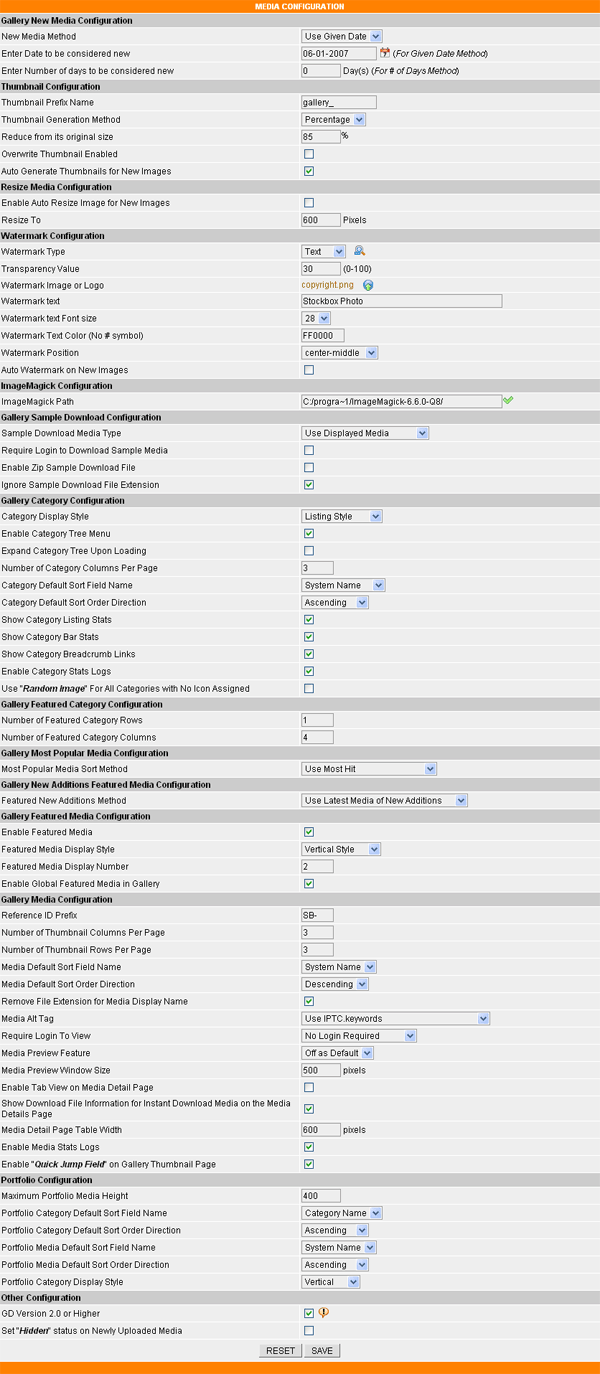
DOWNLOAD DIRECTORY
The download directory is used to store the hi-res download files. By default it is protected by the Apache .htaccess file. Apache will block all access to this directory from web browsers, so all files that reside in this directory are secure. To confirm that this directory is protected, you can enter the following URL into your browser's address field:
- http://www.yourdomain.com/path-to-stockbox/download/
- If the download directory is secure you should see a forbidden (403
error) message displayed in your browser.
- If there is no forbidden message displayed, then you need to
check the following:
- Make sure that the supplied .htaccess file is in the download folder.
- Ensure that the web server is running Apache.
- Ensure that the httpd.config file is properly configured.
<Directory />
Options FollowSymLinks
AllowOverride All
</Directory>
If you are running IIS (Internet Information Services), you should protect the download directory using the instructions below. The .htaccess will not work with the IIS.
- Go to MS Control Panel.
- Launch IIS server control panel in the Administrative Tools
panel.
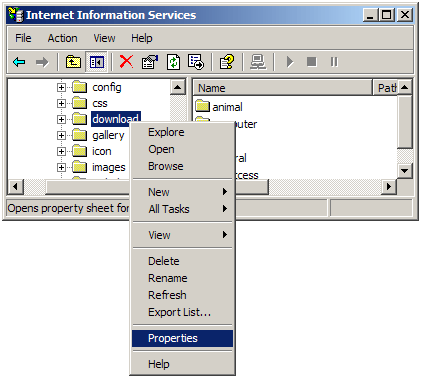
- Navigate to the Stockbox installation directory and click on it.
- Right click on the download directory and select
Properties in the menu drop down function.
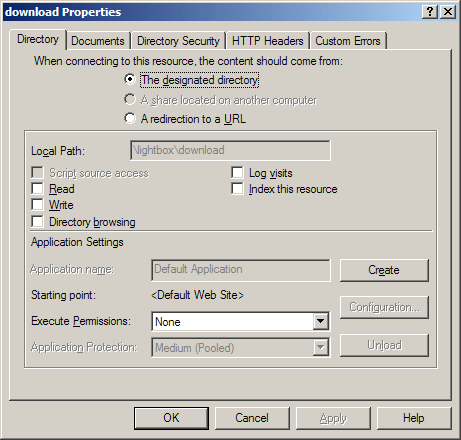
- Un-check Read/Write/Directory Browsing as in the above screen shot.
- Click Apply to deny any access to the download directory from web browsers.
- Click OK to close the download Properties Window.
- The download directory is now protected and all files under it will
be secure.
FTP (CLIENT) PROGRAM
You can use any FTP (client) program to upload files to your server. There are a number of commercial applications such as WS_FTP Pro or FlashFXP, or you can download a free one such as FileZilla.
An example of uploading and changing the file permissions using an FTP Application.
- Run the FlashFXP application.
- Launch Quick Connect.
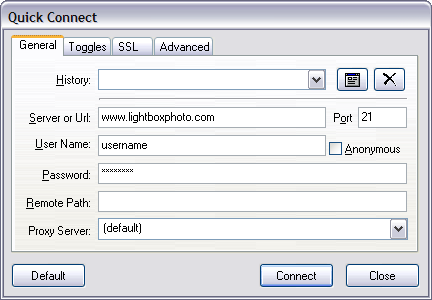
- Fill in all information and click Connect, to connect to your server.
- Browse to the directory (folder) on your server where Stockbox is installed (Right Pane). Then click on the gallery folder.
- Browse to your local files that you wish to upload, select the files and right click on the local files (Left Pane).
- Select Transfer, to transfer the selected files
or directories to your server (Right Pane).
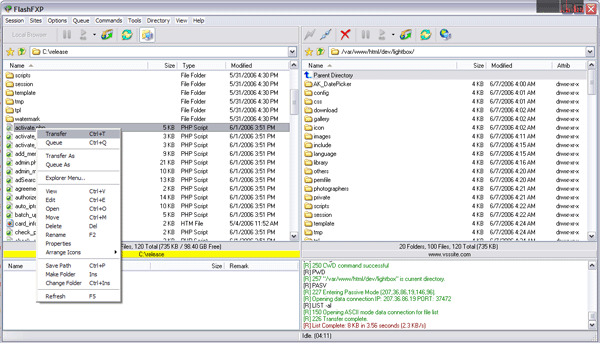
- Your display images should be uploaded to folders inside the gallery folder.
- If you are offering instant downloads, you will need to repeat the
process with your download files. This time you will be uploading your
files to the download
folder.
FILE PERMISSIONS
Most servers by default don't allow you to write data from a web browser to the server. Stockbox needs to have write permission, to write data to your server (examples of this will be when Stockbox generates thumbnails or applies watermarks). If you see an error that says "Reading File Error" or "Can't Open File for Writing" it means that your server doesn't allow you to write to the server from your browser.
Changing the File Permissions using the FlashFXP application.
- Using the above FTP steps to connect to your server.
- Right click on the target files or directories in the Remote
Pane (Right Pane).
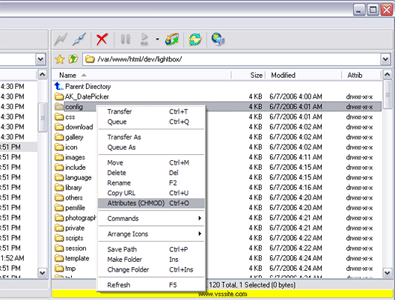
- Select Attributes (CHMOD) in the menu drop down
function.
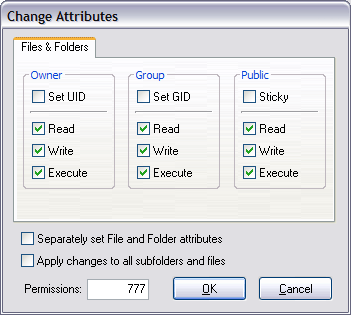
- To change permissions to 777, tick all checkboxes or enter the value 777 in the box provided and click the OK button to change the file permissions.
- Repeat as required.
PUBLIC GALLERY
A Public gallery is a gallery that anyone can access without any login required.
- Gallery home page.
- Gallery main category page.

- HOME
Links customers (users) to the gallery home page. - GALLERY
Links customers to the main gallery page that displays all main categories. - NEW ADDITIONS
Links customers to a page that contains all new media that were added to the gallery on, or after the date entered in the Enter Date to be considered new text field in the Configuration Media
section. - MOST POPULAR
Links customers (users) to a page that contains the most popular media thumbnails. The most popular media is configurable in the Media Configuration section. - CATEGORY
Links customers to the main gallery page that displays all main categories. - LIGHTBOX
Displays the customer's current active lightbox contents. - PRODUCTS (Ent. version)
The system displays all available subscriptions, packages and virtual CDs that you have setup in the Product Manager section. - MY ACCOUNT
Displays the customer's account info (including order details and download links if applicable) if they are logged in, otherwise the login form will be displayed. - SHOPPING CART
Displays the customer's shopping cart contents. - NEWS (Ent. version)
Links to a page containing all active News items. The News items can be managed in the Templates & CM
News Manager section. - PORTFOLIO (Ent. version)
Links to a page containing all active portfolios. The Portfolios can be managed in the Media Manager
Portfolio Manager section. - ABOUT US (about.tpl template)
This page can be used to tell customers about you, your company and your products or services. - CONTACT US (contact.tpl template)
This page can be used to display your contact details. The contact form is included within the page to allow customers to send you a contact message via email. Stockbox will send the message to the email address that is entered in the Notification Email Address text field in the General Configuration section of the admin control panel. - ORDERING INFO (orderinfo.tpl template)
This page can be used to explain to customers how to purchase media from your site and to explain to them what they can expect after their purchase is complete.
- CATEGORIES
Stockbox displays the gallery categories in this section. They can be displayed in either a listing format or a drop down menu format as defined in the Configuration Media
section of the admin control panel. - FEATURED MEDIA (Pro. & Ent.
versions)
Stockbox uses the Featured Media section to display media that have been designated as "featured" in the Media Manager section of the admin control panel. - CD COLLECTIONS (Ent. version)
Stockbox will display available CD Collections up to the maximum number specified in the Product Manager
Configuration section.. All available CD Collections can
be viewed on the Products Page of the gallery. - FEATURED PORTFOLIO (Ent. version)
Stockbox will display portfolios that have been designated as featured in this location. The Portfolios can be managed in the Media Manager
Portfolio Manager section. - PHOTOGRAPHERS (Ent. version)
Stockbox will display a list of contributing photographers. - KEYWORD SEARCH SUGGESTIONS (Pro. & Ent. versions)
This feature displays a list of pre-defined keywords that can be clicked to return search results for the particular keyword or keyword phrase.
- To launch the Public Gallery click on the
 Public Gallery link in the top right corner of the
admin control panel.
Public Gallery link in the top right corner of the
admin control panel. - Or access the Public Gallery using the following URL
http://www.yourdomain.com/path-to-stockbox/index.php
Replacing yourdomain.com with your actual domain name and replacing path-to-stockbox with the path to where you installed Stockbox.
The index.php file is called when users access the public gallery.
PRIVATE GALLERY (Pro. & Ent. versions)
A Private Gallery, is a gallery (category) that can only be accessed by logging in with the admin generated Event Id and Password. To protect a gallery (category) please see the Protect & Un-protect Category section.
Launching the Private Gallery
- To launch the private gallery click on the
Private Gallery link at the top right corner of the
admin control panel or via the
Private Gallery Login link in the Public Gallery.
- The core functionality of a Private Gallery is the same as the Public Gallery.
REQUEST A QUOTE (Ent. version)
Users can either "Request a Quote" for an individual media from the Media Details page in the gallery, or they can "Request a Quote" for a Lightbox of images from the Lightbox page of the gallery.
When customers click on the "Request a Quote" link in the public or private gallery, the compose window will open, allowing customers to enter the required information and submit their request to the gallery administrator. The email will be sent to the address input into the "Notification Email Address" field in the General Configuration.
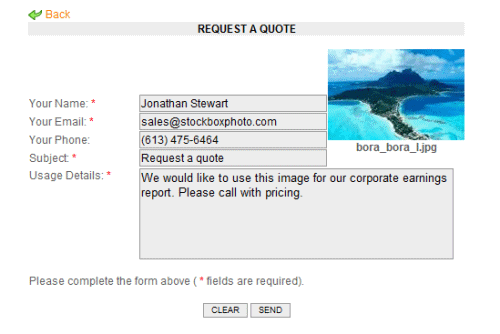
If you have configured the license options in the License Manager
section (Ent. version) and you have enabled the "Enable License Selection in media
"Request a Quote" option in the License Manager
Configuration, then the license options will display for the user to
select from. This allows the user to provide the specific license
options that they would like to receive a quotation for.
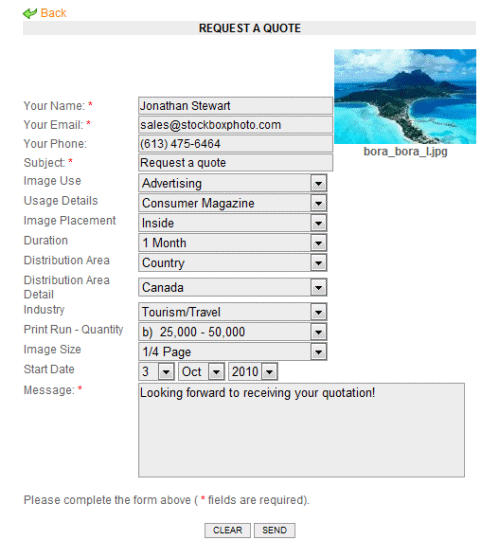
SEND TO A FRIEND & SEND LIGHTBOX
The Send to a Friend and Send Lightbox functions allow customers to an send the selected media or their active lightbox to friends (or associates).
When customers click on the SEND TO FRIEND or SEND LIGHTBOX link in the public or private gallery, the compose window will open to allow customers to enter their friend's information and message.
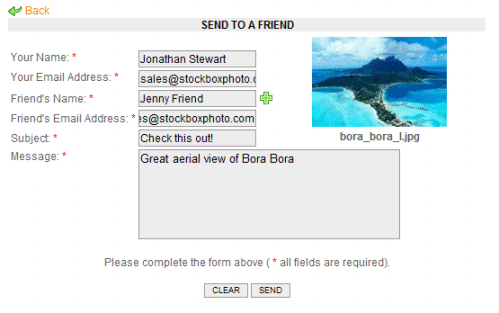
Stockbox offers an option that allows you to bcc (blind carbon copy) this message to your email address by checking the "bcc Admin a copy of SEND TO FRIEND email" checkbox in the General Configuration section. The bcc email address is defined in the Notification Email Address field in the General Configuration section.
If the "Enable SEND TO FRIEND Logs" option is checked in the General
Configuration, you can view the details of the sent emails in the Media
Manager
Send
To Friend Logs and Lightbox
Send
Lightbox Logs sections of the admin control panel.
INVOICE NOTIFICATION (Pro. & Ent. versions)
If you turn on the Enable Notification Invoice Email feature in the General Configuration section, Stockbox will send out a notification invoice email to the customer's email address and the administrator's email address when an order is completed. The admin email is sent to the Notification Email Address field in the General Configuration section.
Stockbox also provides the option to bcc (blind carbon copy) the invoice email to third a party if the Enable bcc Invoice option is turned on. The third party email address is defined in the "bcc Invoice Email Address" text field in the General Configuration section. This feature could be used to automatically send a copy of the invoice to your print shop or order fulfillment centre.
The invoice email is in HTML format. The Registration section can be configured through the Invoice Configuration section. The "Ship To" details will only display if the order contains products that are shipped (i.e. not all instant download types).
PHOTOGRAPHERS (CONTRIBUTOR) SECTION (Ent. version)
The Photographer (Contributor) section allows photographers to upload their digital images to your server. Before accessing this section the Photographer needs to register to the system. Using this section the Photographer (contributor) can do the following:
- Navigate to the public gallery (category).
- Create new Public or Private categories (if permitted by the admin).
- Upload images to a public or private gallery (category).
- Upload high resolution files to the download directory.
- Assign instant download links.
- Apply/Edit IPTC metadata.
- Apply pricing to media.
- Edit/Remove/Delete the image properties of uploaded media.
- Edit their account profile.
- Add or Edit their portfolio.
- View their sales reports.

To browse from one category to another, click on the category name or use the breadcrumb trail (if you are already in a category).
- Click on the
Public Gallery link of to view the public gallery.
- Click on the
 Media Manager link to return to the main page of your
account.
Media Manager link to return to the main page of your
account. - Click on the
Sales Report link to view a report on your media sales.
- Click on the
Account Profile link to view and edit your account profile.
- Click on the
 Portfolio link to manage your portfolio.
 - Click on the
Photographer info link to view information from the
gallery owner.
- Click on the
 Logout link to logout from your account.
 - Click on the
Help link to view help documentation for the page that
you are currently viewing.
- Click on the
New Category link to create a new category.
- Click on the
Upload New Display or Download Files link to upload your media.
- Click on the
Enable Download Links link to assign the download links for your
media.
- Click on the
 Global Update link to update the media properties for media
in an entire category (including sub-categories if selected).
Global Update link to update the media properties for media
in an entire category (including sub-categories if selected). - Click on the
 Import Hi-res link to import images that were uploaded to the
"Hi-res Auto Resize" location. The system will automatically move
the hi-res images to the correct directory in the download folder as
well as assigning the original link to the respective display image
Import Hi-res link to import images that were uploaded to the
"Hi-res Auto Resize" location. The system will automatically move
the hi-res images to the correct directory in the download folder as
well as assigning the original link to the respective display image - Click on the
 Upload Category Icon link to upload icons (images) that you
can then assign to a category by editing the category in the Media
Manager. A photographer can only edit categories that they created..
Upload Category Icon link to upload icons (images) that you
can then assign to a category by editing the category in the Media
Manager. A photographer can only edit categories that they created..
SEARCH GUIDE
The system will search the following fields for results when customers use the Standard Search (Quick Search) or the Advanced Search (Pro. & Ent. versions) functions in the gallery.
- Category Fields
- System name
- Display Name
- Description
- Media Fields
- System name
- Display name
- Author
- Copyright
- Keywords
- Description
- IPTC Metadata
- It's category properties
Standard Search (Quick Search)
By default the system uses “Match at least one keyword” for the quick search function. If customers input “beautiful sunset” (without the quotes) into the standard search field, then the search function would return results for any media that contains either “beautiful” OR “sunset” in its properties.
The system supports the “AND” and “NOT” operands in the quick search function by the use of the plus sign (+) and minus sign (-) respectively in front of the keywords.
- If a customer inputs “beautiful +sunset” into the search field, the system will only return results for any media that contains both “beautiful” AND “sunset” in its properties.
- If a customer inputs “beautiful –sunset” into the search field, the system will return results for any media that contains the keyword “beautiful”, but this media can't contain the keyword “sunset” in its properties.
- Note: There must not any spaces between the second keyword and the input operands (+), (-) keywords. Also, please ensure that the "Enable Partial Text Searching" option is unchecked in the General Configuration if you want users to be able to use these operands in their searches.
Note: If you want to change the default setting for
the standard search from “Match at least one keyword” (OR operand) to “Match
all keywords” (AND operand) then you will need to change the value from
OR to AND in the Search Manager
Configuration
section.
The advanced search function doesn’t use the same algorithms as above. It offers an option to allow customers to choose which operand they want to use for their searches.
There are three options available.
- Match at least one keyword
The system will return results for any media that contain either one of the input keywords in its properties. - Match all keywords
The system will only return results for any media that contain all input keywords in its properties. - Match exact phrase
The system will only return results for any media that contains the exact input keyword phrase in its properties.
- Category Drop Down List
The system will only return results for media within the selected category. - Media Properties
The system will look into the above category's and its media's fields for results, if this checkbox is checked. - Media Metadata
The system will look into the IPTC metadata fields for results, if this checkbox is checked. - Rights Managed
The system will return results for any media that have been assigned to the "Rights Managed" type, if this checkbox is checked. - Royalty Free
The system will return results for any media that have been assigned to the "Royalty Free" type, if this checkbox is checked. - Model Release
The system will return results for any media with "Model release" status for its release status, if this checkbox is checked. - Property Release
The system will return results for any media with "Property release" status in its release status, if this checkbox is checked. - Vertical
The system will return results for any media with "Vertical" status in its orientation status, if this checkbox is checked. - Horizontal
The system will return results for any media with "Horizontal" status in its orientation status, if this checkbox is checked. - Square
The system will return results for any media with "Square" status in its orientation status, if this checkbox is checked. - Panorama
The system will return results for any media with "Panorama" status in its orientation status, if this checkbox is checked. - Black & White Only
The system will return results for any media with "Black & White Only" status in media properties, if this checkbox is checked. - Media Type
The system will return results for any media based on the selected type, e.g. Image or Video. - Use Partial Search (keyword contains)
When this option is enabled, the system will return any media which its searchable contents contains the input keyword. This means that if the entered keyword makes up part of a keyword contained in the media's searchable contents, the media will be returned in the search results. e.g. if the user inputs the keyword "ant" into the search input field, the search function will return results for "ant", "anteater", "anthill" etc., but it will also return results such as "plant", "elephant:, etc. This feature can be a very useful tool, but it can also provide many extraneous results.
- The system will return results for both "Rights Managed" and "Royalty Free" license types if both checkboxes are checked.
- The system will return results for both "Property Release" and "Model Release" media if both checkboxes are checked.
- The system will return results for both "Vertical", "Horizontal", "Square" and "Panorama" media if all four checkboxes are checked.
- The system will return results for both "Image" and "Video" media if both checkboxes are checked.
SEARCH MANAGER
- Appended
Keyword (Pro. & Ent. versions)
The system will append any word, or character that you input in the "Appended Keyword" field to user's input keyword when they are performing a search in the gallery. You can add as many appended keyword as you want using the semicolon ";" to separate them. Below is example of how the system will work with appended keywords.
e.g. Appended Keywords: "s;ed"
The user enters the keyword "flower" in the gallery search feature and the system will search for results based on the three words below.
"flower", "flowers" and "flowered".
Using this example users are able to obtain results for plurals or past tense of the word when they enter the singular, present tense of the word.
- Keyword
Synonyms (Pro. & Ent. versions)
The system will search for additional results using the keyword synonyms for keyword input by the user. Below is an example of how the system will work for the keyword synonyms.
e.g.
Archetype: flower
Synonyms: rose;orchid
The user enters the keyword "flower" in the gallery search feature and the system will search for results based on the three words below.
"flower", "rose" and "orchid"
Note: the system will not search for "flower" when users input the keyword "rose". If you want the system to return results for "flower" when users input the keyword "rose", then you will need to create the synonym "flower" for the keyword "rose".
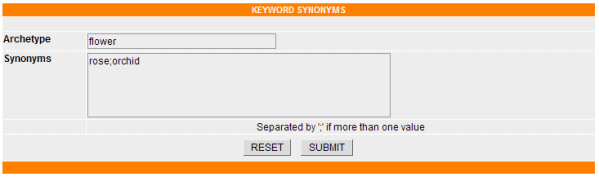
-
Predefined Keywords (Pro. & Ent. versions)
Predefined keywords, are keywords that you want to have listed in the gallery so that users can click on each keyword to obtain a particular group of images which contain the selected keyword. You can add as many predefined keyword as desired by separating them with the semicolon ";"

- Search Logs
(Pro. & Ent. versions)
The Search Logs feature allows you to track the user's search terms. The log displays which keywords were searched and how often they were searched. The displayed sort order of the Search Logs or related information can be changed by clicking on the column header title links. This option needs to be enabled in the Search Manager Configuration
section.
- To view details of the search logs click on the search phrase
link.
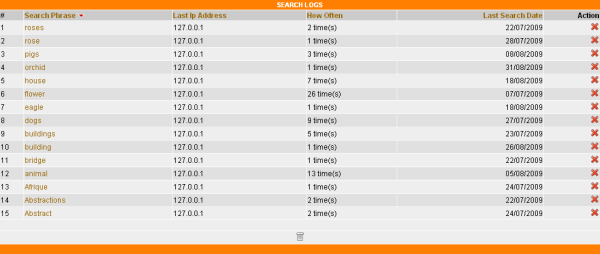
- Empty Search Logs: To delete all recorded search
terms, click on the
icon.
- To delete an individual search term click on the
Delete
icon for the target keyword.
- To view details of the search logs click on the search phrase
link.
- Configuration
- Click on the Search Manager
Configuration link in the main menu.

Advanced Search Configurations:
- Enable Category Drop Down Field (Pro. & Ent.
versions)
The system will display the category drop down list on the Advanced Search page for users to select when this option is enabled. - Enable Media Properties Checkbox (Pro. & Ent.
versions)
The system will display the Media Properties checkbox on the Advanced Search page when this option is enabled. - Enable Metadata Checkbox (Pro. & Ent. versions)
The system will display the Metadata checkbox on the Advanced Search page when this option is enabled. - Enable Royalty-Free Checkbox (Ent. version)
The system will display the Royalty Free checkbox on the Advanced Search page when this option is enabled. - Enable Rights Managed Checkbox (Ent. version)
The system will display the Rights Managed checkbox on the Advanced Search page when this option is enabled. - Enable Model Release Checkbox (Ent. version)
The system will display the Model Release checkbox on the Advanced Search page when this option is enabled. - Enable Property Release Checkbox (Ent. version)
The system will display the Property Release checkbox on the Advanced Search page when this option is enabled. - Enable Orientation Checkbox (Ent. version)
The system will display the Vertical, Horizontal, Square and Panorama checkboxes on the Advanced Search page when this option is enabled. - Enable Black & White Checkbox (Ent. version)
The system will display the Black & White checkbox on the Advanced Search page when this option is enabled. - Enable Media Type Checkbox (Ent. version)
The system will display the Media Type checkbox on the Advanced Search page when this option is enabled. - Enable "Use Partial Search" Checkbox (Ent.
version)
The system will display the "Use Partial Search" checkbox on the Advanced Search page when this option is enabled. - Enable Category Properties Searchable
The system will also search for results based on the category properties (such as Name and Description) when this option is enabled. To obtain more accurate results it is recommended that this option be disabled.
- Click on the Search Manager
Quick Search Configurations:
- Quick Search Method
There are two options available.
OR: when this option is selected, the system will return results when the searchable contents contain at least one of the user's input keywords. This method returns a broader (larger) set of results.
AND: when this option is selected, the system will return results when the searchable contents contain all of the user's input keywords. This method returns a narrower (smaller) set of results.- Enable Partial Searching for Quick Search
When this option is enabled, the system will return any media that has searchable contents containing the input keyword. This means that if the entered keyword makes up part of a keyword contained in the media's searchable contents, the media will be returned in the search results. e.g. if the user inputs the keyword "ant" into the search input field, the search function will return results for "ant", "anteater", "anthill" etc., but it will also return results such as "plant", "elephant:, etc. This feature can be a very useful tool, but it can also provide many extraneous results.- Enable Royalty-Free Checkbox (Ent. version)
The system will display the Royalty-Free (RF) checkbox on the quick search form when this option is enabled.- Enable Rights Managed Checkbox (Ent. version)
The system will display the Rights-Managed (RM) checkbox on the quick search form when this option is enabled.- Enable Media Type Checkbox for Quick Search
The system will display the Media Type checkbox on the quick search form when this option is enabled.
Media Searchable Fields Configuration:
By default all media properties fields are searchable after you install the Stockbox system. However, you can specify which fields you want to be searchable. Each time you make changes to this section, the system will ask you to rebuild the searchable contents. You must confirm the action in order for the system to update the searchable contents with new searchable data configuration. Note: these media properties fields are different (separate) from the IPTC Metadata. You can configure the searchable IPTC fields in the Configuration
- Media Reference ID
Check this option when you want users to be able to search for the Media Reference ID.- Media System Name
Check this option when you want users to be able to search for the media system name (file name).- Media Display Name
Check this option when you want users to be able to search for the media display name.- Media File Path
Check this option when you want users to be able to search for the media file path.- Media Author Name
Check this option when you want users to be able to search for the media author name.- Media Copyright String
Check this option when you want users to be able to search for the media copyright.- Media Keywords
Check this option when you want users to be able to search for media keywords.- Media Description
Check this option when you want users to be able to search for media description.
Other Configurations:
- Enable Search Logs (Pro. & Ent. versions)
When this option is enabled, the system will store the details in the database for the keywords that were searched and how often they were searched.- Minimum Keyword Characters
To avoid excessive use of server resources, the minimum characters should be set to 3.- Maximum Keyword Characters
To avoid excessive use of server resources, the maximum characters should be set to no more than 30. The system will exclude the additional characters from the search if they are present.
LANGUAGE MANAGER (Ent. version)
This feature allows you to offer additional languages for your customers to select from. The primary system language is English and therefore you are not able to delete this language from the system.
Using this feature you can:
- Add additional languages
- Edit an existing language
- Set the default language that will be displayed when users visit your site
- Delete a language
USING THE LANGUAGE MANAGER
Please Note: before adding a new language, you will need to make sure that the following directories are writable (permissions set to 777):
- images directory
- language directory
- scripts directory
- template directory
- tpl directory
- Click on the Language Manager
Language
Manager link in the main menu.
- On the LANGUAGE MANAGER page, please fill in the
following fields in the NEW LANGUAGE section:
- Language Name
Enter your language system name. Please use Latin characters only without any invalid characters. - Language Description
Please describe your language. This description is usually your language name and will be displayed in the Language select box in the gallery. - Language Icon
This is the icon for your language. This icon will be displayed if your Language Display Style (selected it in the Language Configuration) is set to Icon. This icon will be uploaded by the system to the images directory.
- Language Name
- Click on the ADD button to create the new language. The system will create a folder named with the specified system language name in the images, language, scripts, template and tpl folders. It will then copy all files in the english (primary language) folders to your new language folders.
- You will need to edit the files in the folders above to translate the text from English into your language.
- To edit an existing language, click on the Edit
icon
for the desired language on the LANGUAGE MANAGER page.
- On the EDIT LANGUAGE page, you can edit the Language
Description or click on the upload
icon to upload a new language icon.
- Click on the SUBMIT button to save your changes.
You can specify the default language that the system will display when users enter your site. On the LANGUAGE MANAGER page, the default language will be marked as Yes in the User Default Language column. To set another language as the default language, simply click on the No link for the desired language and the status will change to Yes.
4. Delete a language- On the LANGUAGE MANAGER page, click on the delete
icon for the language that you want to delete.
- On the DELETE CONFIRMATION page, click on the confirm
icon to confirm the language deletion.
Please Note: you will have to manually delete the following folders:
- images/admin/<your-language-name> and its contents
- language/<your-language-name> and its contents
- scripts/<your-language-name> and its contents
- template/<your-language-name> and its contents
- tpl/<your-language-name> and its contents
STOCKBOX SEO (SEARCH ENGINE OPTIMIZATION) (Pro. & Ent. versions)
This feature is only available for the Pro. and Ent. versions. The Stockbox SEO feature concentrates on optimizing the dynamic content of your Stockbox system which will allow the major search engines like Google, Yahoo, MSN, etc... to crawl your site more effectively and therefore add more content to their databases.
SYSTEM REQUIREMENTS
- Apache server 1.3 or higher. This feature is not supported in IIS.
- Apache mod_rewrite module must be enabled on your server.
- .htaccess must be enabled on the Stockbox root directory.
- Please Note: the current version of Stockbox (4.07 and later) contains a .htaccess file called .htaccess(stockbox) in the root directory (where the main index.php file is located). Therefore, if you have created your own .htaccess that has the RewriteRule and this file resides in the same directory as Stockbox or a parent directory, you will need to make sure the existing RewriteRule doesn't affect Stockbox's RewriteRule. If there are no conflicts you can copy the contents of the .htaccess(stockbox) into the existing .htaccess file in the Stockbox directory. If you don't have an existing .htaccess file, you can simply rename the .htaccess(stockbox) to .htaccess before using the SEO feature.
USING STOCKBOX SEO
There are two main components to this feature:
- Dynamic meta tags for the Media Details and Category page headers.
- Search Engine Friendly and Optimized URLs (SEF URL).
- DYNAMIC META TAGS FOR THE MEDIA DETAILS AND CATEGORY PAGE HEADERS
With this feature, your static Page Title, Meta Keywords and Meta Description on the Media Details and Category page headers will be automatically changed to the content of your selected media properties. There are seven options available and your selection will depend on which data you have added to the respective database fields.
- System Name
- Display Name
- Description
- Author
- Copyright
- Keywords
- IPTC metadata
- All available fields
- Media Page Header Configuration
To change the media property displayed for the page title, meta keywords and meta description tags, please follow the steps below:
- Click on the Stockbox SEO link in the main menu.
- On the Stockbox SEO page, you can select the desired media property for each tag in the Media Page Header Configuration section.
- Click on the SAVE button to save your changes.
- Category Page Header Configuration
To change the media property displayed for the page title, meta keywords and meta description tags, please follow the steps below:
- Click on the Stockbox SEO link in the main menu.
- On the Stockbox SEO page, you can select the desired media property for each tag in the Category Page Header Configuration section.
- Click on the SAVE button to save your changes.
Changing the default meta tag content
Stockbox SEO will use the default content in the following instances:
- On any other pages except the Media Details or the Category pages.
- If the current media properties content is empty.
The default meta tag content can be edited in the "Meta Tag Default Configuration" section of the General Configuration.
- SEARCH ENGINE FRIENDLY AND OPTIMIZED URLs
Stockbox SEO will change all static & dynamic URLs that are generated by Stockbox to Search Engine Friendly URLs (SEF URLs). For example, the URL to go to the category listing page is http://<your-stockbox-path>/index.php?module=media&pId=100&category=gallery/Abstracts and with the SEO feature enabled it will be changed to http://<your-stockbox-page>/index/gallery/Abstracts.
Please Note: If you added any relative URL to the gallery templates (any URL that aren't generated by Stockbox and don't contain the full domain name, e.g. href="index.html"), the system may return Page Not Found, Error 404 because the relative URL will be appended at the end of the current SEF URL, which will make server recognize it as an invalid path. Therefore, to ensure that everything functions correctly, please follow the directions below:
- Please change all relative URLs in the HTML tags <a href="<your-URL>"> and <form action="<your-URL>"> to absolute URLs.
- Please make sure that all of your HTML codes that contain URLs like <a> and <form> tags follow the standard style: <a href="<your-absolute-URL>"> and <form name="<your-form-name>" method="<your-method>" action="<your-absolute-URL>">. e.g. <a href="http://www.domain.com/index.html" or <form name="form1" method="post" action="http://www.domain.com/process.php">.
a. Enable/Disable Stockbox SEO
Please follow the steps below:
- Click on the Stockbox SEO link in the main menu.
- On the Stockbox SEO page, check the Enable SEO checkbox to enable the Stockbox SEO feature, or un-check to disable the Stockbox SEO feature.
Note: enable or disable Stockbox SEO won't affect the Media Details Configuration. If you want to disable the Media Details page title, meta description and meta keywords, simply select ----None---- in the respective dropdown boxes.- Please make sure the RewriteEngine parameter in the Stockbox root directory's .htaccess is On. It's On by default.
- Click on the SAVE button to save your changes.
b. Using - Tailing Keywords
Tailing Keywords are the extra keywords that will be appended to the end of all media and category URLs. This will provide the search bots with more data from your URLs to store in their databases, resulting in more effective SEO. Stockbox SEO will fetch Tailing Keywords based on the media property content of the current user's selected language. If it is empty, Stockbox SEO will use English instead.
To configure the Tailing Keywords feature, please follow the steps below:
- Click on the Stockbox SEO link in the main menu.
- In the Tailing Keywords section, please configure the following options:
- Tailing keywords for media URLs: Choose the data option that you want the system to append to the end of the media URL.
- Tailing keywords for category URLs: Choose the data option that you want the system to append to the end of the category URL.
- Tailing Keywords Separator: Choose the symbol that you want the system to use to separate all appended keywords. If the Tailing Keywords string contains spaces or invalid characters, this symbol is also used to replace them. e.g. If you choose the "_" (underscore) to be the separator, and the string is "These are$the?Tailing~Keywords", it will become "These_are_the_Tailling_Keywords".
- Tailing Keywords Limitation: If your Tailing Keywords string is too long, you can limit the number of characters that will be displayed. Set this option value to 0 to disable the limitation. e.g. If your Tailing Keywords string is "Hello_world" and the Limitation value is 5, then the final output string will become "Hello".
- Please make sure Stockbox SEO is enabled, then click on the SAVE button to save your changes.
c. Using - Remove Stopwords
Most Search Engines do not consider extremely common words in their indexing in order to save disk space and/or to speed up their search results. These filtered words are known as "Stopwords". Stockbox SEO will remove all Stopwords from the Tailing Keywords strings before displaying them.
To configure the Remove Stopwords feature, please follow the steps below:
- Click on the Stockbox SEO link in the main menu.
- In the Remove Stopwords section, please configure the following options:
- Enable Remove Stopwords: Use this option to Enable or Disable the Remove Stopwords feature.
- Stopwords List: Enter your Stopwords into this text box. Each word is separated by the carriage return (Press Enter key).
- Please make sure Stockbox SEO is enabled, then click on the SAVE button to save your changes.
d. Using - Keywords Translating
This feature is used for translating characters, words and/or phrases of the Tailing Keywords strings to the other languages. This is useful if Stockbox will have multiple languages displayed and you need for example all Spanish or German special characters to be translated to the suitable Latin characters. e.g. If a Tailing Keywords string has an "Español" word and you add a translating entry for ñ to n, this word will become "Espanol".
To configure the Keywords Translating feature, please follow the steps below:
- Click on the Stockbox SEO link in the main menu.
- In the Keywords Translating section, please fill in the following fields.
- From: Enter the original character, word or phrase that needs to be translated. This value is case sensitive.
- To: Enter the translating character, word or phrase. This value is case sensitive.
- Language: Choose the language that the translating entry will be applied to.
- Click on the
You can click on the
e. Using - Stockbox Error 404 Report Page
This feature will display an 404 Error page inside Stockbox instead of your own HTML error file.

You can edit the Error 404 content in the ./template/<language-system-name>/404.tpl file. With <language-system-name> english, or in any other languages that you have added to the system.
Please login to our Help Desk system for details on the latest version. Once logged in, you will be able to submit a support ticket, review our knowledge base and download updates. We provide free updates for a period of one year from your original purchase date (upgrades do not extend this period). Please note that it is your responsibility to perform the update installation.
If you prefer, we can update the software for you and customize the new template set to match your existing site at a current cost of $150.00. This fee only applies to single language installations and currently there will be an extra fee of $50 per additional language. If you would like us to do this for you, please login to the Help Desk to make the payment via the Upgrade page (we will need your FTP, gallery admin and phpMyAdmin login details to do so). In order to be eligible to receive updates you need to have an active support & update subscription. You can confirm this by logging in to our Help Desk system.
You can upgrade your existing version by doing the following. By installing an update/upgrade you confirm that you have reviewed and understood the terms of our current EULA and that you agree to be bound by the terms of this agreement.
ATTENTION: Before attempting to install an update or upgrade, we strongly advise that you do a complete backup of your site including the MySQL database. If you are not familiar with this please ask your host for assistance. When backing up the software files make sure that you download/upload in BINARY mode.
Update Process
-
Unzip the zip package on your local machine. Before doing so, check to make sure that the word “upgrade” is in the filename (e.g. stockboxphoto-ent-4.50-upgrade.zip). Also make sure that you have downloaded the correct version ("-ent-" for Enterprise, "-pro-" for Professional and "-std-" for the Standard license). Otherwise you don’t have the correct file and you will need to submit a support ticket before proceeding any further.
-
Upload all unzipped files to your server via FTP in binary mode to the same location that you previously installed Stockbox.
-
Ensure the following directories and files have their permissions set as follows. Please note that not all of these folders will be present if you are upgrading from v3.xx.
- All files under "config" dir and the "config" dir itself to 777
- All files under "css" dir and the "css" dir itself to 777
- The "download" directory itself to 777
- The "gallery" dir itself to 777
- The "icon" directory itself to 777
- All files under "images" dir and the "images" dir itself to 777
- All files under "language" dir and the "language" dir itself to 777
- All files under the "scripts" dir and the "scripts" dir itself to 777
- The "session" dir itself to 777
- All files under "template" dir and the "template" dir itself to 777
- The "tmp" directory itself to 777
- The "tmp/virtual_cd" directory to 777
- All files under "tpl" dir and the "tpl" directory itself to 777
- The "tpl_c" directory itself to 777
- The "./modules/image_tools/tmp" directory to 777
- All files under "./upgrade/config" dir and the "./upgrade/config" dir itself to 777
- The "./upgrade/session" dir itself to 777
- The "upload" directory itself to 777
- All files under "watermark"
dir and the "watermark"
dir itself to 777
-
Run the upgrade.php file
from your web browser by doing the following and follow the instructions.
- http://www.yourdomain.com/path-to-stockbox/upgrade/index.php
-
Replace the yourdomain.com
with your domain name and path-to-stockbox
with the folder name where you installed the software.
-
Login to the admin control panel and confirm that
your configuration and payment gateway settings are correct.
-
In the Media Manager >> Media File
Types section of the admin area check that that the opening code
for the .jpg media file type is as follows: <img src="[FILENAME]"
border="0" width="[WIDTH]" height="[HEIGHT]" alt="[ALT]" title="" />
-
Important: For security purposes, please delete
all setup files that are listed below before using Stockbox.
- upgrade folder and its contents
- setup.php file
- SetupHostTest.php file
- database.inc.php file
There is a main menu
(blue help icon) in the top right corner of the gallery admin area.
There are also “mini” help menus
(red help icon) on each page of the admin area.
We strongly recommend that you backup your site and database locally at regular intervals even if your host provides this service.
DATABASE BACKUP PROCESS
If you are unsure of this process or do not know how to login to your
phpMyAdmin, please contact your hosting provider for assistance.
1. Login to your phpMyAdmin Database Administration Tool.
2. Select the Stockbox database that you want to backup.
3. Once the database is selected, the screenshot below will be displayed.
4. Click on the Export link at the top of the page.
5. The export page will be displayed, allowing you to backup your data.
6. Click the Select All link under the drop down list of the DB tables.
7. Scroll down the screen and check the "Save As File" checkbox.
8. Click on the Go button at the right bottom page.
9. Choose the target location where you want to save the DB backup. Stockbox recommends that you make regular backups of your database.

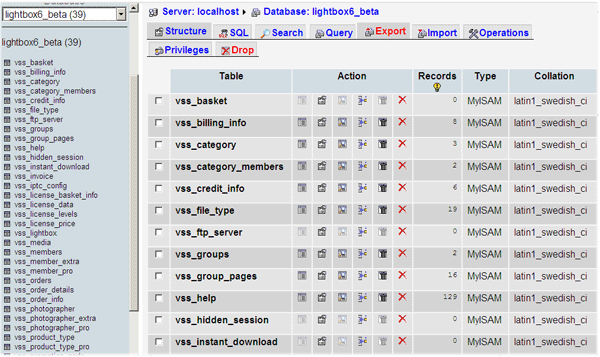
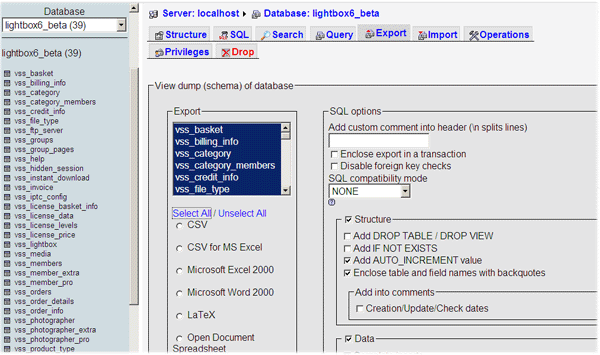

INSTALLATION
To run the setup file to install Stockbox, please follow the procedure outlined below.

 |
 |
|
|
|
Please note that you should replace domain.com with YOUR domain name and your_folder with the folder name where you uploaded the Stockbox Photo® software files.
|
|
Page 1 - Welcome Page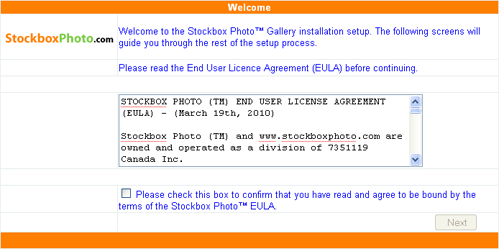 Page 2 - Database Information Page Page 3 - Confirmation/License Key Page Please verify all the information on the confirmation page and input you software license key before you continue. Note: For a Linux or Mac installation, remember
to change mode (CHMOD) the following before clicking the EXECUTE
button. Page 4 - Successful Completion Page You will need
to create a Master Admin Account before logging into the Admin Control
Panel.
DO NOT delete
these files until after you have
successfully logged into the
Admin Control Panel. Let us know if you require template customization
services. We can provide an affordable solution to match the look
and feel of the Stockbox Photo® gallery to your existing website or create
a new look and feel based on your specified requirements. To receive
a quotation, please email your design requirements and/or a link
to a sample site to our
and we will respond accordingly. For technical support, please submit a ticket to our Help Desk system.
|
|
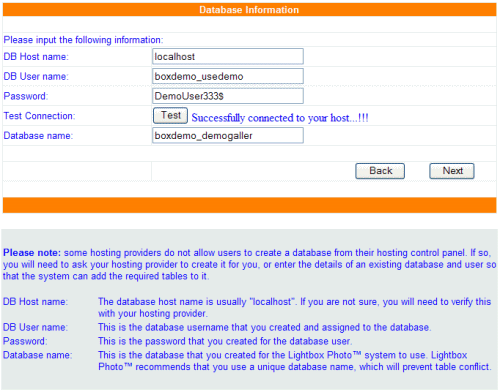


FAQ - Frequently Asked Questions
Answers to additional questions can be found in the Knowledge Base section of the Help Desk.
Batch Upload Media via ftp:
Q. I have a category that contains over 600 images,
what is the best way to add them to the gallery?
A. You can batch upload media via FTP to the
gallery folder. You can upload an entire folder of images
then the folder name will become the category system name once the folder
has been brought into the database using the Auto Detect feature. You should
run a batch process on your hi-res images prior to upload to re-size them
for display. You need to upload your display sized images to the gallery
folder. The system will use these to generate the thumbnails. If you
want to offer instant downloads, then you will need to upload the high resolution
files to the download folder (with the respective Product Type prefixed
to the filename). There is more information on this in the Media Manager
Instant
Download Links section of the main help menu. After the media have been
uploaded, please remember to change the file AND folder permissions
to 777 (r/w/e). Once the images have been added to the gallery, you can
then add watermarks, pricing, descriptions etc.
Customizing:
Q. How can I determine which style in the css file corresponds
to the items in the gallery.
A. The look and feel of the dynamic content is primarily
controlled by the css. There are a couple of ways to detect the css style.
The basic way is to view the page source, then find the "class" that applies
to the tag you are looking for. The second way is using the Web Developer
add-on for Firefox. You can install it here:
https://addons.mozilla.org/en-US/firefox/addon/60. After installing
this add-on, you can click on CSS --> View Style Information (or press Ctrl+Shift+Y)
and then select the part that you want to view CSS style information for.
Q. How can I change the meta tags that are displayed in the
gallery?
A. You can change the default meta tags in the "Meta
Tag Default Configuration" section of the General Configuration.
Q. Is it possible to change the size of the slideshow.
A. Yes, you can change the size of the slideshow
by editing the #myGallery section in the gallery.css file.
Q. Is it possible to change the link path for the
HOME button in the dynamic menu and the Home link in the breadcrumb trail?
I want it to point to my site homepage instead of the gallery main page.
A. Yes, you can change the link path for the "Home
Public Breadcrumbs Link" in the General Configuration section and you
can change the link path for the Home navigation menu button, by
editing the button in the Templates
& CM
Nav.
Menu Manager section .
Q. I would like to have a different homepage on my
site rather then using the gallery main page as my homepage.
A. The Gallery
Navigation Menu Manager section allows you change the navigation menu buttons from within admin
control panel. With the Pro. & Ent. version you are able to add more pages
to the gallery or delete existing pages from it using the
Static Content Manager. If you have the Std. License you will first need to create a static index.html page based
on the main gallery template (this will allow you to maintain the same
look and feel of the gallery). The easiest way to do this is to copy the
html source code when the gallery is displayed in your web browser. You
will need to remove the dynamic call tags as they will not function on the
static html page. After you have created this file you will need to change
the link paths for the Home button and Home breadcrumb link to point to
this new homepage (see previous question).
Q. In the status bar of my browser I can see a message that says
"Powered by Stockbox Photo....". How can I edit this text?
A. You can change or remove that text by editing
the protect.js file in the scripts folder. You can edit this file with any
text or html editor.
Q. I would like to remove the required checkbox (that
displays the user agreement) from the registration form. Is this possible?
A. Yes, you will need to un-check the Enable
Agreement Checkbox in the Customers
Configuration
section of the Admin Control Panel.
Q. Can I add html code to the product type label
field?
A. Yes, you can add html code to the product type
label field to bold an item, add hyperlinks etc.
Q. Can I use special characters such as 's in my
file names?
A. No. Do not use any special character or leave
spaces in your file or category names, as it could cause issues with some
DB versions. If you wish to use spaces in the file or category names, then
use the ( _ ) underscore instead.
Q. How do I add an image or icon to the categories
on the main Gallery (categories) page?
A. You can either upload category icons to the “icon”
directory via FTP and then assign them to the categories by editing the
category in the Media Manager, or you can upload the icon to the category’s
directory itself. If you upload the icon to the target category’s directory,
then you must name it as “icon.jpg”. The system will automatically
load the “icon.jpg” for the target category for selection
when it detects one. With the Pro. & Ent. versions, you can also use thumbnail images in the target category
for icons, by selecting the “Use Random Image” option in
the Icon drop down list. If the “Use Random Image”
is selected, the system will randomly use thumbnail images from the target
category and its sub categories.
Q. I would like to change the buttons on the navigation
menu bar to ones that match those on my home page, how can I do this?
A. To change the menu buttons, you just need to upload
your new buttons to the image folder giving them the same file names and
they will replace the existing buttons, or you can use the
Gallery Navigation Menu Manager section to change the navigation
menu buttons from within admin control panel.
Q. How should I separate keywords?
A. Keywords or keyword phrases should be delimited
by semi-colons only.
Q. How can I make the Quick Search show results for
images that have both keywords and not images that just have one or the
other keyword?
A. If you want to change the default setting for
the Quick Search (standard search) from “Match at least one keyword” (OR
operand) to “Match all keywords” (AND operand) then you will need to change
the option from OR to AND in the Search Manager
Configuration
section of the Admin Control Panel.
Miscellaneous:
Q. Can I assign the same image file to more than
one category?
A. Yes, with the Pro. and Ent. versions you can do
this by editing the image in the Media Manager section. On the Media Properties
page you can choose multiple categories by holding down the Ctrl
key while clicking on the category name in the list. Note: If you
have assigned an image to more than one category and you only want to delete
one instance of the image, then you will need to browse to the image in
the category that you want to remove it from and use the Remove function.
DO NOT use the Delete function, as it will delete the physical file from
the server and remove all instances of the image.
Q. Can I offer free downloads by setting the price
to zero 0.00?
A. It is not possible to have “free” downloads. However,
you could use the Sample Download feature
for this, or create a 100% Promotion Code for the customer to use. With
the Ent. version you can use the VIP Customers
feature to allow customers to download without paying at the time of checking
out.
Q. I have added keywords to my images, but the search
feature is not returning any results.
A. If you are using the IPTC feature, then you will need
to click on the searchable IPTC icon
in the media manager for each category. When inputting keywords you should
separate them with semi-colons only.
Q. When creating a category in the admin area, I
am unsure what to input for the system name?
A. The system name is the actual file or folder name
as it resides on the server. System names must not contain any invalid characters:
~ ` ! @ # $ % ^ & * ( ) + = \ | } ] { [ " ' : ; / ? > . < , and spaces.
If you upload the files and folders to the gallery using your FTP client,
then the system name will be the same as the names that you have uploaded.
You can add an optional display name if desired. With the display name,
you can add a more descriptive name and use the above restricted characters
if necessary. If you are creating categories or uploading files from
within the admin control panel then you will need to input a system name.
However, in some instances you may find that a display name is not required
as you will not need to use any of the restricted characters. e.g. a category
system name “Travel” will have the same display name, but for a category
system name “airtravel”, you will want to add the display name “Air Travel”.
Q. I uploaded my images, added watermarks and then
generated my thumbnails. Now my thumbnails are watermarked, is it possible
NOT to have watermarks on the thumbnails?
A. Yes, you just have to change your operating order.
After uploading your images, you should generate your thumbnails first and
then add your watermarks. This way, only your display images will be watermarked.
Q. How many file formats can the Stockbox system
be used with?
A. The system is able to display any file formats that are
viewable in a web browser. If the file format is not viewable from within
a web browser, the system provides a link for users to download the other
formats so that they could view them locally in the associated application.
You would just use the call [FILENAME] in the opening code (input into the
Media File Type section of the admin). In the
same way, other file formats that will open in a browser can be added to
the system by inputting the opening code into the Media File Types section
of the admin area. Current default file types are: gif, jpg, au, avi, aif,
htm, html, mid, mp3, mp4, mpg, mov, png, ra, ram, rar, swf, wav, zip, wma, wmv,
flv
and pdf. Regardless of what file format is displayed in the gallery, any
file format may be offered for download.
Q. After unzipping the software, I see an index.html
file in each folder. What is this for?
A. This file is to prevent directory browsing if
your server (hosting account) allows it. This file can be edited, replaced
or removed as desired.
Q. Is there a faster way of deleting the lightboxes?
Perhaps by directly accessing a table through MySQL?
A. You can click on the
icon in the Lightbox Detail section of the to remove all lightboxes and
contents from the system. Alternatively, there is a table in the MySQL DB
called vss_lightbox, you could truncate this table and all the user’s lightboxes
would be removed.
To eliminate the ones from the search engine, look for the IP that has several
lightboxes and use the following query: DELETE FROM vss_lightbox WHERE
ipaddress = 'ip address of the search engine'
To eliminate a range of lightboxes you could use the following query:
DELETE FROM vss_lightbox WHERE session_id >= 'start session id' AND session_id
<= 'end session id'
Q. I tried to add a new category from within the
media manager and received the following error message. "The system has
detected that the Safe Mode is enabled on your server. In order to have
this system working properly when adding a new category, Safe Mod.... Why
do I see this message?
A. Safe mode is a PHP setting and will have to be
changed by your host, unless you have root access to your server. If they
are unwilling to turn safe mode off, then it will not effect the running
of the software but you will not be able to create categories from within
the admin control panel, you will have to create or upload folders (categories)
with your FTP program.
Q. I have just set up my new website and I am trying
to add images to the gallery. The images I have uploaded will not re-size
down to 500 pixels wide, they just stay the same size as I uploaded.
A. If your images are large, or there are large number
of images in a folder the server may timeout, before the process completes.
The most efficient way is to do this is to run a batch process locally to
re-size your images for display and then upload your display size images
(e.g. 500px wide) to the gallery folder. These images will be used by the
system to generate the thumbnails. Also, you need to make sure that you
have set the folder AND file permissions to 777.
Q. Can I specify different product types for different
categories?
A. Yes, a product type will only display if a price
is assigned to it. Therefore, if you do not want a product to display for
a particular category, then you just don’t assign a price to the product
type for that category. To remove a product from displaying you need to
add a price of zero (0.00).
For technical support, please submit a ticket to our Help Desk system.
Thank you for choosing Stockbox Photo® Gallery
Software.
The preferred choice for professional photographers,
artists and artisans to display and sell their work online.
Content Copyright
© Stockbox Photo® Gallery Software
www.stockboxphoto.com. All rights reserved
Stockbox Photo® US Trademark Reg. No. 3893429
(updated: 31/05/2011)